E-Paper



Jaishankar backs ‘fair and durable approach’ to end Israel-Hamas conflict
External affairs minister S Jaishankar represented India at the Brics Plus meet following PM Modi’s return to India after the main sessions of the summit

 Prefer HTon Google


NEW DELHI: India on Thursday joined Russia and China in backing efforts to prevent the widening of the Israel-Hamas conflict, with external affairs minister S Jaishankar saying a “fair and durable” approach to end the hostilities should lead to a two-state solution.
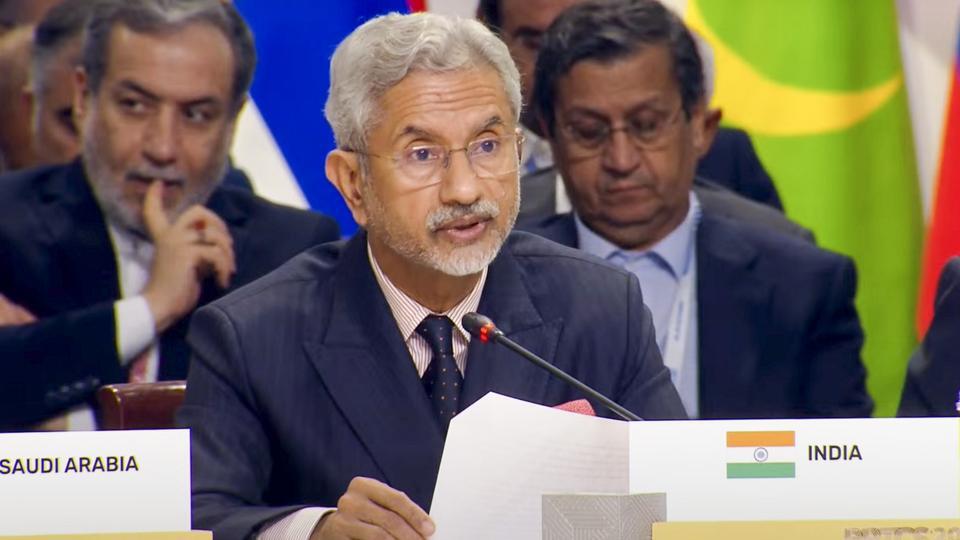
Expressing concern at the situation in West Asia, Jaishankar told the outreach session of the Brics Summit in the Russian city of Kazan that there is widespread anxiety that the conflict “would spread further in the region”.
“The situation in the Middle East, West Asia for us, is an understandable concern,” he told the Brics Plus meeting attended by 36 countries, including 22 heads of state.
“Maritime trade has also been deeply affected. The human and material consequences of further escalation are truly serious. Any approach has to be fair and durable, leading to a two-state solution,” he said.
Jaishankar reiterated Prime Minister Narendra Modi’s assertion that “this is not an era of war” and said disputes must be settled by dialogue and diplomacy. “International law should be adhered to, without exception. And there should be zero tolerance for terrorism,” he added.
Jaishankar represented India at the Brics Plus meet following Modi’s return to India after the main sessions of the summit. The meeting was also attended by Russian President Vladimir Putin, Chinese President Xi Jinping, Turkish President Recep Tayyip Erdogan and Egyptian President Abdel Fattah El-Sisi.
India has watched the recent escalation of the conflict, following Israel’s attacks on Lebanon, with growing concern and called for an end to hostilities. Besides being home to nine million Indian expatriates, West Asia is a key energy source for India.
Putin said the region is on the brink of “full-scale war” after the military action started a year ago in Gaza spread to Lebanon, and the level of confrontation between Israel and Iran rose sharply. “This is all reminiscent of a chain reaction and puts the whole Middle East on the verge of full-scale war,” he said.
The situation in the Middle East involves the “exacerbation of a long-standing conflict”, Putin said, adding it would be impossible to restore peace “without rectifying the historical injustice in the Palestinian territories”.
“All Brics countries are concerned about the situation in Gaza and hope all options will be used to reduce tensions,” he said.
Xi backed a ceasefire in Gaza and said Brics can act as a “stabiliser” to ensure global security. “We need to continue to push for a ceasefire in Gaza, relaunch the two-state solution and stop the spread of war in Lebanon,” he said. “There should be no more suffering and destruction in Palestine and Lebanon.”
Jaishankar’s address also focused on the reform of global governance architecture and strengthening and expansion of independent platforms such as Brics. “As the old order changes while inequities of the past continue, Brics is a statement in itself and can make a real difference,” he said on X.
Pointing to the need to reform established institutions, especially the UN Security Council and multilateral development banks, Jaishankar called for democratising the global economy by creating more production hubs to build resilient and shorter supply chains.