
 E-Paper



Jewar to Lucknow in 100 minutes? Inside the Delhi-Varanasi bullet train project, Ashwini Vaishnaw's big plan
Union railways minister Ashwini Vaishnaw said the proposed Delhi-Varanasi bullet train will reduce travel time across Uttar Pradesh once it becomes operational.

 Prefer HTon Google


The proposed Delhi-Varanasi bullet train project, which will pass through Jewar in Uttar Pradesh, is expected to reduce travel time between Jewar and Lucknow to approximately one hour and 40 minutes, while the overall journey from Delhi to Lucknow will take about two hours and 10 minutes, railway minister Ashwini Vaishnaw said on Saturday.
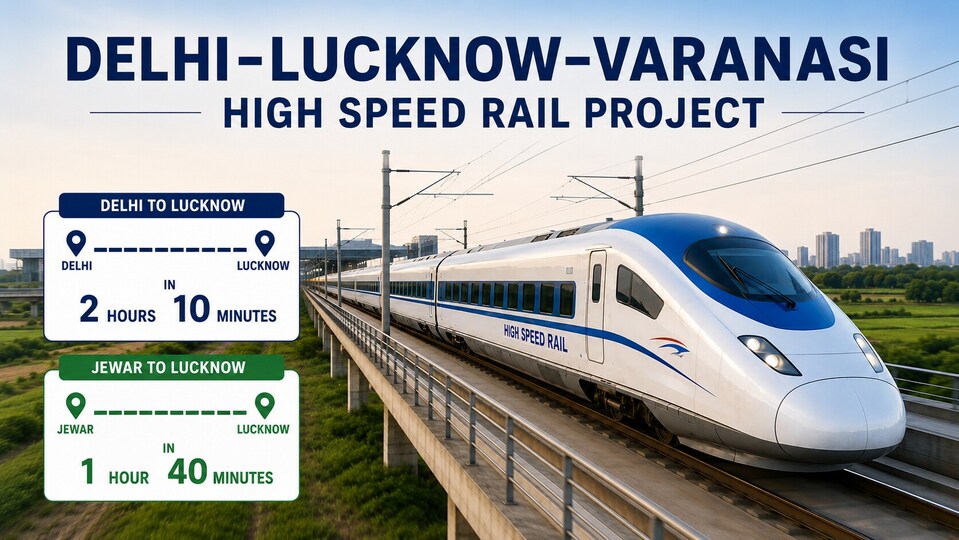
The project was announced by finance minister Nirmala Sitharaman in the Union Budget for 2026-27. Meanwhile, work is already underway on India’s first bullet train corridor connecting Mumbai and Ahmedabad.
Vaishnaw on Delhi-Jewar-Lucknow-Varanasi bullet train project
Speaking at an event in Jewar on Saturday, Vaishnaw said the proposed Delhi-Varanasi bullet train will reduce travel time across Uttar Pradesh once it becomes operational.
He said the trip from Delhi to Lucknow will take about two hours and 10 minutes, while passengers travelling from Jewar to Lucknow will complete the journey in about one hour and 40 minutes, Hindustan reported.
“Just as the Ganga flows, the bullet train will run in the same way,” he was quoted as saying in several media reports.
Vaishnaw also said the proposed Delhi-Lucknow-Varanasi bullet train corridor would transform connectivity in Uttar Pradesh and provide a major push to industrial and economic development.
Earlier in April, Jewar MLA Dhirendra Singh met Vaishnaw and requested a high-speed rail link to the newly opened Noida International Airport.
Notably, commercial flight operations at Noida airport began on June 15. Built across 1,300 hectares in Jewar, the airport is expected to handle around 12 million passengers every year during its first phase.
It has also become the second-largest airport in the National Capital Region (NCR) after Delhi's Indira Gandhi International (IGI) airport, the country's busiest airport. Once all phases are completed, the airport is expected to serve up to 70 million passengers annually.
Inside the proposed project
The Delhi-Varanasi High-Speed Rail corridor is one of the seven new bullet train projects announced in the Union Budget 2026-27. Stretching about 813 kilometres, the corridor is planned to connect several key cities.
Apart from the Delhi-Varanasi route, the other proposed high-speed rail corridors include Mumbai-Pune, Pune-Hyderabad, Hyderabad-Bengaluru, Hyderabad-Chennai, Chennai-Bengaluru and Varanasi-Siliguri.
Officials believe the Delhi-Varanasi corridor will play a key role in improving connectivity between the national capital and one of the country's major religious destinations.
Railway officials had earlier told HT that the proposed stations along the route are expected to include Delhi, Noida, Jewar Airport, Mathura, Agra, Firozabad, Etawah, Kannauj, Raebareli, Prayagraj, New Bhadohi, Lucknow, and Varanasi, linking Uttar Pradesh's political, religious, and industrial centres.


