E-Paper



Karnataka election results point to bipolar polity in southern state
Congress won the Karnataka assembly elections by the biggest vote share and seats after a whopping 34 years.

 Prefer HTon Google


Until the counting of votes began in Karnataka the Janata Dal (Secular) or JD (S) was hoping to play kingmaker in the state. Those hopes have been crushed with the Congress winning 136 out of the 224 assembly constituencies (ACs) in the state and the JD (S)’s own seat tally coming down from 37 to 20. Will Karnataka now move towards a bipolar polity where the JD (S) increasingly becomes a marginal political force? While one must wait for at least one more election to make sure that the 2023 results are not an aberration, at least three data points suggest that 2023 is a far more bipolar election than what Karnataka has seen in a long time.
Vote share of top two parties is the highest since 1985
The combined vote share of the Congress and the Bharatiya Janata Party (BJP), is 78.9%. This is the highest combined vote share of the top two parties in the state since the 1985 elections.
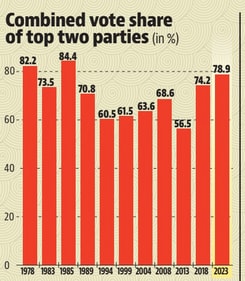
When read with the fact that the JD (S)’s vote share has dropped to 13.31%, the lowest since its debut election in 1999, this suggests a growing trend towards bipolarity in the state’s politics.
Median ENOP in 2023 is the lowest ever in Karnataka
One way to look at fragmentation (or lack of it) in voting patterns is to look at the effective number of participants (ENOP) in an election. ENOP is defined as the sum of reciprocal of squares of vote share of each candidate in a given constituency.
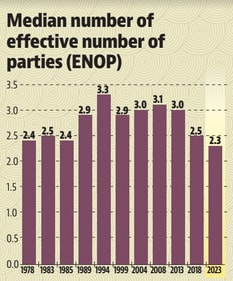
A higher ENOP value means that vote shares are fragmented across more candidates. Trivedi Centre for Political Data (TCPD) has data for Karnataka election results from 1978 onwards. A calculation of median ENOP values for Karnataka shows that the 2023 number, 2.3 is the lowest since 1978. This means that even at the AC level, contests were more bipolar than they have been since 1978.
To be sure, not all regions of the state are equally bipolar
A sub-region wise analysis of the median ENOP numbers shows that the fragmentation (or lack of it) of politics is different in different parts of the state. Coastal Karnataka, which has historically been polarised between the Congress and the BJP, has the lowest
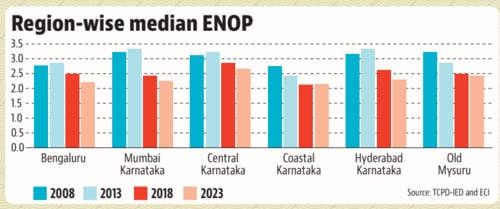
ENOP in the state while central and southern Karnataka have the highest ENOP numbers. These are the sub-regions where the JD(S) has been the strongest. However, median ENOP value has gone down in every sub-region between 2018 and 2023 elections except in coastal Karnataka where it has increased marginally.