E-Paper



‘Make reels, back OSM, don't panic’: Schools get script from CBSE amid backlash
A document titled “Material for Principals” included scripts of what to read out. At one point, it urged principals to describe the board as “highly proactive".

 Prefer HTon Google


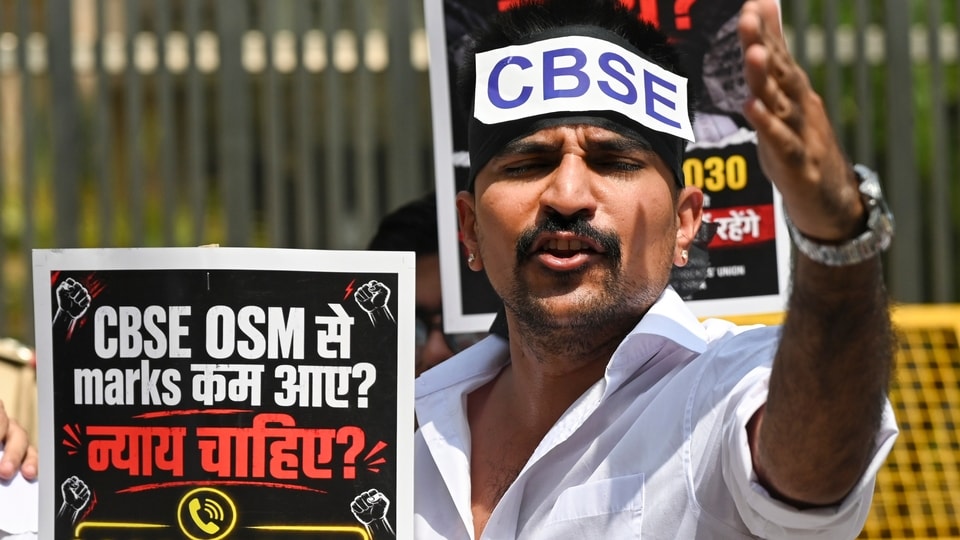
The regional offices of the Central Board of Secondary Education (CBSE) circulated a social media toolkit to school principals this week, directing them to defend the board’s controversial on-screen marking system on social media, and hundreds of schools — including government-run Kendriya Vidyalayas and Jawahar Navodaya Vidyalayas — subsequently posted videos echoing the talking points, HT has found.
A document titled “Material for Principals”, seen by HT, included scripts of what to read out. At one point, it urged principals to describe the board as “highly proactive, empathetic, and communicative regarding these teething issues.”
One of the read-outs it contained for the principals was to state: “As with the rollout of any technology on such an unprecedented scale, I know that a few implementation bumps have caused concern... Please, do not panic. I want to reassure every student and parent that no child will be allowed to suffer due to a technical error.”
Also Read | In a first, Centre may use armed forces for NEET-UG re-exam logistics on June 21
Principals were also asked to tell students that if they found “a discrepancy between your performance and your reflection on the digital sheet”, they should use the official CBSE re-evaluation process.
Videos go viral on social
In several videos — most of them reels on Instagram — reviewed by HT, students and principals appear to repeat phrases closely resembling language in the circulated document, including the above quote.
But not all principals complied. “I saw that Instagram has been flooded with principals supporting CBSE and the OSM process despite knowing very well about the problems it caused to students. The document ‘Material for Principals’ was sent to me by the head of our regional office. However, I feel we should voice students’ concern, stress and agony as their careers are at stake. Hence, I did not make any video in CBSE’s OSM favour,” said the principal of a Delhi-based private school, who requested anonymity.
Among the institutions that did post videos, Kendriya Vidyalaya and a Jawahar Navodaya Vidyalaya schools — both run by the central government under the ministry of education — were prominent.
A video posted by Kendriya Vidyalaya No. 1 Air Force Station Gorakhpur features a Class 12 student defending the system. “I am satisfied with my marks that I obtained in all subjects. The problems faced by students are a new phenomenon as every year students face such problems. I don’t think OSM is the problem,” the student states.
Principal Barrister Pandey told HT the video reflected the school’s own decision. “Students can share their opinions in the controversy and it was the decision of our school staff that we should post the opinion of our students on OSM on social media,” Pandey said, denying that the school went by the toolkit.
A video posted by Jawahar Navodaya Vidyalaya Jajpur shows principal-in-charge Abhimanyu Bhatt defending the system.
“OSM is a very good initiative by CBSE... proper evaluation of answers has been done... teachers got plenty of time to read each and everything. Class 10 students should also benefit from OSM in coming years,” Bhatt says, adapting the script’s talking points.
Anisha Sharma, principal of Delhi Public School Siliguri, said in a video that OSM was introduced “with a positive outlook keeping in mind that evaluation will be fair, accurate, faster and transparent” — using phrases that were verbatim in the document.
The “Material for Principals” document states: “From an academic standpoint, the OSM system has fundamentally improved the structural integrity of our assessments... It frees up our evaluators to focus strictly on content rather than arithmetic, paving the way for a more standardized, transparent, and eco-friendly evaluation process aligned with the National Education Policy.”
CBSE's response
A CBSE spokesperson did not respond to requests for a comment. “We did not instruct anybody to post any video in our favour,” a senior official said, asking not to be named.
As of May 26, nearly one in four of the around 1.8 million students who appeared for the Class 12 examination applied for scanned copies of their answer books, a rise of over 208% in applications compared with last year. CBSE attributed the spike partly to a sharp fee reduction announced on May 17.