
 E-Paper



Number theory: Making sense of India’s inflation numbers
The government released both retail and wholesale inflation numbers for the month of August this week.

 Prefer HTon Google


The government released both retail and wholesale inflation numbers for the month of August this week. Not only have the two indices – Consumer Price Index (CPI) for retail prices and Wholesale Price Index (WPI) for wholesale prices – moved in opposite directions, they have also surprised analysts from different sides. While August CPI exceeded analyst projections, WPI print came in lower than expected. What does this mean as far as the larger inflation scenario in the economy is concerned? Here are four charts which explain this in detail.
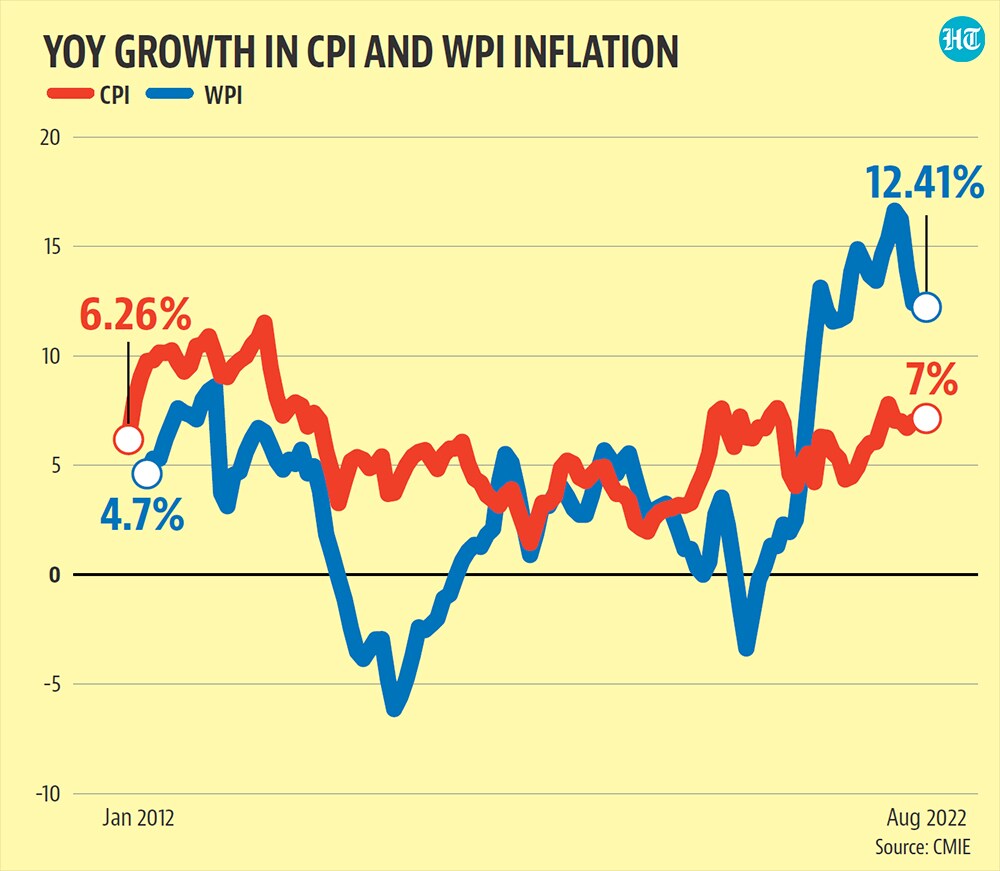
Both wholesale and retail inflation continue to be high...
August was the eighth consecutive month when CPI stayed above the 6% threshold, which is the upper limit of RBI’s tolerance band under India’s inflation targeting framework. Given the fact that the Monetary Policy Committee (MPC) does not expect CPI to come back under 6% until the March 2023 quarter, the current phase of inflation staying above the RBI’s tolerance band is likely to be the longest ever since India adopted its inflation targeting framework in 2016.
As far as wholesale prices are concerned, August is the 17th consecutive month when WPI has grown in double digits in India. This is unprecedented if one looks at the current WPI series which has annual WPI growth from April 2012 onwards.
High inflation hurts because it squeezes purchasing power, especially of the poor whose incomes are normally not inflation-indexed.
To be sure, retail inflation has been much worse under the current CPI series which starts from January 2012. Headline CPI was more than 8% for two years beginning February 2012. The highest CPI print during the recent inflationary spike was 7.8% in April 2022.
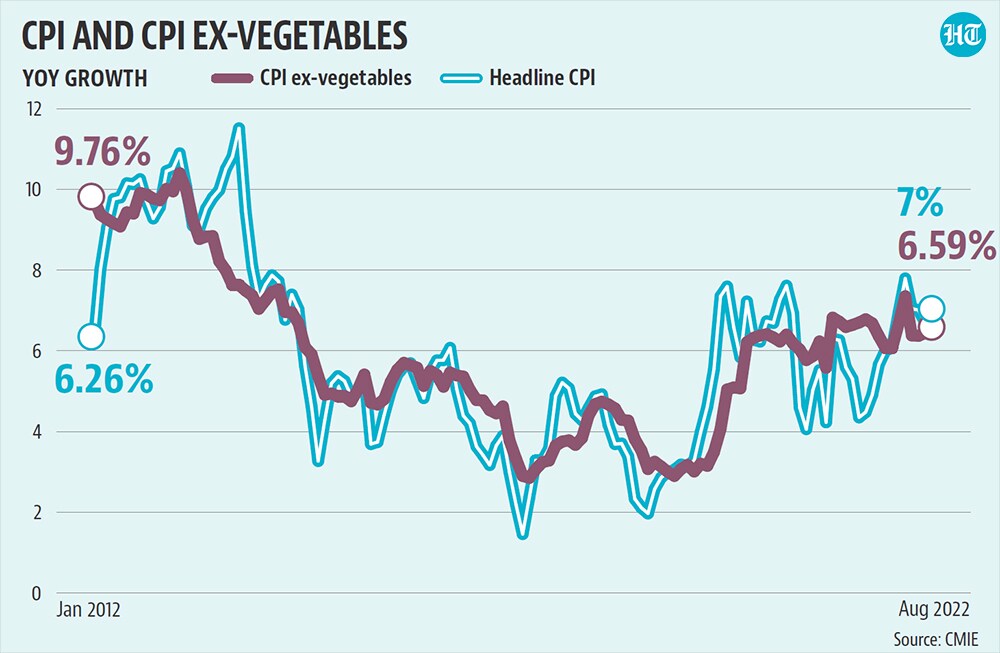
... but the latest inflation cycle seems to have peaked.
This is what matters going forward. WPI values have fallen for the third consecutive month in August. As far as CPI is concerned, while August saw a reversal of the falling trajectory in headline inflation which began in May, the rise in inflation appears to be much less significant once vegetable price inflation in factored out. While headline CPI increased from 6.7% to 7% between July and August, CPI excluding vegetables increased by a mere 16 basis points – one basis point is one hundredth of a percentage point – during this period. Vegetable prices are one of the most volatile in India and often driven by seasonal shocks to production rather than the broader macroeconomic situation.
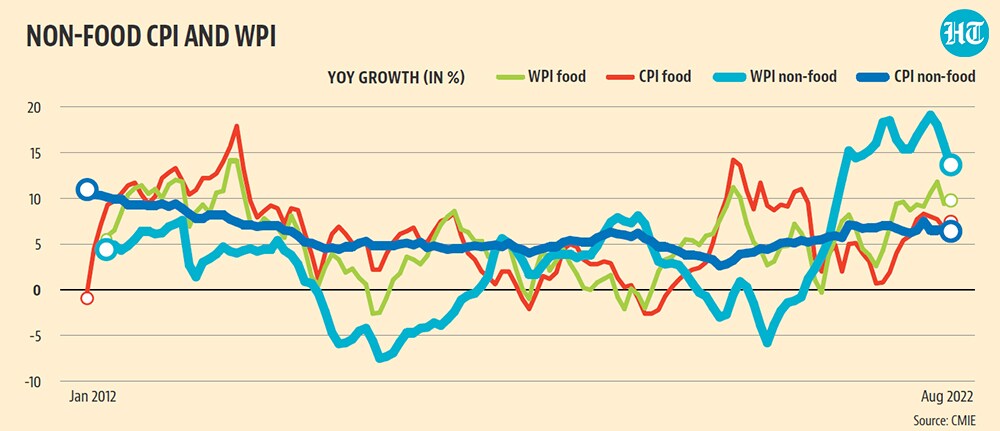
Non-food component of WPI basket shows the clearest evidence of inflation peaking...
Because CPI and WPI serve a very different purpose – the former tracks household budgets while the latter tracks producer prices – their non-food components are vastly different. WPI, for example, includes a lot of industrial inputs such as metals and chemicals whereas CPI includes household services and housing. A comparison of the non-food basket of CPI and WPI is illuminating: the latter shows a clear evidence of inflation having peaked and now on its way down. The non-food part of retail inflation has not shown this kind of fall. Even if one looks at the core-CPI numbers – this excludes both food and fuel items – the recent trend has been relatively stickier. It is this part of the inflation trajectory which is of interest to most analysts, as dynamics of relative pricing power in wholesale and retail markets are involved. The food part of these indices move in tandem.
... but the worrying rise in cereal prices merits attention
Retail inflation for the cereals and products sub-category stood at 9.6% in August 2022. Wholesale inflation for cereals was 11.8%. Both these numbers have been on a rising trajectory for a long time. While part of the rise is on account of a base-effect – there was a period of disinflation – inflationary tendencies have gained momentum in the past few months in contrast to the overall inflationary trend. Given the backdrop of two back-to-back bad cropping seasons – a premature heat wave led to a fall in wheat output and monsoon deficiency in some rice growing states is expected to do the same to this year’s rice production – and higher than normal international prices, inflationary pressures in India’s cereal economy could put a squeeze on budgets of poor households. To be sure, the extent of such a squeeze will also depend on whether or not the government decides to continue the PM Garib Kalyan Yojna which has been giving 5 kg extra cereal per person per month to around 800 million people in the country.


