E-Paper



Number Theory: How the electoral math in Punjab has changed since 2019
What has made the political situation even more complicated is that the BJP and the SAD have parted ways
Published on: Apr 15, 2024, 08:59:49 IST

 Prefer HTon Google
Share via


Copy link

Punjab sends 13 MPs to the Lok Sabha. It was the only north Indian state and the second state (after Kerala) where the Congress won a majority of seats in the 2019 Lok Sabha elections. Between 2019 and 2024, a lot has changed in the politics of Punjab. Here are three charts which explain this in detail.

How the electoral math in Punjab has changed since 2019
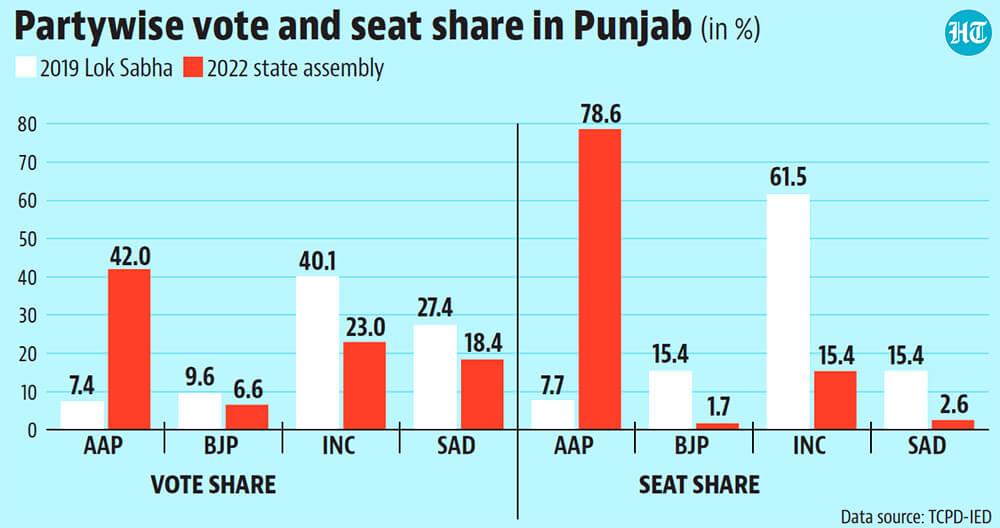
 Punjab will see a four-cornered contest this timeBetween the 1998 and 2009 Lok Sabha elections, Punjab was a bipolar polity where the Congress used to take on the Bhartiya Janata Party (BJP) and Shiromani Akali Dal (SAD) alliance. The combined vote share of the Congress and BJP-SAD alliance reached an all-time high of 89% in the 2009 elections. This bipolar arrangement was disrupted when the Aam Admi Party (AAP) made its entry in the 2014 Lok Sabha elections. While the AAP’s fortunes dipped in the 2019 Lok Sabha elections, it achieved a massive victory in the 2022 assembly elections in the state. What has made the political situation even more complicated is the fact that the BJP and the SAD have also parted ways after the latter walked out of the National Democratic Alliance (NDA) against the three now-repealed farm laws. While the Congress and the AAP have managed to stitch together an alliance in Delhi and Haryana, they are fighting against each other in Punjab. This means that Punjab is set for a four-cornered contest in 2024.
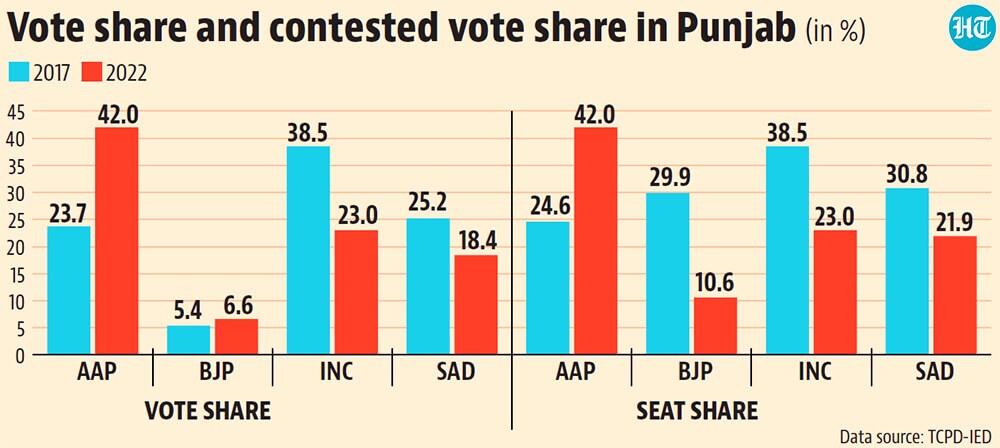
- Who has ceded more ground to the AAP in Punjab?If one tries to answer this question with the 2022 performance of the AAP, it emerges that the Congress is the bigger loser. The AAP’s vote share increased by 18.3 percentage points between the 2017 and 2022 elections. The fall in Congress’s and SAD’s vote shares between these elections was 15.5 and 6.9 percentage points respectively. The BJP’s vote share, on the other hand, increased by 1.2 percentage points between the 2017 and 2022 elections. To be sure, the rise in BJP’s vote share could reflect the fact that it contested more seats than it did in 2017, when it was in an alliance with SAD.
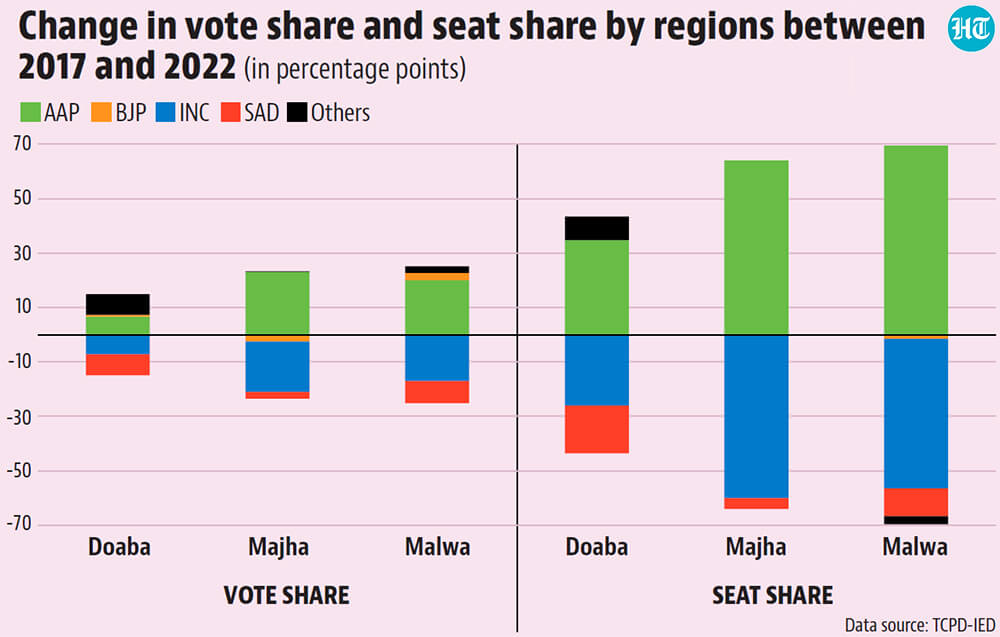
- Are there regional pockets of dominance in Punjab?Broadly, Punjab can be classified into three regions -- Malwa, Majha, and Doaba. Malwa is the biggest region in the state, with eight parliamentary constituencies (PCs), followed by Majha and Doaba with three and two PCs respectively. The assembly constituency (AC) break-up of Malwa, Majha and Doab is 69, 25 and 23 respectively. In the 2022 assembly elections, AAP dominated the Malwa and Majha regions, winning 95.6% and 64% of the ACs in the region. Doaba was the only region where there was a close contest between AAP and Congress. In Doaba, AAP won 43.3% of the seats, while Congress also had a significant presence, winning 39.1% of the seats in the region. These trends are also reflected in vote shares. The AAP gained vote share the most in the Malwa and Majha regions. While the AAP’s vote share gains in the Malwa region came at the cost of both the Congress and the SAD, its gains in Majha were largely at the cost of the Congress. On the other hand, while both the Congress and the SAD lost a large vote share in Doaba, all of these votes did not flow to AAP. Smaller parties – parties other than the four main parties in Punjab -- also gained from Congress and SAD losses in Doaba.
- Exits and defections mean past trends need to be read carefullyTo be sure, the trends seen up to 2022 can further undergo changes in 2024 because of defections and exits. For example, Malwa has seen defections from the Congress to both the AAP (for example, Gurpreet Singh GP) and the BJP (former Punjab Congress chief Sunil Jakhar and MP Ravneet Singh Bittu) after the 2022 assembly elections. Similarly, former Congress chief minister Amarinder Singh, who is also from the Malwa region, merged his Punjab Lok Congress party with the BJP after the 2022 assembly elections. Even if one accepts that this will hurt the Congress in Malwa – a region it almost completely lost in 2022 anyway – it is hard to tell who among the BJP and the AAP might benefit more from these defections in 2024. Moreover, such exits are not limited to Malwa. Vikramjit Singh Chaudhary and Raj Kumar, Congress MLAs from the Doaba region, have also left the Congress, the latter for the AAP. One will, therefore, have to wait for the results of the 2024 Lok Sabha elections to see the new electoral map of Punjab.