E-Paper



Number Theory: Why market fundamentalists are equally wrong about agriculture
The data clearly shows that absolutely unregulated markets are not a silver bullet for the agrarian crisis in India

 Prefer HTon Google


Views about Indian agriculture are polarised. On one extreme are a bunch of farmers’ organisations demanding that the government bring in a law to offer guaranteed minimum support prices (MSP) for all crops in the country. We have previously discussed in detail why such a view is flawed. But there also exists another extreme viewpoint. The crux of this view is that government interventions, mostly with an eye to keep food prices from going up, are the biggest reason for the predicament of the Indian farmers. The best way to guarantee the well-being of Indian farmers, these commentators argue, is for the state to discontinue all interventions in the food market. Will such a policy really work wonders for farm incomes? A look at relevant statistics does not support such blanket arguments.
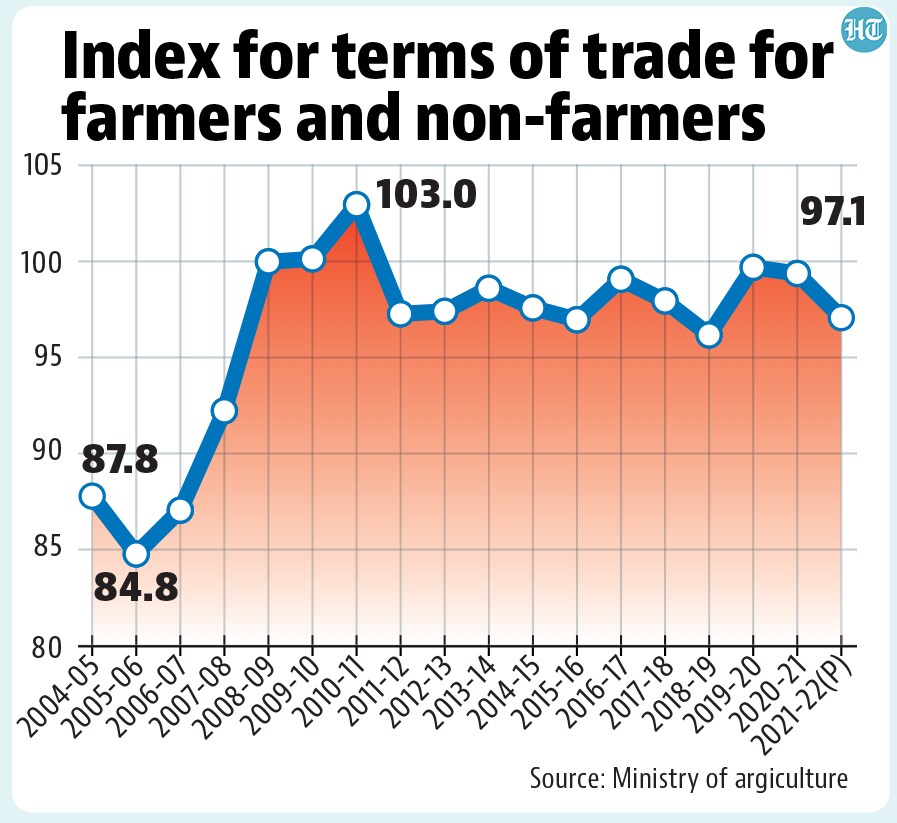
 What has been happening to terms of trade in agriculture?This is the most important question as far as the economic well-being of farmers is concerned. Any argument that says economic problems of farmers are a result of government intervention artificially keeping the prices of farm products lower implicitly argues that the government has forced a worsening of terms of trade for farmers. Terms of trade, simply speaking, is the ratio of prices received and paid by any economic agent. If this number is lower than 100 it means that prices of payables are increasing at a higher rate than prices of the product being sold by farmers. Data from the ministry of agriculture shows that terms of trade have been adverse for farmers in 16 out of 18 years ending 2021-22 for which data is available.
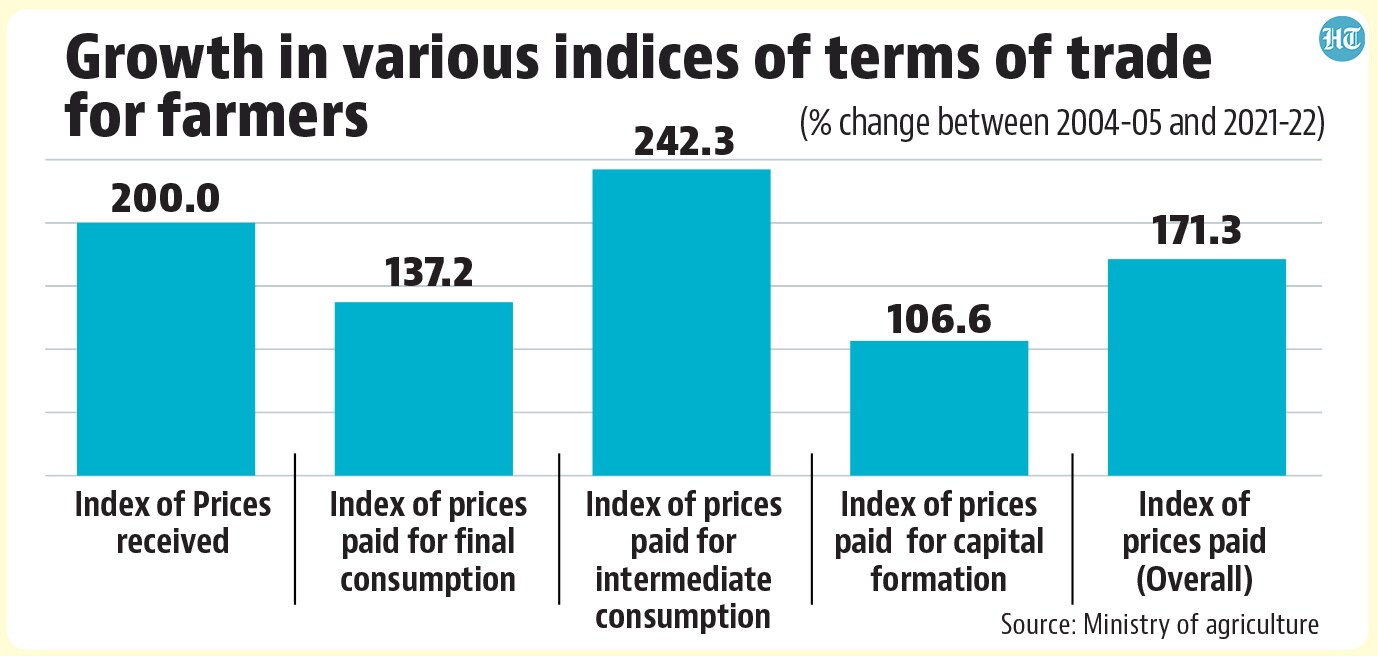
- But the real picture emerges with a disaggregated terms of trade analysisThis is the most important part of the puzzle. Because farmers are a consumer and producer at the same time, their terms of trade depend on prices paid for what they consume as well as what goes into production. The agriculture ministry publishes data on prices paid by farmers for consumption and production related expenses separately. This makes it possible to answer what has really put a squeeze on their incomes. A comparison of various prices paid and received by the farmers shows that their terms of trade would have been significantly better if they had to pay for items they consume rather than those which go into production. The data is unambiguous on this. The index of prices paid towards final consumption (it has a weight of 38% in the overall index of prices paid) grew 2.4 times between 2004-05 and 2021-22 which is lower than the threefold growth in the index of prices received by the farmers. Even the index of prices paid for capital formation (it has a weight of 18.4%) grew by just 2.1 times during this period. However, the index of prices paid for intermediate goods (read farm inputs with a weight of 43.4% in the index of prices paid) has increased 3.4 times during this period. Clearly, prices in the input market are the biggest reason farm incomes are not as high as they could have been. This is a statistic which is not mentioned frequently enough when it comes to discussions on the well-being of farmers. While one can always argue that deregulating food markets completely could have led to a higher growth in prices received, such a policy would also entail a higher growth in the index of prices paid for final consumption by farmers.
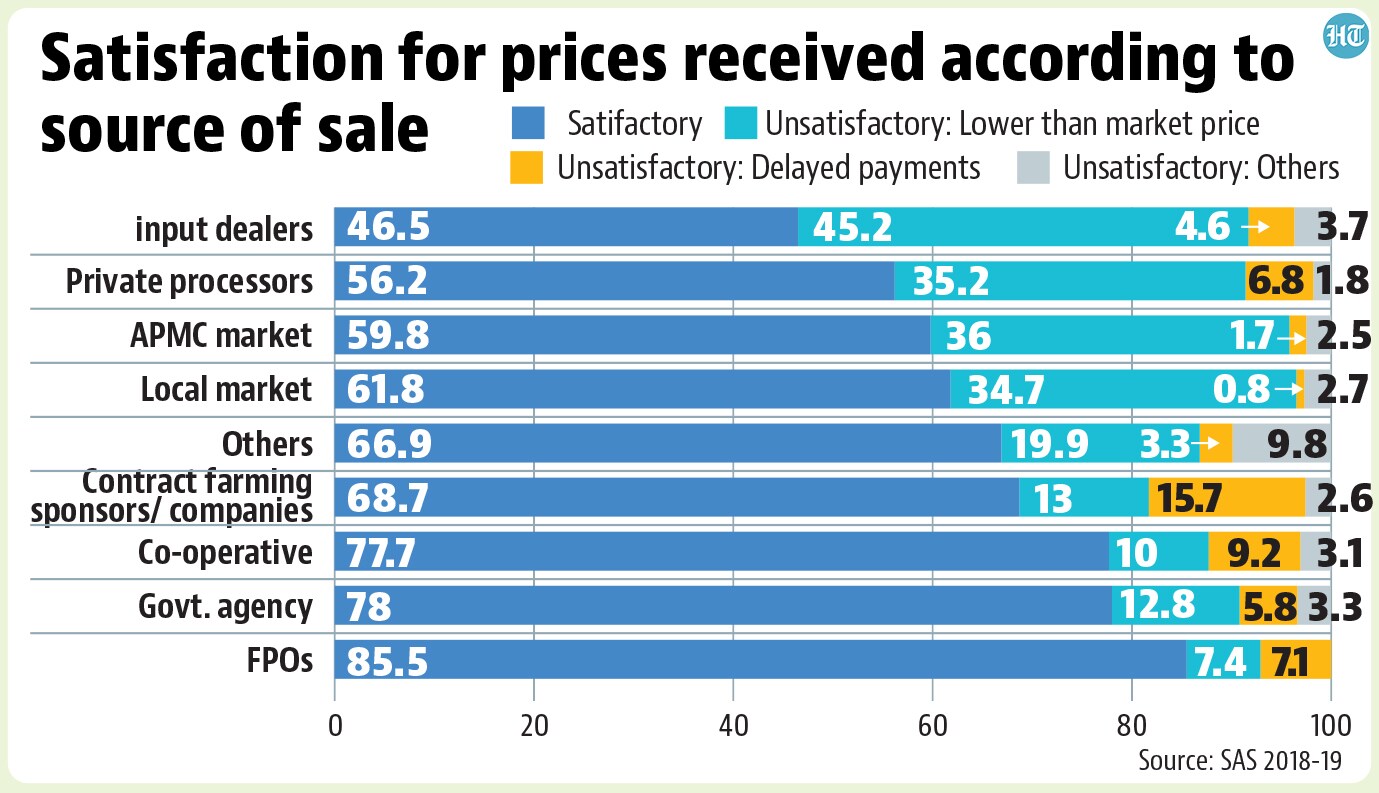
- Promoting co-operatives is a better way to increase returns to farmers than free marketsOnce again, the data is clear. The 2018-19 Situation Assessment Survey (SAS) conducted by the National Sample Survey Office (NSSO) shows that satisfaction or dissatisfaction vis-à-vis prices received varied significantly for farmers depending on where they sold their products. This was as low as 46.5% for product sold to input dealers (who have seen the biggest growth in prices received from farmers as per terms of trade data discussed above) and as high as 85.5% for product sold in farmer producer organisations (FPOs). The data clearly shows that absolutely unregulated markets are not a silver bullet for the agrarian crisis in India; indeed, they are another extreme of dogmatic solutions which have no objective basis even if one was to ignore the larger concerns of food price stability for millions of poor people who are not directly employed in agriculture and gain by price control interventions of the government. An improvement in agricultural incomes requires farmers to be organised into cooperatives so that they can increase their bargaining power in both input and output markets.