E-Paper



Parliamentary panel flags exam irregularities; seeks time-bound NTA reform plan
The committee also pulled up the higher education department over delays in publishing the All India Survey on Higher Education

 Prefer HTon Google


A Parliamentary panel on Tuesday asked the Centre to publish a “time-bound roadmap” for implementing the recommendations of the High-Level Committee on Education (HLCE) on exam reforms, saying irregularities continue despite the creation of a monitoring mechanism after the National Eligibility cum Entrance Test for Undergraduate (NEET-UG) 2024 exam controversies.
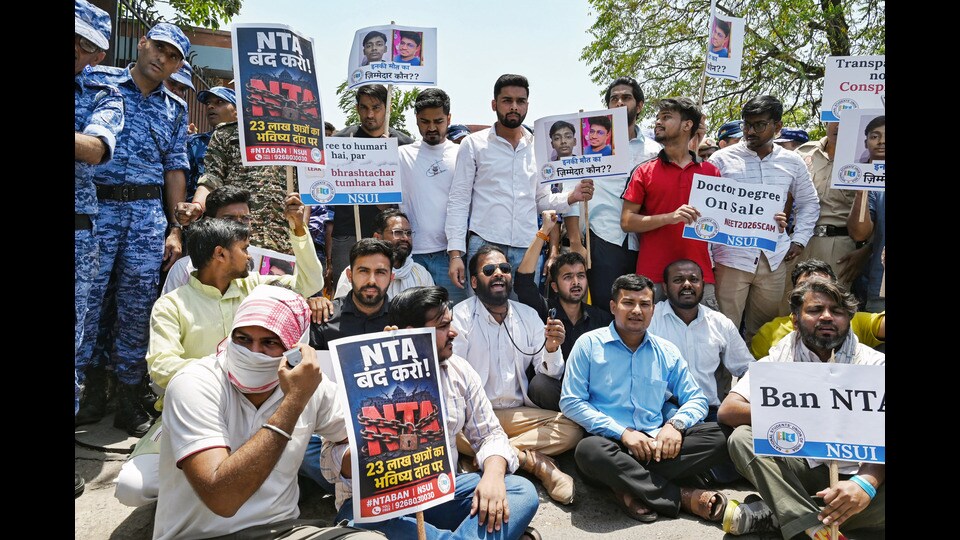
In a report tabled in Parliament on Tuesday, the department-related Parliamentary standing committee on education, women, children, youth and sports headed by Congress MP Digvijaya Singh said paper-related irregularities were still leading to cancellation of examinations and causing anxiety among students.
It recommended that the education ministry “publish a time-bound implementation roadmap” for the HLCE recommendations “at the earliest”.
The ministry set up a HLCE after controversies surrounding NEET-UG 2024. The committee submitted its report in October 2024, recommending reforms in national entrance testing, strengthening of the National Testing Agency (NTA), greater coordination with states and staggered examinations.
A high-powered steering committee headed by former ISRO chairman K Radhakrishnan was later constituted to oversee implementation.
“However, despite these measures, paper irregularities are still happening,” the panel noted.
NEET-UG 2026 held on May 3 was called off on May 12 following allegations of a paper leak, including purported overlaps between a pre-circulated guess paper and the actual paper. More than 2.27 million candidates appeared for the May 3 examination. The re-examination is scheduled for June 21.
Also Read:Existing schemes not enough for displaced women, children in Manipur: Panel
The committee also pulled up the higher education department over delays in publishing the All India Survey on Higher Education (AISHE). While the ministry informed the panel that data collection for AISHE 2022-23, 2023-24 and 2024-25 had been completed and the reports will be released together, the panel said publishing three years’ data simultaneously “defeats the purpose of an annual survey”.
It reiterated its demand for student-level data collection and called for a fixed annual timeline for AISHE publication, saying delays undermine evidence-based policymaking, particularly in monitoring SC/ST/OBC/EWS enrolment.
The panel also expressed dissatisfaction with the government’s response to the Central Advisory Board of Education (CABE), the apex advisory body on education, noting that no meeting has been held since 2019.
Describing the department’s reply as lacking “specificity”, it sought a comprehensive response.
Separately, the committee flagged the slow progress of the Institute of Eminence scheme launched in 2017, noting that only 12 of the 20 institutions envisaged under the programme have been notified nearly eight years after its launch.
It also questioned the exclusion of leading institutions in social sciences and humanities, including Jawaharlal Nehru University (JNU), from the scheme.