
 E-Paper



‘Unfortunate’: BJP slams 10 Opposition CMs who skipped PM Modi-led Niti Aayog meet
PM Modi called for a "ground-up" approach to make India a developed economy by 2047 at the 8th governing council meeting of the Niti Aayog.

 Prefer HTon Google


The country grows when the states grow, Prime Minister Narendra Modi said at the 8th governing council meeting of the Niti Aayog on Saturday, calling for a “ground-up” approach to make India a developed economy by 2047.
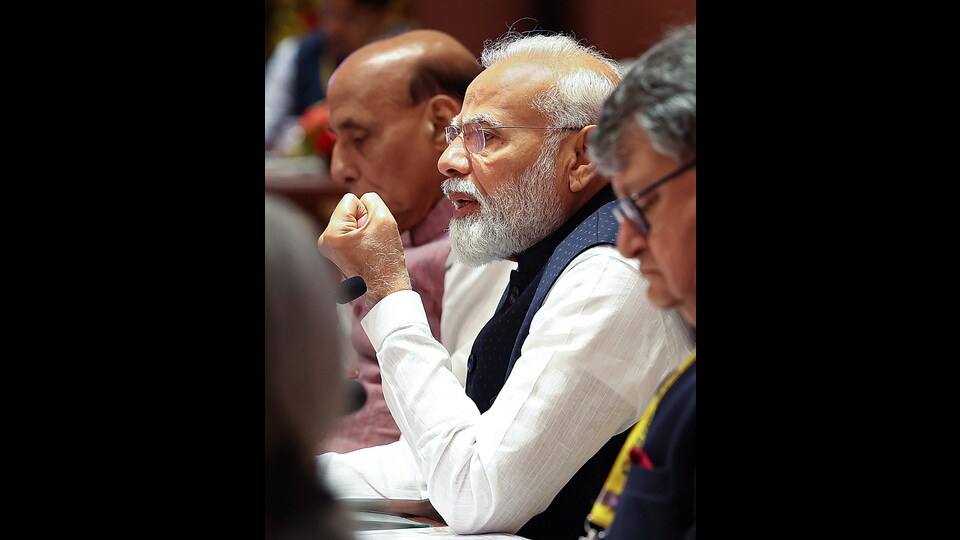
In his address, PM Modi said that India’s goal of becoming a developed country had to be achieved within the bounds of fiscal prudence. “It is very important that our future generations not be burdened by our present activities,” he said.
He added that India is now at a “take-off stage” and that the country had to grab a never-before opportunity.
The meeting was, however, overshadowed by 11 chief ministers skipping the event, prompting the ruling Bharatiya Janata Party (BJP) to call the boycott by some“unfortunate”.
The chief ministers who skipped the meeting included Arvind Kejriwal (Delhi), Bhagwant Mann (Punjab), Mamata Banerjee (West Bengal), Nitish Kumar (Bihar), K Chandrashekar Rao (Telangana), MK Stalin (Tamil Nadu), Ashok Gehlot (Rajasthan), Siddaramaiah (Karnataka), Pinarayi Vijayan (Kerala), Naveen Patnaik (Odisha), and N Biren Singh (Manipur).
Read: 'Photo khichwane?': Punjab CM Mann defends decision to skip Niti Aayog meeting
“Niti Aayog is an important platform for the country’s development plan. This is its eighth governing council meeting. Its boycott by some state chief ministers is unfortunate,” said senior BJP leader and former Union minister Ravi Shankar Prasad.
“Chief ministers not showing up to the meeting means they are not willing to present the issues of their people in the council,” Prasad said. “You will get more opportunities to oppose Modi. But why are you causing harm to the people of your state?” he asked at a press briefing at the BJP headquarters in Delhi.
Briefing the media on the developments of the meeting, themed “Viksit Bharat @2047”, Niti Aayog CEO BVR Subrahmanyam, quoting the PM, said that every state will soon have a Niti Aayog-like institution so that governments at both the Centre and state-level can work in a collective manner.
“India grows when states grow and the most important sectors, such as education, health and agriculture are in the domain of the states. We all should have a collective vision and Niti Aayog has been a successful model for Centre-state cooperation,” Subrahmanyam quoted PM Modi as saying.
The absence of chief ministers from the Saturday meeting comes amid a pitched tussle between the BJP-led Centre and a host of Opposition parties, who have demanded that President Droupadi Murmu, not Prime Minister Modi, inaugurate the new Parliament complex. Fissures have also grown over the Centre’s May 19 ordinance, which restored control over services in Delhi to the Centre under the lieutenant governor (LG) and essentially overruled a Supreme Court order.
In a letter to the Prime Minister on Friday, Kejriwal said that he was “boycotting” the meeting in protest against the “undemocratic and unconstitutional” ordinance.
Kejriwal’s Aam Aadmi Party (AAP) colleague, Bhagwant Mann, on his part, said that he would stay away from the governing council meeting because the Union government was ignoring issues “related to farmers”.
In West Bengal, Trinamool Congress leaders said CM Mamata Banerjee, who would not attend the meeting, proposed the names of finance minister Chandrima Bhattacharya and chief secretary HK Dwivedi as her representatives. But the Centre replied that only chief ministers could attend, they added.
Other CMs, meanwhile, cited prior commitments for their inability to attend the meeting.
Read: 'No sense': Nitish Kumar on new Parliament building event, Niti Aayog meet
While senior members of the Bihar cabinet said that Nitish Kumar expressed his inability to attend because of “prior commitments”, people in KCR’s office said that the Bharat Rashtra Samithi (BRS) president had a scheduled meeting with Kejriwal in Hyderabad.
Officials in Tamil Nadu said that Stalin, the Dravida Munnetra Kazhagam president, is on a three-day trip to Singapore and Japan.
Gehlot’s office said he was unwell, while functionaries from Patnaik’s Biju Janata Dal said the CM was busy with meetings in the state.
Manipur CM Biren Singh is, meanwhile, dealing with ethnic violence in his state.
Condemning the Opposition’s protest, he said, “On behalf of the party, we want to raise this issue seriously. How far will you go protesting against Modi? You did not come to lay the foundation stone of the Parliament, you will not come to its inauguration. Modi ji’s international popularity has increased and you are commenting on that too.”
The council, headed by the Prime Minister, who is the chairman of the Niti Aayog, includes all state chief ministers and lieutenant governors (LGs) of Union territories.
Representatives from 19 states and six Union territories attended the meeting.
Among them, Chhattisgarh CM and Congress leader Bhupesh Baghel asked for the council’s intervention in iron ore being made available to units in his state. Goa CM Pramod Sawant thanked the PM for “assigning the highest number of G20 meetings (nine) and SCO meetings (four)” to Goa.
Jharkhand CM Hemant Soren sought central assistance in developing the state’s road network, and Andhra Pradesh CM YS Jagan Mohan Reddy called for reductions in expenditure on logistics.
Read: BJP flays CM Mann for skipping Niti Aayog meet
On other states choosing to boycott the deliberations, CEO Subramaniam said: “These states obviously missed the enriching discussions. The loss is of these states. But Niti Aayog will support and work with all states on all issues.”
The meeting discussed eight prominent themes: Viksit Bharat@2047, MSMEs, infrastructure and investments, minimising compliances, women empowerment, health and nutrition, skills and Gati Shakti for area development and social infrastructure.
In his opening remarks, the PM said the country was now prepared to make the leap from basic infrastructure, such as roads, housing and water, to advanced and integrated infrastructure to be built in states, such as the ambitious Gati Shakti Master Plan to boost multi-modal connectivity.
“The idea to use Gati Shakti to decide on where to locate and build school or a public health facility,” Subrahmanyam said after the meeting.
The Niti Aayog’s aspirational districts programme (ADP), which is focused on speeding up development in 112 districts which historically have poor socio-economic indicators, was a model for Centre-state cooperation and an aspirational blocks programme is in the offing, the PM said.
To be sure, India is currently a lower-middle income country with a gross national income per capita (GNI) of $2170, according to the World Bank. Developed economies typically have a GNI per capita of $13205, according to the World Bank’s classification.


