
 E-Paper



PM Modi to ask military to keep pace with changing global geo-politics
National security remains grim for India with China in a military expansion mode on land and sea borders & Pakistan stoking internal fires in J&K and Punjab.

 Prefer HTon Google


Prime Minister Narendra Modi today will address the Combined Commanders Conference at Bhopal even as the military posture of India’s principal adversaries—China and Pakistan—has recorded no positive change on the borders. The meeting will be attended by all tri-service commanders of the rank of commander-in-chiefs with Chief of Defence Staff Gen Anil Chauhan leading the military show.
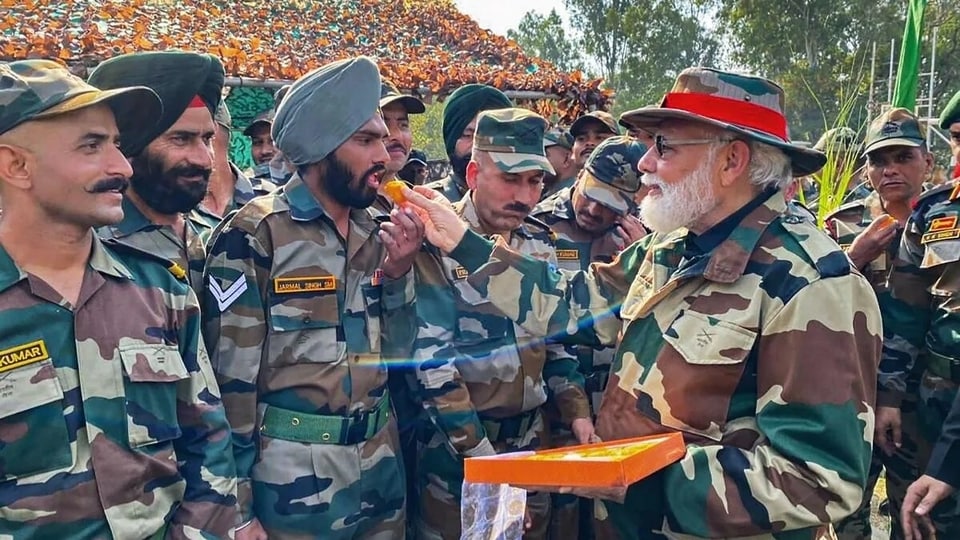
While PM Modi will emphasize on “Aatmanirbhar Bharat” or “Make in India” concept to promote the indigenization of hardware, he is expected to draw the attention of military commanders on the rapidly changing geo-politics in the world in wake of rapid military-economic rise of China. That the Indian defence exports have jumped ten-fold from 2016-2017 to ₹15,920 crore is a positive marker for the “Make in India” initiative.
In the past two days, the military commanders under the leadership of Defence Minister Rajnath Singh and CDS Gen Chauhan have debated about future wars, the Agniveer scheme and the impact of social media on the Indian military.
Although PM Modi will urge the armed forces to attain operational synergy in light of the impending military theatre commands, he will ask the forces to remain prepared as there is no positive change on either the Indian land borders or the Indo-Pacific.
The situation along the 3488 km Line of Actual Control (LAC) remains tense with the PLA deploying additional reserve forces in the Eastern Sector before the start of the 20th National Party Congress of the Communist Party of China. There has been disengagement of troops from the friction points in East Ladakh post-PLA May 2020 aggression but there has been no de-escalation of forces with PLA continuing to deploy three heavy combined armed brigades (with armor element) along the 1597 km long East Ladakh LAC. There continues to be friction over PLA hindering Indian Army's right to patrol its border in Depsang Plains in the Daulet Beg Oldi sector and the Charding Ninlung Nullah (CNN) junction in the Demchok sector with the Indian side still waiting for confirmation of the next round of senior military commanders dialogue.
The military situation on India’s western front is on a wait-and-watch mode as Pakistan, despite being in a serious political and economic mess, has not let down its posture with its deep state continuing to stoke internal fires in Punjab and Jammu and Kashmir through overground separatist workers. The only positive aspect is that the ceasefire is holding in Jammu and Kashmir but that it also works to the advantage of the Pakistan Army as it is being stretched by the Taliban on its western front.
With the rapid expansion of the PLA Navy and its forays into the Indian Ocean, the Indian Navy will also be on its toes as the Indo-Pacific theatre could erupt at any time as the threat of Taiwan is clear and present from Xi Jinping's regime. As the PLA Navy is investing heavily in nuclear-powered conventionally armed submarines, the time has come for Indian national security planners to counter this challenge as the nuclear ballistic missile firing submarines have only deterrent value in real terms. The time has come for the Indian military to innovate with new plans and strategies as equations are changing with old allies and new friends.


