
 E-Paper



President Murmu undertakes sorties on INS Vaghsheer
The Supreme Commander’s two-hour dived sortie onboard INS Vaghsheer reaffirmed the image of the submarine force as a cornerstone of India’s credible deterrence and maritime security

 Prefer HTon Google


President Droupadi Murmu on Sunday undertook a sortie onboard a frontline submarine from the Karwar harbour in Karnataka, witnessing first-hand the prowess and demanding nature of the silent arm of the country’s naval power, officials aware of the matter said.
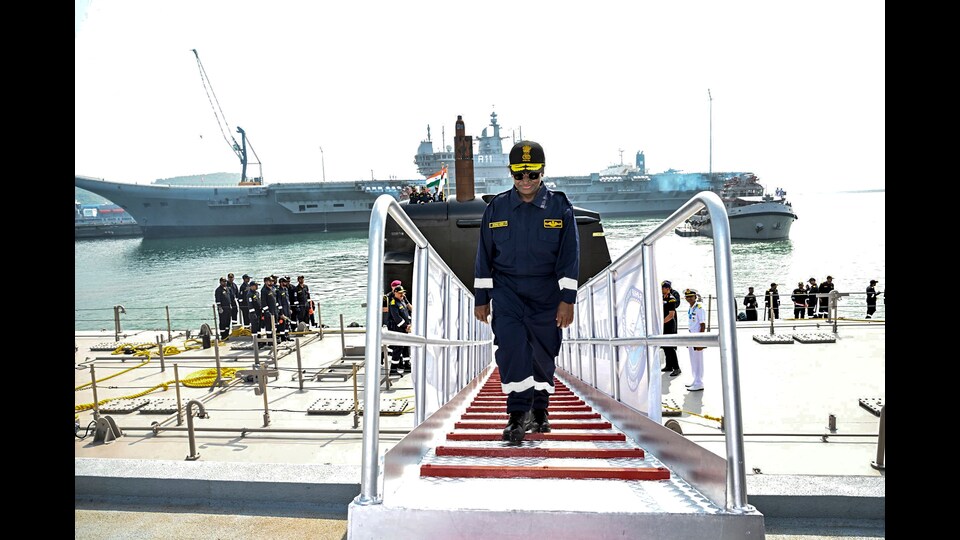
The Supreme Commander’s two-hour dived sortie onboard INS Vaghsheer reaffirmed the image of the submarine force as a cornerstone of India’s credible deterrence and maritime security, they added. Murmu is the second President to undertake a sortie in a submarine after APJ Abdul Kalam; and the first to be onboard a Kalvari-class diesel-electric attack submarine.
“This maiden embarkation onboard an indigenous Kalvari-class submarine reflects the continued engagement of the Supreme Commander with the armed forces in operational settings,” the Rashtrapati Bhavan said. Navy chief Admiral Dinesh K Tripathi and Western Naval Command chief Vice Admiral Krishna Swaminathan accompanied the President.
In November 2024, the President witnessed an operational demonstration by the navy onboard the indigenous aircraft carrier INS Vikrant.
Vagsheer is the navy’s sixth and final Kalvari-class submarine under a ₹23,562-crore programme called Project 75. The Kalvari-class (Scorpene) submarines were constructed at Mazagon Dock Shipbuilders Limited (MDL) in Mumbai, with technology transfer from French firm Naval Group. The boats are capable of various missions such as anti-surface warfare, anti-submarine warfare, long-range strikes, special operations, and intelligence.
Murmu interacted with the submarine crew and witnessed the operational demonstrations, the Rashtrapati Bhavan said in a statement.
“It was indeed a very special experience for me to sail, dive and spend time with our sailors and officers onboard INS Vaghsheer. The multiple successful firings and challenging operations carried out by INS Vaghsheer demonstrate the crew’s exceptional preparedness and dedication. Witnessing the discipline, confidence and enthusiasm of the Vaghsheer crew assures me that our submarines and the Indian Navy are combat-ready against any threat and under all circumstances,” she later wrote in the visitor’s book.
The maiden sortie by the Supreme Commander onboard an indigenous Kalvari-class submarine was more than a ceremonial embarkation, said one of officials cited above. “It is a powerful reaffirmation of the nation’s confidence in indigenous submarine construction and the centrality of undersea warfare in safeguarding national maritime interests,” he added.
The President was briefed on the role of the submarine arm in India’s maritime strategy, and the operational capabilities and contributions in safeguarding national maritime interests, the Rashtrapati Bhavan wrote on X. “She interacted with the crew of INS Vaghsheer and commended their dedication, commitment and spirit of selfless service. She said that this indigenous submarine is a shining example of the Indian Navy’s professional excellence, combat preparedness and unwavering commitment to national security,” it added.
The President’s sortie also put the spotlight on the modernisation of the navy’s underwater capabilities. The ₹70,000-crore Project 75I for building next-generation conventional submarines in the country is likely to be concluded soon. MDL and German yard thyssenkrupp Marine Systems (tkMS) will build six advanced submarines to sharpen the navy’s underwater capabilities under P-75I.
The first submarine under P-75I will be delivered to the navy seven years after the contract is signed, with the rest at the rate of one per year.
These advanced submarines, a variant of HDW Class 214 vessels, will come with air independent propulsion (AIP) systems. AIP significantly increases a submarine’s underwater endurance and reduces the risk of detection. The first submarine under P-75I must have a minimum of 45% indigenisation, with the local content going up to 60% in the sixth.
India is on course to strengthen its strategic forces with a new locally-made nuclear-powered ballistic missile submarine named Aridaman. It will be the navy’s third Arihant-class submarine, and will serve as an undetectable launch platform for missiles armed with nuclear warheads. Aridaman is set to be commissioned early next year, followed by a fourth SSBN codenamed S-4* in 2027. SSBN stands for ship submersible ballistic nuclear or nuclear-powered ballistic missile submarines.
The navy commissioned its second indigenous SSBN, INS Arighaat, at Visakhapatnam in August 2024, strengthening India’s nuclear triad or ability to launch strategic weapons from land, sea and air. The United States, Russia, the United Kingdom, France and China are the only other countries that can deliver nuclear warheads from a submarine. India’s first indigenous SSBN, the 6,000-tonne INS Arihant, was commissioned nine years ago and it successfully completed its first deterrence patrol in 2018.


