E-Paper



Puri: Jagannath Yatra begins with devotees after a hiatus of two years
With Covid restrictions relaxed, this year, the state government allowed people to attend the festival but, on a condition, they wear their face masks

 Prefer HTon Google


Around a million devotees from across the country congregated at Puri on Friday to attend the Jagannath Rath Yatra. The Rath Yatra was held in Puri without devotees for the last two years following a Supreme Court directive on likelihood of spread of Covid infection due to large scale congregation.
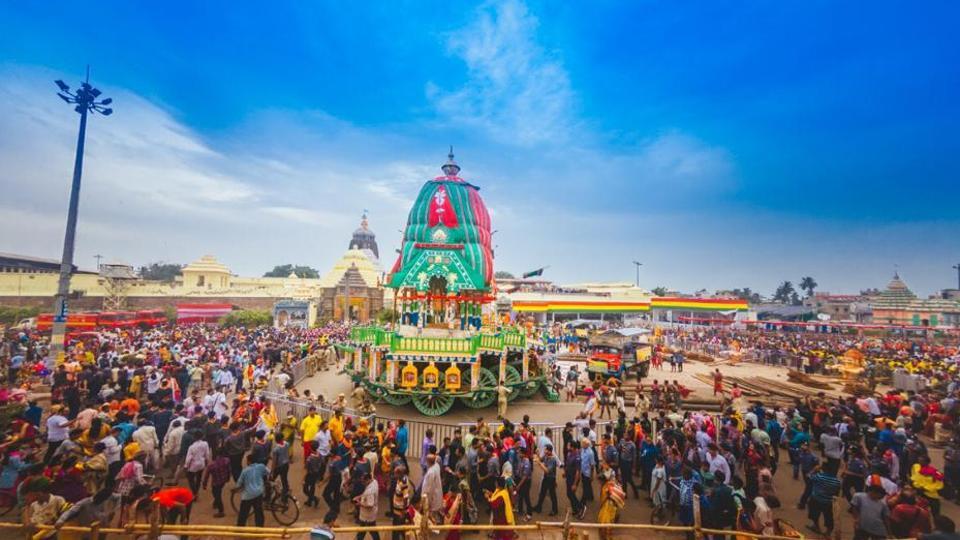
With Covid restrictions relaxed, this year, the state government allowed people to attend the festival but, on a condition, they wear their face masks.
Also Read: For Jagannath Yatra, Puri all decked up to witness sea of humanity after 2 years
The state government would distribute 10lakh masks free to people coming for the festival.
With the chants of ‘Jai Jagannath’ reverberating in the air, the Trinity- Lord Jagannath and his siblings Lord Balabhadra and Goddess Subhadra were taken out from the 12th century temple to their respective chariots in a special ritual called Pahandi Bije in which the idols of Jagannath and Balabhadra are pushed, pulled and dragged in rhythmic movement to the accompaniment of beating of drums, cymbals, blowing of conch and chanting of their names by the temple servitors.
On Friday, the rituals of the three deities began three hours ahead of schedule with Mangala Alati and Mailama niti of Lord Jagannath got over by 3:30am.
At first, Chakraraj Sudarsan was ushered to Nandighosha chariot followed by the Pahandi of Lord Balabhadra to Taladhwaja chariot, Subhadra to Darpadalan chariot and Jagannath to Nandighosha chariot. The three chariots were decked up in colourful clothes.
The Rath Yatra is the only time when Lord Jagannath comes out of his holy abode so that people of all faiths can see him as only Hindus are allowed into the temple on regular days.
To manage the huge gathering, 180 platoons of police and over 1000 experienced officers have been deployed in the temple town with at least three inspector generals of police working under the supervision of an additional director general of police.
To beat the sweltering heat, 10 fire pumps have been deployed at Bada Danda to spray water on the devotees.
Over 50 CCTV cameras have been installed along the main road to monitor the crowd movement from the integrated control room.
An ambulance corridor has been created and about 500 life guards deployed along Puri beach for rescue operations if needed.
The railways will operate 200 special DMUs to Puri from different locations apart from the regular trains.
President Ram Nath Kovind, PM Narendra Modi, chief minister Naveen Patnaik, union education minister Dharmendra Pradhan, union railways minister Ashwini Vaishnav and other ministers extended their respective greetings for people on the occasion.