
 E-Paper





Follow the latest breaking news, major developments and agenda-setting stories from India and around the world with the newsdesk at Hindustan Times. Operating round the clock, the desk brings together experienced editors, reporters and correspondents to deliver fast, accurate and contextual reporting across subjects that influence public policy, governance, business, society and international affairs. The HT News Desk covers politics, elections, government policies, the economy, business and markets, science and technology, the environment, law and order, infrastructure, education, climate issues and geopolitics, while closely tracking developments across states, institutions and global capitals. The team also leads coverage of major breaking news events, policy announcements, court proceedings, natural disasters, public emergencies and significant international developments. Reports published by the newsdesk are based on information gathered from reporters on the ground, official statements, government agencies, court records, regulatory filings, recognised institutions and other authoritative sources. Stories undergo editorial scrutiny and verification processes to ensure accuracy, fairness and relevance, and are updated as events evolve and additional information becomes available. Whether covering a key political decision in New Delhi, an economic policy shift affecting millions, a landmark court ruling or a major global event, the HT News Desk aims to provide readers with reliable, fact-based journalism that delivers not only the latest developments but also the context and analysis needed to understand their wider implications.
Rajasthan industries offer better wages, conditions to lure migrants back
The resumption of industrial activity has struggled after the easing of lockdown imposed due to coronavirus outbreak in absence of the workforce that fled cities for their home towns.


The coronavirus induced lockdown and the resulting reverse migration of labourers has left several industries in Rajasthan facing a severe manpower crunch, forcing them to lure workers back with a promise of higher wages and better working conditions.
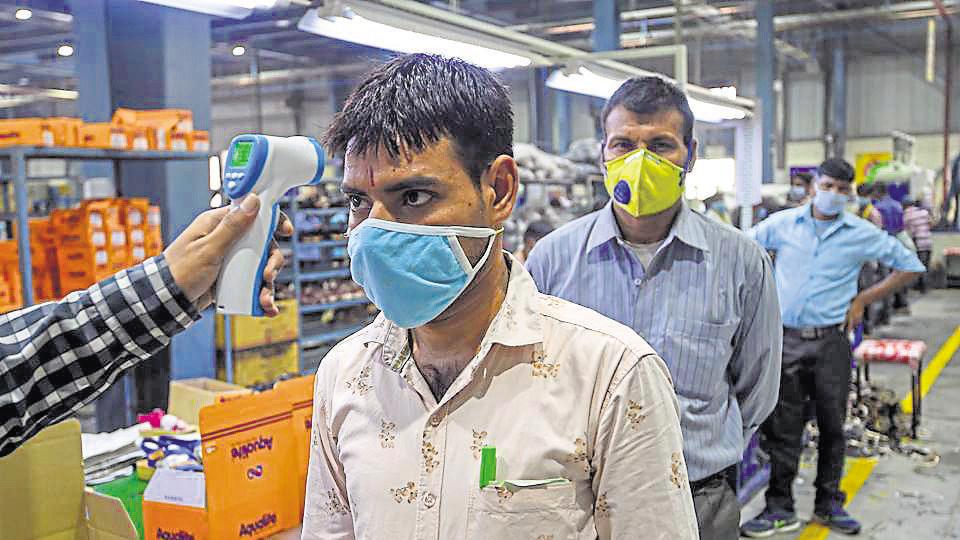
The state government has also offered to help in bringing workers back from their home states, provided the industry bears the transportation cost. Labour secretary Niraj K Pawan said, “If the industry provides us details of districts from which they want labourers back, we will coordinate with those states and facilitate their transport,” he said.
Despite the permission to resume operations from May 3, most industries in the state including construction, autos, real estate, MSMEs, textiles and garments are struggling due to the shortage of labourers, who had left for their hometowns in absence of work, income and shelter during the lockdown while gripped by Covid scare.
The HT Guide to Coronavirus COVID-19
NK Jain, FICCI (Federation of Indian Chambers of Commerce & Industry), Rajasthan chairman on the subcommittee on MSMEs said there is a 40 per cent shortage of labourers.
“Only about 70 per cent of industry is functioning and they are completing old orders as there is no new demand. Those industries that have demand are getting labourers back but others are making do with what they have,” he said.
Sunil Jain president, CREDAI, Rajasthan said the real estate and the construction sector is facing up to 40 per cent shortage of workers.
“Most of the labourers in the construction industry in Rajasthan come mainly from the five states of Uttar Pradesh, Madhya Pradesh, Bihar, Odisha and Bengal. But now, most have returned, so we have to either get them back or employ new labour.”
Also Read: Covid-19 death toll in Rajasthan rises to 251; cases cross 11,000-mark
Jain said some firms are making efforts to bring back workers from their home states. “I know of some real estate firms that are trying to get workers back through contractors. Contractors are in touch with the labourers and are convincing them to return by offering assurance of full work and wages. A few have even sent vehicles to ferry labourers back,” he said.
Aseem Kumar, general secretary of Rajasthan’s garment exporters association says the industry is facing up to 70 per cent labour shortage.
“Factories are offering higher wages, accommodation and even promising work for the whole year, but the workers are not ready to return,” said Kumar.
A majority of garment exports from Rajasthan go to Japan but also to the US, Europe and South America.
Kumar said the export season for the northern hemisphere is ending but was starting for the southern hemisphere where summer will be setting in. “Those firms who have orders for South America need more labour force at this time and are making efforts to bring them back,” he said.
Kumar said the crunch has led to labour wages rising by 15-20 per cent.
The labour in the garment industry is paid per piece rate. A worker can earn 500-600 per day, depending on the style of the garment and the skill required, he said.
Jain, too, acknowledged that wages have increased by 20-25 per cent. The daily wage rate ranges from Rs 400 to Rs 1000 depending on the skill set required for the job.
Kumar said the garment industry needs a skilled work force and therefore can’t be replaced with anyone. “Our workers have been with us since a long time and are trained as per our needs. New labour will have to be trained from the start and that will take time.”
Jain said the construction sector hopes to train the available migrants to overcome the shortage. “We have sought permission from the government to let us open skill training centres on project sites to train labour,” he said.


