E-Paper



SC seeks affidavit from UP govt on arrests, safety compliance after Yamuna Expressway bus fire
SC sought affidavit from UP government on action taken against driver, owner of sleeper bus whose fire in Greater Noida killed nine passengers last month

 Prefer HTon Google


The Supreme Court has sought an affidavit from the Uttar Pradesh government on the action taken against the driver and registered owner of the sleeper bus whose fire on the Yamuna Expressway in Greater Noida killed nine passengers last month, including whether those responsible have been arrested and whether the bus met all safety and regulatory requirements.
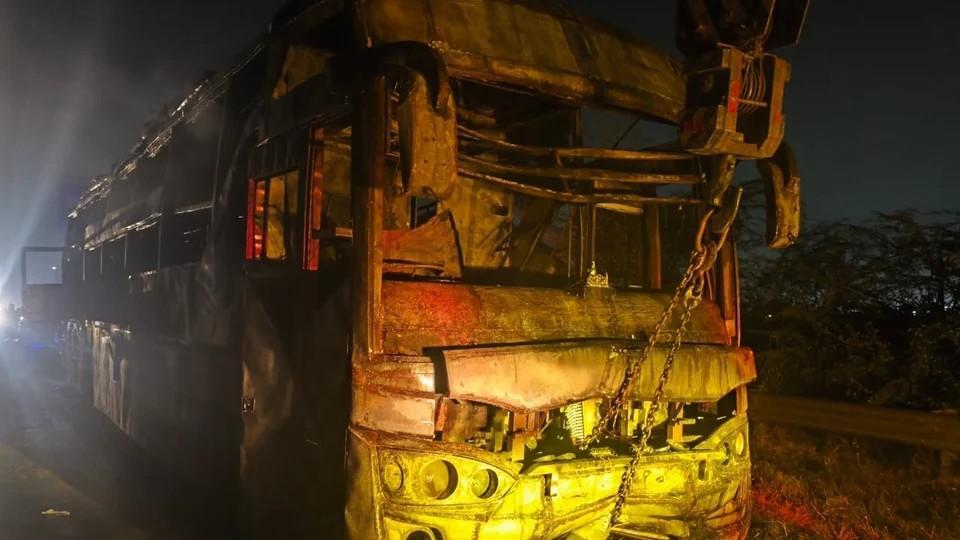
A bench of justices JB Pardiwala and KV Viswanathan also sought details on the bus’s compliance with rules before it was put on the road, as well as its permit, fitness, insurance and safety requirements. The court directed the UP chief secretary, the Centre and the secretary of the Ministry of Road Transport and Highways to respond.
The bench, taking up the application after the September 23/24 incident in which nine passengers were charred to death inside the bus, said it wanted to know what steps had been taken against the driver as well as the registered owner and “whether they have been arrested so far”. It also specifically asked whether the registered owner had complied with all rules and regulations before putting the double-decker bus on the road.
The court, in its order released on Thursday, directed that all necessary information be furnished by affidavit by the next date of hearing.
The application before the Supreme Court sought a detailed report from the UP chief secretary covering the cause of the fire, ownership and registration of the bus, its permit, fitness and insurance, authorised passenger capacity, compliance with construction and fire-safety requirements and any unauthorised alterations.
It has also sought details of the working condition of emergency exits and safety devices, the challan and violation history of the vehicle, operator and driver, the response time of police, fire, ambulance and expressway authorities, and action taken against those responsible.
The application further sought a time-bound preventive action plan and disclosure of any in-depth study conducted under the state scheme contemplated by the Motor Vehicles Act.
The bus, operated by Raj Kalpana Travels, was travelling from Delhi’s Kashmere Gate to Mahoba when it caught fire near the 33-km point of the Yamuna Expressway around 11.30pm on September 23. It had around 35 passengers on board. Nine died, while others escaped or were rescued.
Prime Minister Narendra Modi and Uttar Pradesh chief minister Yogi Adityanath had announced compensation of ₹2 lakh each for the families of the nine people who died, while ₹50,000 will be provided to each injured person.
Police and survivors said some passengers had noticed a burning smell coming from the driver’s cabin shortly before the fire. An FIR based on a passenger’s complaint alleged that the driver and conductor failed to stop despite warnings. Those allegations are part of the investigation. Two bus drivers and a conductor were later arrested.
The incident also raised questions about the vehicle’s regulatory history. Police said that the bus was registered in Bihar, while its owner was from Madhya Pradesh; its fitness certificate had been issued in Rajasthan and its pollution certificate in Haryana. Records further showed multiple traffic fines amounting to about ₹1.75 lakh.
The incident was the latest in a series of deadly fires involving sleeper buses on Indian highways, renewing questions over the safety of the increasingly common long-distance coaches. The Union government told Parliament in December 2025 that at least 64 people had died in 45 incidents of buses catching fire while in operation over the preceding three years.
The application in the top court has asked the court to direct the Centre and states to identify passenger-bus drivers against whom five or more offences or contraventions have been recorded in the relevant one-year period and place their cases before licensing authorities for action under the Motor Vehicles Act and Rules. It has also sought a bar on transport vehicles having more than five unpaid challans from crossing toll or fee plazas until the dues are paid, as well as electronic integration of e-challans with VAHAN and FASTag.
The application proposes that vehicles without valid fitness certificates or functional speed-limiting devices, and public-service vehicles without vehicle-location tracking devices and emergency panic buttons, should not be permitted to use national highways or expressways.
Among the other proposed measures are a uniform national checklist for physical inspection of sleeper and double-decker buses, covering emergency exits, fire detection and suppression systems, electrical and air-conditioning wiring, tyres, brakes, approved berth layouts and the validity of fitness, permits and insurance.
The application has also sought risk-based inspection of sleeper and double-decker buses, suspension of registration or permits of vehicles failing critical safety requirements, and technical standards linking vehicle-location tracking devices with speed limiters, route monitoring and smoke and fire detectors. It has further sought mandatory crew fire-response training, pre-departure passenger safety briefings, digital passenger manifests and integration of emergency buttons with the 112 emergency response system and highway control rooms.
For expressways, the application proposes risk-based fire and rescue plans, including deployment of fire tenders, ambulances and rescue equipment, periodic night drills and publication of actual response times. It has also sought a review of older sleeper and double-decker buses, including the possibility of retrofitting or phased withdrawal where necessary.