
 E-Paper



Social security code bill tabled in Lok Sabha
With this code, the Centre will be able to fix provident fund contributions to be made by employees in different sectors and provide for payment of gratuity to fixed-term employees.


The Code on Social Security, 2019, seeking to consolidate laws relating to the social security of employees, was introduced in the Lok Sabha on Wednesday.
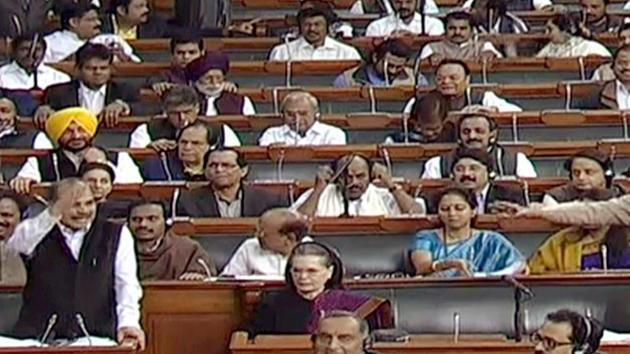
With this code, the Centre will be able to fix provident fund contributions to be made by employees in different sectors and provide for payment of gratuity to fixed-term employees.
The Code will subsume nine central labour laws -- Employees’ Compensation Act, 1923, Employees State Insurance Act, 1948, Employees Provident Funds and Miscellaneous Provisions Act, 1952, Maternity Benefit Act, 1961, Payment of Gratuity Act, 1972, Cine Workers Welfare Fund Act, 1981, Building and Other Construction Workers Cess Act, 1996, and Unorganised Workers Social Security Act, 2008, and Employment Exchanges (Compulsory Notification of Vacancies) Act 1959.
The code has two salient aspects. The first is that the government has walked back a proposal to give flexibility for companies or units that employ up to 300 workers to fire them or even close shop without seeking its permission. The current ceiling for this is 100.
However, the code has measures in place to protect the interests of nine states (including heavily industrialised ones such as Haryana, Gujarat, and Maharashtra) that have laws in place allowing this; labour is a concurrent subject which means both the Centre and the states can make laws on it.
Introducing the bill in the House, Union labour minister Santosh Gangwar said the code is part of a larger exercise to consolidate 44 labour laws into four broad codes on wages, occupational safety, industrial relations and social security.
The bill will also empower the Centre to exempt certain establishments from all or any of provisions of the proposed code, which also makes Aadhaar mandatory for availing benefits under various social security schemes.
It also proposes to set up a social security fund using corpus available under corporate social responsibility to provide welfare benefits such as pension, medical cover apart from death and disability benefits to workers.
On Wednesday, social justice and empowerment minister Thaawarchand Gehlot introduced the Maintenance and Welfare of Parents and Senior Citizens (Amendment) Bill, 2019, in the lower house.
According to the bill, those who intentionally abuse their parents or senior citizens under their care or abandon them may be sentenced to six months’ imprisonment or slapped with a fine of ₹10,000 or both.
It also has provisions for the elderly to claim maintenance and for mandatory registration of senior citizens care homes and other institutions which will have to comply with prescribed minimum standards.
The bill defines “abuse” as physical, verbal, emotional and economic abuse, neglect and abandonment, causing assault, injury, physical or mental suffering. “Children” in relation to a parent or a senior citizen means son or daughter, whether biological, adoptive or step-child, and includes son-in-law, daughter-in-law and grandchildren.
It provides for establishment of a tribunal for senior citizens to file claims for maintenance and assistance and disposal of such applications within 60 days.
According to the proposed legislation, there will be a nodal officer at each police station, not below the rank of an assistant sub-inspector, to deal with the issues relating to parents and senior citizens.
Human resource development minister Ramesh Pokhriyal ‘Nishank’ introduced in the Lok Sabha a bill to set up central Sanskrit universities.
The bill seeks to convert three deemed universities -- Rashtriya Sanskrit Sansthan, the Shri Lal Bahadur Shastri Rashtriya Sanskrit Vidyapeeth (both in New Delhi) and the Rashtriya Sanskrit Vidyapeeth in Tirupati -- presently functioning in the country into central universities.


