E-Paper



Number Theory: More takeaways from matching of donors, parties for EB funding
Here are a few more interesting data points from the electoral bond data published so far
Updated on: Mar 22, 2024, 18:59:21 IST


Share via


Copy link

With the Election Commission of India (ECI) publishing data on electoral bonds (EB) with alphanumeric codes, the matching of donors with parties for almost 75% of the total donations under the scheme is now complete. Analysis of this data, together with matching of donor records from the ministry of corporate affairs (MCA) database has already been published in these pages. Are there any more takeaways from this data? Here are a few more interesting data points from the electoral bond data published so far.

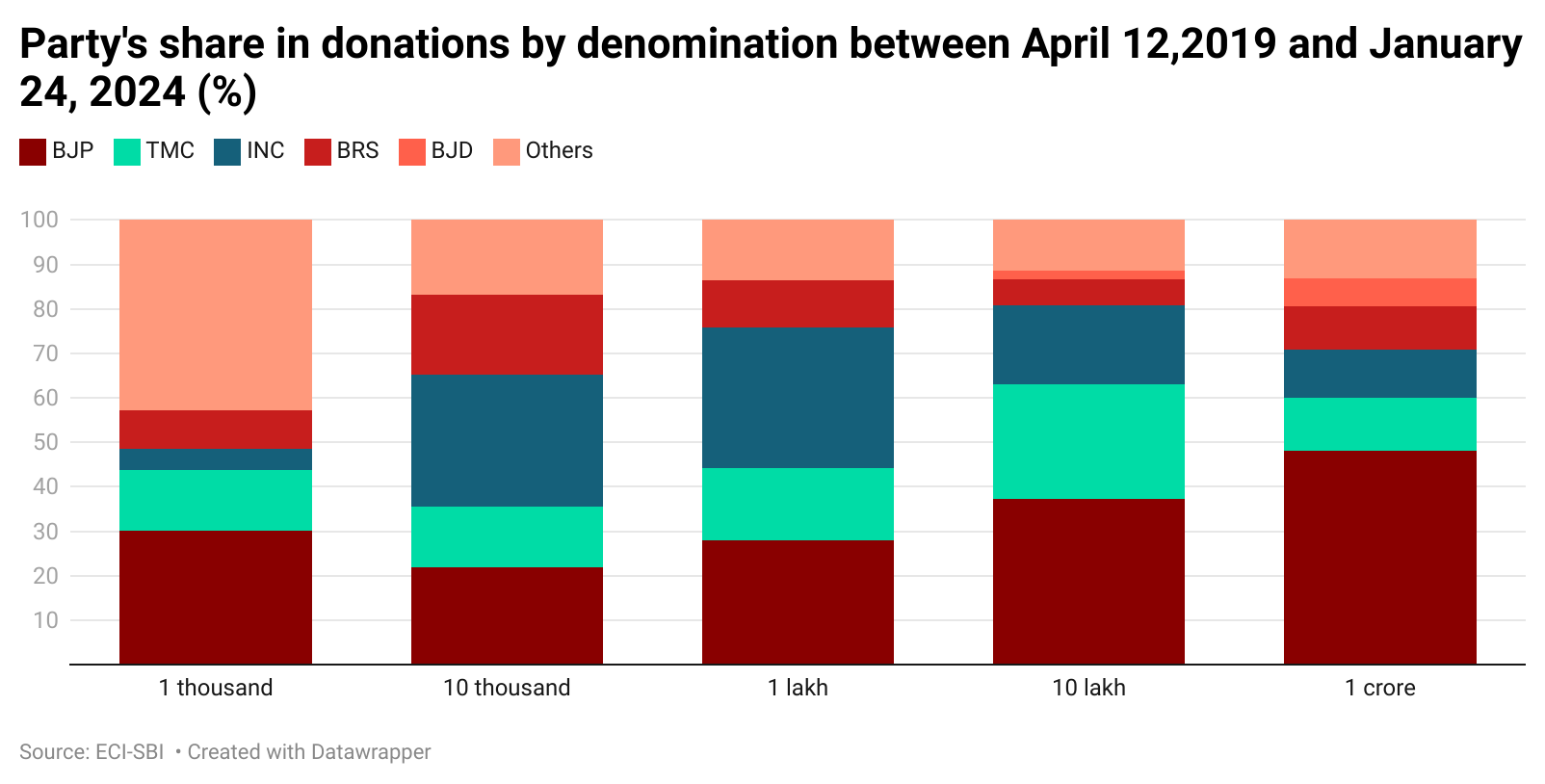
 BJP leads donations via Electoral Bonds in every denominationIn principle, the electoral bond route to political donations was available to anybody willing to make a donation of at least ₹1,000 to a political party. However, the data released by ECI shows that the scheme was mostly used for donations which were much bigger in size. Of the total 20,421 electoral bonds redeemed between April 12, 2019 and January 24, 2024 for which ECI released data on March 14 and March 21, 59.8% came from bonds of maximum denomination, ₹1 crore. The BJP also had the highest share of donations in the two highest electoral bond denominations of ₹10 lakh and ₹1 crore and the second-highest share in all lower denominations.
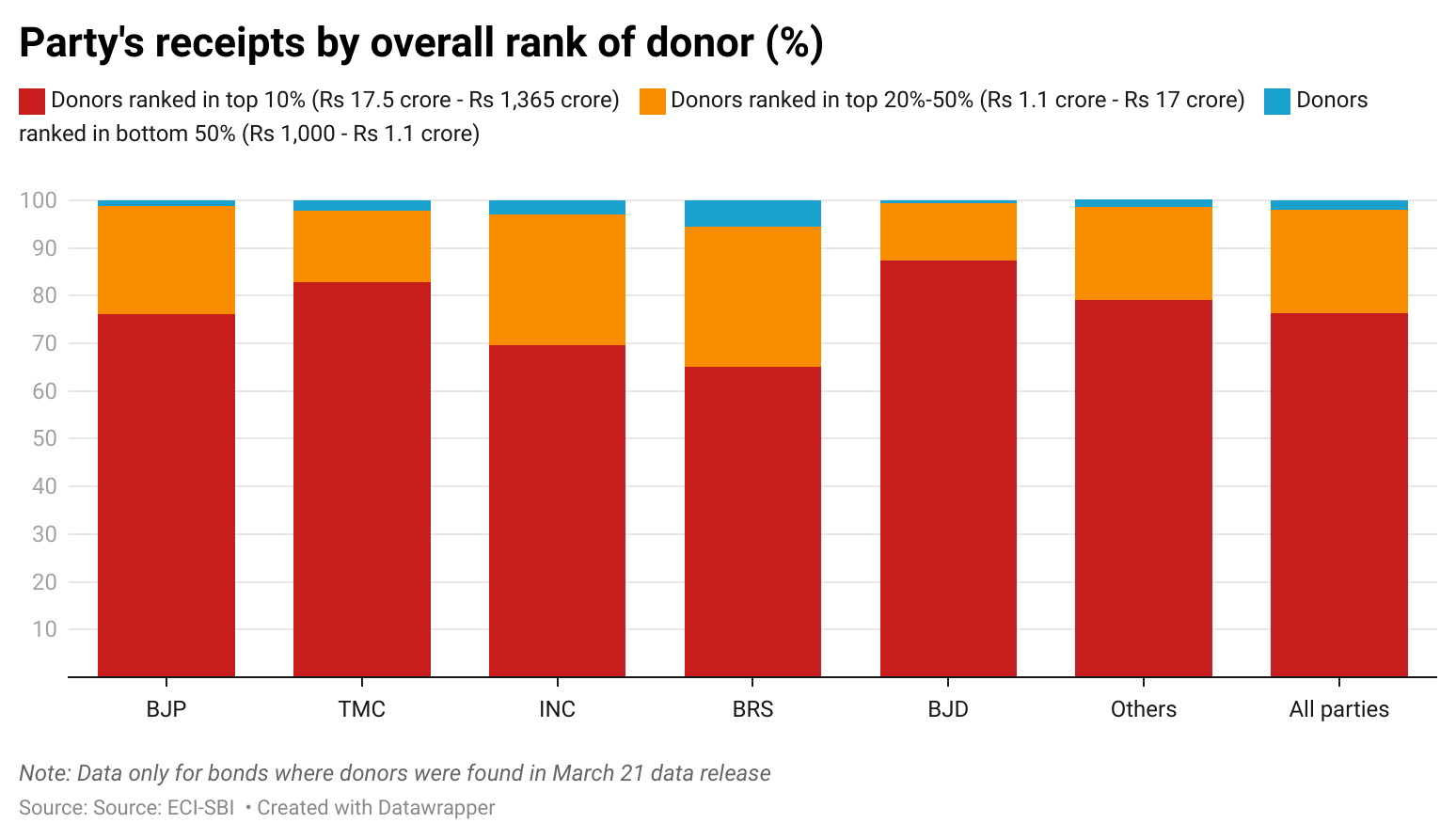
- Are some parties more dependent on big ticket donors than others?This is an important question. If a political party gets the largest amount of money through many more individual donations of a small ticket size, it is not necessarily a bad thing for political funding, as it could denote organic support reflecting in political donations for a party. On the other hand, a political party getting less amount of money overall, but from very big donors would increase the chances of a quid-pro-quo with a big donor. HT has tried to answer this question by clubbing all donations of the 1,208 unique donors for which a recipient was available in the March 21 data release. The median amount donated by a donor is ₹1.11 crore. The top 10% of donors donated between ₹17.5 crore and ₹1,365 crore, and the bottom 10%, between ₹1,000 and ₹5 lakh. The BJP received 76% of its overall donations (for which matching is possible) from donors in the top 10% size class. While this number is larger than that of the Congress, it is actually smaller than the share of donations received by the two other parties (the All India Trinamool Congress or TMC and the Biju Janata Dal or BJD) among the top five recipients. To be sure, almost all political parties received very little funding from the individual donations which fall in the bottom 50% by ticket size. This shows that smaller donations were pretty much irrelevant under the EB scheme.
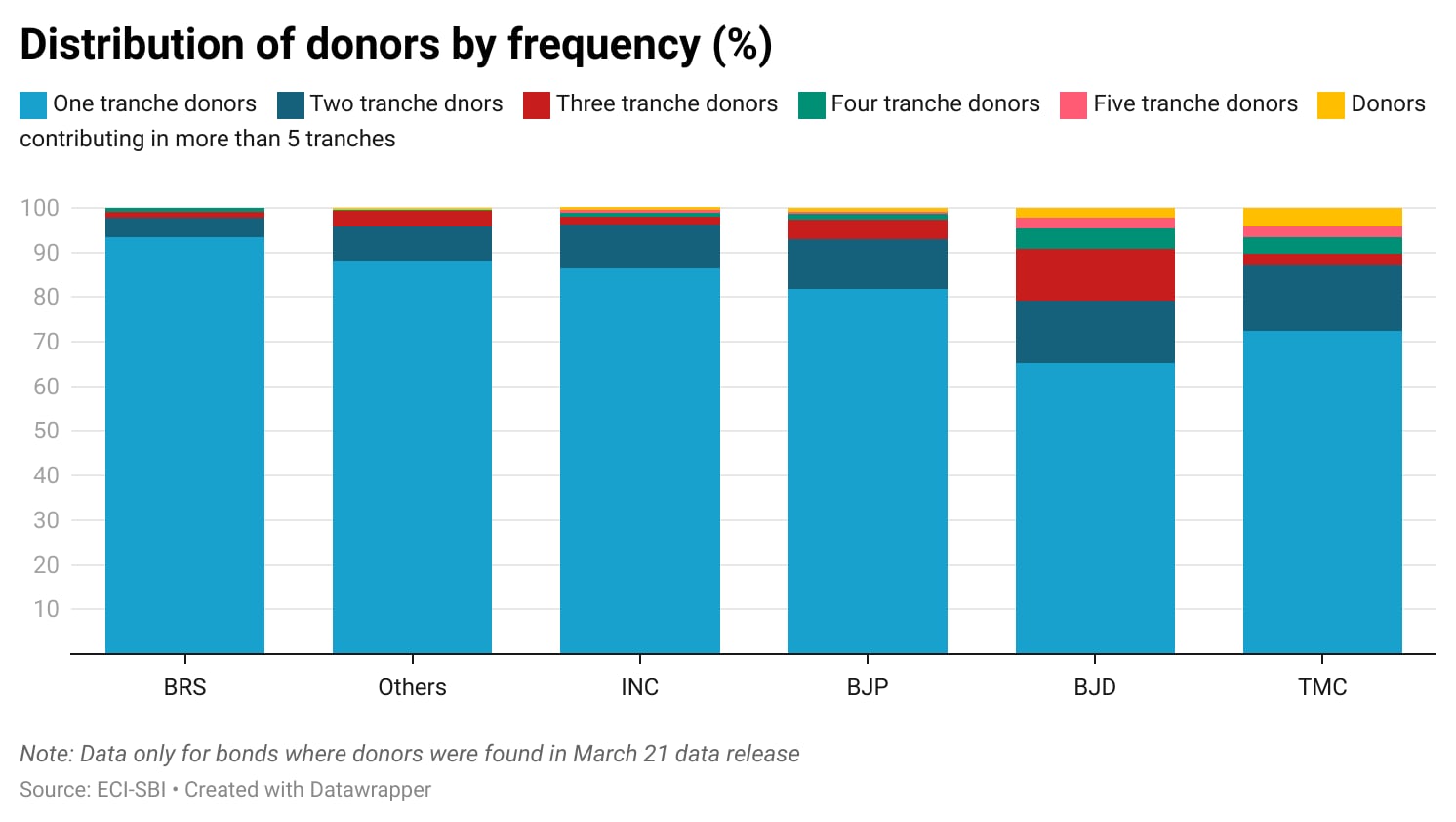
- Were there regular donors to some parties?This is an interesting question to ask because a regular donor-party link could signify a stronger link between a commercial entity and political party. ECI has published matchable donor-redeemer data for 22 tranches of electoral bond sales. An HT analysis of this data shows that the most regular donor-party link in electoral bond is between Haldia Energy Ltd and the TMC with the latter receiving ₹281 crore from the former in 13 tranches. The second and third most regular donor-party link which the data throws is between Future Gaming & Hotel Services Pvt Ltd and the TMC (12 tranches) and Megha Engineering & Infrastructures Ltd and the BJP (11 tranches). A breakup of all donors for the top five recipients by the frequency of their collaboration shows that the TMC and the BJD had the highest proportion of donors who contributed in more than five tranches, followed by the BJP, the Congress, and the BRS. This order remains the same if the regular contributor threshold is lowered to donors contributing in more than three tranches. To be sure, this data needs to be read with overall size of donors to a political party, which has already been published in these pages.