
 E-Paper



Coalition intact, but no power-sharing possible: Tamil Nadu CM MK Stalin
Tamil Nadu CM MK Stalin rejects Congress's call for a coalition government, asserting it won't succeed, while BJP seeks to form a coalition with AIADMK.

 Prefer HTon Google


Chennai Tamil Nadu chief minister MK Stalin on Wednesday said that a power-sharing government will not succeed in Tamil Nadu, responding to the Congress’s demand for a coalition regime ahead of the assembly elections in the state.
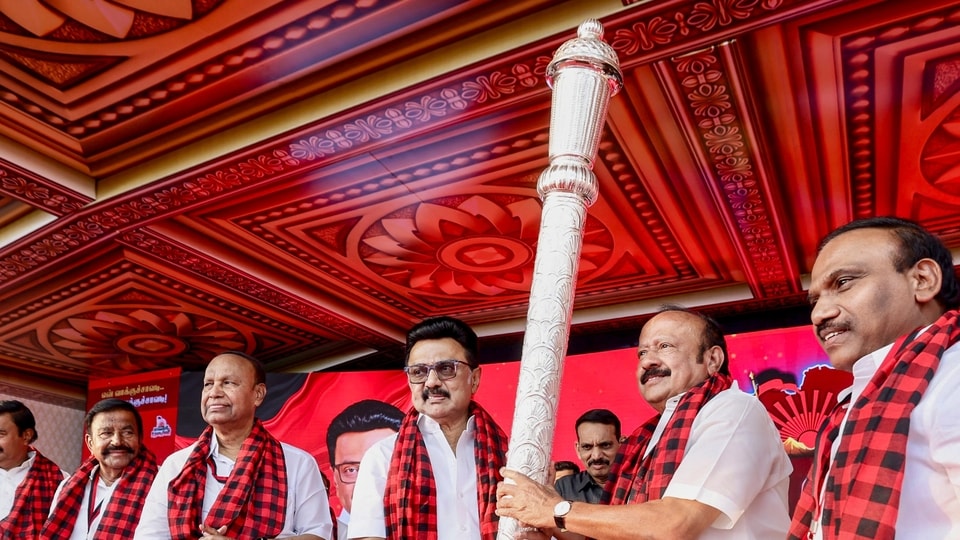
Speaking at an event in Chennai, Stalin said, “It (power-sharing) will not work in Tamil Nadu...We know that and so do they (Congress). Some people with ulterior motives are attempting to disturb the alliance. Neither us (Dravida Munnetra Kazhagam) nor them (Congress) are worried about this.”
Stalin said that he shared “family-like ties” with Congress leader Rahul Gandhi. “He (Gandhi) considers me as one among his family. I, too, consider him the same.”
Discussions of power-sharing emerged as a key issue among allies of the ruling party as well as the opposition, with a section of the Congress’s Tamil Nadu unit urging its leadership to negotiate a deal with the DMK.
Meanwhile, the Bharatiya Janata Party (BJP) expressed interest in forming a coalition government in Tamil Nadu, while its ally, the All India Anna Dravida Munnetra Kazhagam (AIADMK), has opposed the proposal. While Prime Minister Narendra Modi and Union home minister Amit Shah have asserted that the National Democratic Alliance (NDA) will form the government, AIADMK general secretary and chief ministerial candidate Edappadi Palaniswami has been taking an opposition stance that his party will form a majority government.
Following CM Stalin’s statement, Congress MP Manickam Tagore said the people of Tamil Nadu will decide whether they want a coalition or single-party government.
“Our failure was in failing to implement people’s verdict in 2006,” Tagore wrote on X.
In the 2006 assembly elections, the DMK won 96 seats and was short of 22 seats for a simple majority in the 234-member assembly. In the absence of an absolute majority, then DMK chief M Karunanidhi formed a minority government with outside support from parties such as the Congress and the Left.
Since 1967, Tamil Nadu has been ruled successively either by the DMK or AIADMK. They have historically opposed coalition governments in Tamil Nadu, despite being part of them at the national level. An AIADMK cited the example of the 1980 assembly elections in TN – when the DMK and the Congress proposed a coalition government, people of Tamil Nadu rejected them and voted the AIADMK as the single largest party.


