
 E-Paper



Supreme Court rejects extension of ED director Sanjay Mishra’s tenure
Mishra’s extensions were challenged through petitions moved by several opposition party leaders.

 Prefer HTon Google


New Delhi The Supreme Court on Tuesday quashed the Union government’s decision to grant two extensions of tenure to Enforcement Directorate (ED) chief Sanjay Kumar Mishra in 2021 and 2022 and termed these orders “illegal” because they came after a court order that said no further extensions be given to him. And while the court affirmed the Centre’s 2021 amendments to the pertinent laws to extend the tenure of the Central Bureau of Investigation (CBI) director and ED chief up to a maximum of five years, it said these could not be used to defend Mishra’s extension because its writ cannot be nullified using a law.

Read here: SC cancels ED chief Sanjay Mishra’s 3rd extension, says it was illegal
Mishra can continue in office till July 31 to enable the Centre to initiate a “smooth transition in the larger public interest”, the Court further directed.
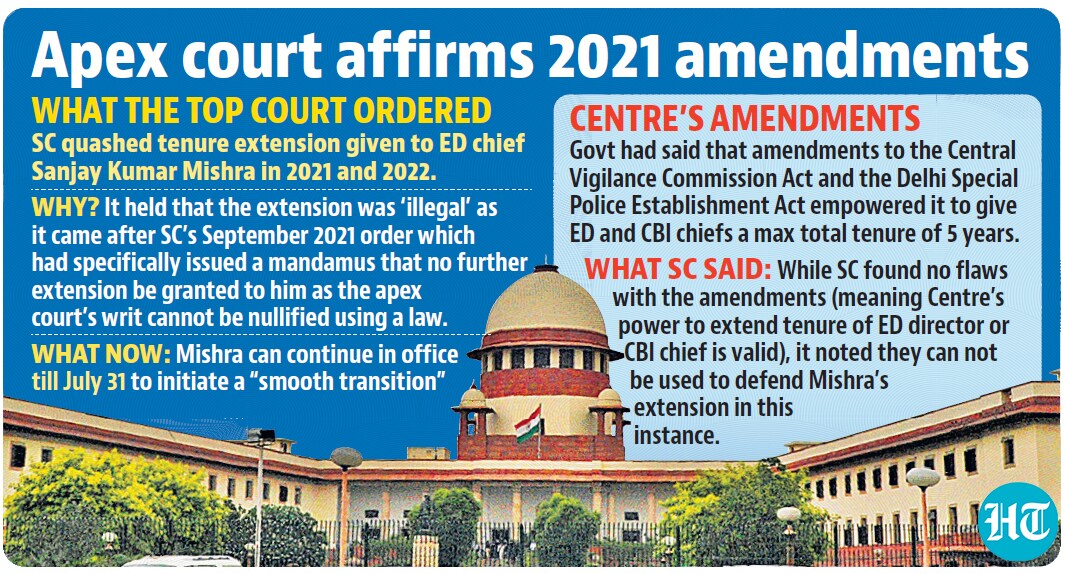
A bench, headed by justice BR Gavai, held that though the Centre has the power to continue the tenure of an ED director beyond the mandatory two-year term, it could not have the granted the two extensions to Mishra in view of a September 2021 Supreme Court order in the Common Cause case, restraining any further extension to him. The 1984-batch IRS officer, who was granted a third extension in November last year, was otherwise set to demit office in November 2023.
“This court has specifically issued a mandamus that no further extension shall be granted to the second respondent (Mishra). The Union of India and Mishra were both parties in the proceedings before this court in the Common Cause case. The mandamus issued to the parties was binding on them... The impugned orders dated 17th November 2021 and 17th November 2022 granting extensions to the tenure of Mishra for a period of one year each are held to be illegal,” stated the 103-page judgment.
While it upheld the 2021 amendments to the Central Vigilance Commission (CVC) Act and the Delhi Special Police Establishment (DSPE) Act empowering the Union government to give an ED director and a CBI chief a maximum cumulative tenure of five years, the court rejected the Centre’s contention that Mishra’s extension can be protected under the new law despite the September 2021 order of the top court. The bench noted that while the effect of the judgments of the court can be nullified by a legislative act by removing the basis of the judgment, but a specific direction issued in relation to the parties in a case will remain binding.
“This court has clearly held that nullification of mandamus by an enactment would be impermissible legislative exercise. This court has further held that transgression of constitutional limitations and intrusion into the judicial power by the legislature is violative of the principle of separation of powers, the rule of law and of Article 142 of the Constitution of India,” said the bench.
Mishra’s extensions were challenged through petitions moved by Congress leaders Randeep Singh Surjewala, Jaya Thakur, Trinamool Congress MP Mahua Moitra, and others.
Read here: Who is Sanjay Kumar Mishra, ED director whose 3rd extension SC termed ‘illegal’?
Mishra was initially appointed as ED director for a two-year tenure ending November 2020. Before his tenure came to an end, he was granted a one-year extension that was challenged in the top court by an NGO, Common Cause. By a judgment in September 2021, the court allowed the extension, noticing that the tenure was coming to an end in about two months. However, the judgment was clear that no further extension was to be granted to Mishra. On November 15, 2021, the Centre brought amendments to the CVC Act and the DSPE Act governing the appointment of heads of the two agencies. This allowed the government to extend the tenure of CBI and ED chiefs for a period of three years beyond their two-year tenure by granting extensions of one-year each.
Finding no flaws with the 2021 amendments, the top court noted that such extensions can be granted by the government only if the selection committees, which are constituted for recommending their appointment, recommend their extension in public interest and also record the reasons in writing. The composition of the high-level committee for the appointment of the CBI chief comprises the Prime Minister, the Chief Justice of India or his nominee, and the leader of Opposition or the single largest party in Opposition. The panel to select the ED chief includes the central vigilance commissioner, vigilance commissioners, and three secretaries in the ministries of home affairs, finance and personnel.
Affirming the amendments, the court noted that “it is not at the sweet will of the government” that the extensions can be granted to the incumbents in the office of the director of CBI or ED but that it is only following the recommendations of the selection committees and reasoned orders that such extensions can be granted.
“When a committee can be trusted with regard to recommending their initial appointment, we see no reason as to why such committees cannot be trusted to consider as to whether the extension is required to be given in public interest or not. At the cost of repetition, such committee is also required to record reasons in writing in support of such recommendations,” it added. The court maintained there was no manifest arbitrariness in bringing the 2021 amendments nor could there be a contention in law that Parliament did not have power to enact on this subject.
Defending its decision to extend Mishra’s tenure, the Centre argued in the court that Mishra’s continuation at the helm of ED was essential from the point of view of an upcoming peer review by the Financial Action Task Force (FATF) that will grade India on its laws being compliant with the international protocols on tackling money laundering and financial terrorism.
During submissions opposing the petitions, the Centre, represented by solicitor general Tushar Mehta and additional solicitor general (ASG) SV Raju, further told the bench that the 2021 order was passed despite the two-judge bench recognising the power available with Centre to grant extensions. The law officers stressed on the point that the basis of the 2021 order has now been removed through the amendment to the Central Vigilance Commission (CVC) Act, passed last year, by which ED director can enjoy an extension of one-year each till a maximum of three years beyond the original two-year tenure.
In its judgment on Tuesday, the court held that the question of altering the basis of the September 2021 order never arose since the 2021 order had found that there was no proscription on the government to appoint a Director of Enforcement beyond a period of two years. At the same time, it had restrained the Centre from extending Mishra’s tenure after the completion of his tenure in November 2021, added the bench.
“Though we have held that orders dated 17th November 2021 and 17th November 2022 granting extensions to respondent No.2 are not valid in law, we are inclined to take into consideration the concern expressed by the Union of India with regard to FATF review. We are further inclined to take into consideration that the process of appointing the Director of Enforcement is likely to take some time. In that view of the matter, we find that in order to ensure the transition to be smooth in the larger public interest, it will be appropriate to permit respondent No.2 to continue to be in office till 31st of July 2023,” stated the order.
Read here: Supreme Court refuses Centre's third tenure extension to ED director Sanjay Kumar: ‘It’s illegal'
The petitioners in the case were represented by senior counsel Abhishek Manu Singhvi, Anoop G Choudhary, Gopal Sankarnarayanan and advocate Prashant Bhushan. Senior advocate KV Viswanathan (now a SC judge) had assisted the court as amicus curiae when the matter was argued in May 2023.



