E-Paper



Number Theory: Three charts that show 2023 is a year of extreme weather
Temperatures have been rising across the globe
Updated on: Sep 4, 2023, 08:26:25 IST


Share via


Copy link


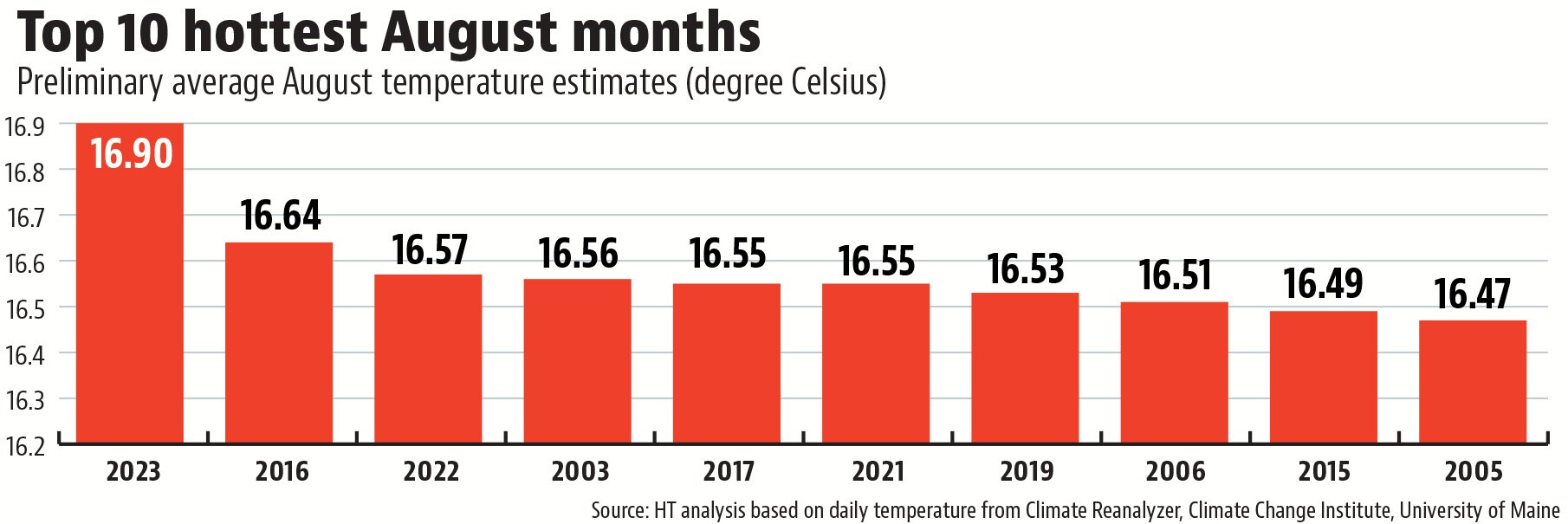
 August 2023 will be the third consecutive hottest monthLong-term data on observed temperature is generally available as monthly averages. An HT analysis of these numbers up to July showed that June and July 2023 were the warmest respective months since 1880, the earliest period for which data is available. While August’s average temperature will only be released in the middle of September, preliminary estimates – these are based on daily observations for some regions and forecasts for others – suggest that August 2023 is also likely to end up as the warmest August ever. This means that 2023 is on course for being the warmest recorded year on the planet, as was explained in HT on August 21.
- Sea surface temperatures in 2023 are the highest ever for every month since AprilWhat is commonly understood as temperature is the temperature of the air two metres above the surface, irrespective of whether the surface is land or water. However, it is important to track sea surface temperatures (SST) separately as well. This is not just a technicality. Warming of the ocean surface affects how water circulates from deep sea to surface, which in turn affects nutrients available to marine ecosystems and the people dependent on them. SST also impacts rainfall. For example, part of the reason for high SSTs this year is the cyclical warming of the equatorial Pacific Ocean called El Nino, which is also the immediate reason for India’s dry monsoon. An HT analysis of data from the Extended Reconstructed Sea Surface Temperature, or ERSST, dataset shows that 2023 is the hottest recorded year since 1854 (the earliest year for which data is available). While a cyclical pattern in SSTs is well-established – this is what leads to the El Nino and La Nina cycles – the fact that the top 10 warmest SST years are all from the 21st century means that the climate crisis has a role to play here as well.
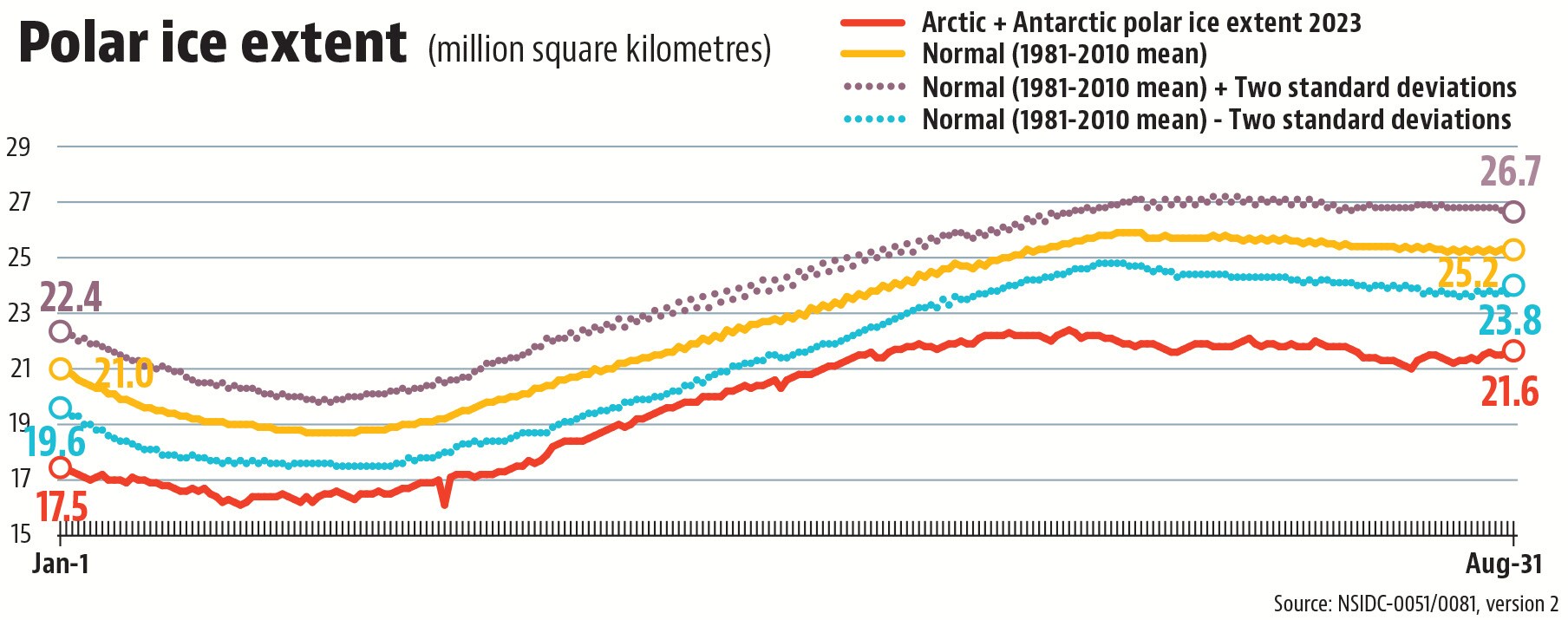
- The way 2023 has broken all past records this year is also counter-intuitive. It is natural to expect that a very warm summer at the north pole (which roughly coincides with the winter at the south pole) has melted a lot of Arctic sea ice. However, that is not the case. The extent of ice at the north pole has been the lowest this year on only nine days so far. It is a very warm winter at the south pole – ice extent here was the lowest this year on 214 days – that appears to be driving the trend in polar ice so far this year.