
 E-Paper



‘Trekked 2 km, only 1 stretcher’: How terrain made retrieving bodies difficult after Jharkhand plane crash
Ramesh Kumar, Second in Command of SSB, said that they had just one stretcher which they brought with them on which they carried the bodies.


After all seven people on board an air ambulance enroute from Ranchi to Delhi died after it crashed in Jharkhand's Chatra district on Monday night, a challenge lied ahead for the rescue teams to retrieve the bodies as the terrain in the area made it difficult.
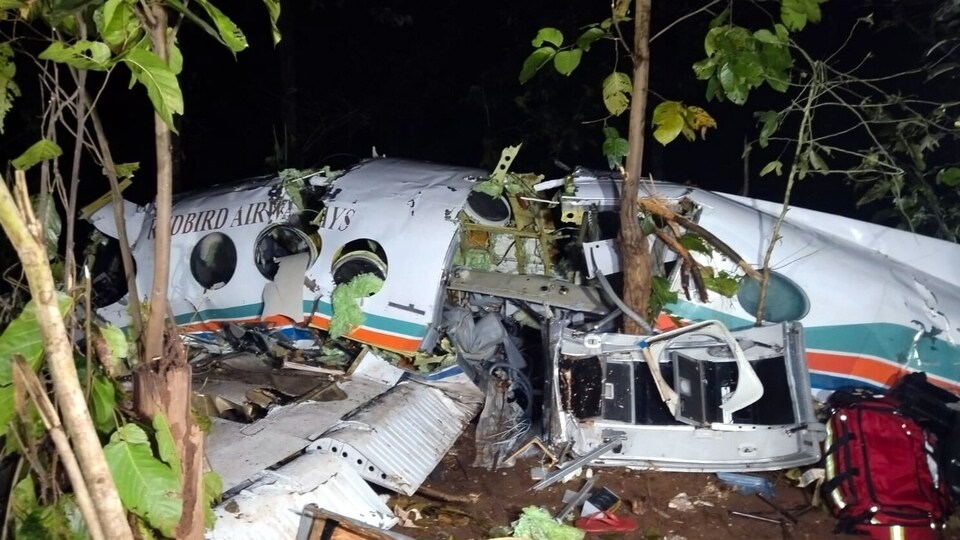
According to Ramesh Kumar, Second in Command of SSB, they received the information about the plane crash last night but had to trek for several kilometers to reach the crash site and retrieve the bodies.
Kumar, from the crash site, said that there was no road for at least two kilometeres there and ahead of there, there's a trek of around 5 kilometers. He said that by the time his team and he reached the crash site, they found no one alive there and that it was “very difficult” to retrieve and carry the bodies.
Also read: Father of doctor who died in Jharkhand plane crash breaks down on camera: 'Sold farm to educate him'
“We received information that a plane had crashed...This area is quite inland...There's no road at all for two kilometres and beyond that, there is a trek of around 5 k that one has to cross...When we arrived here at night, we saw that no one was found alive,” Kumar said.
‘Bodies entangled with crashed plane’
The difficult terrain to reach the crash site was not the only challenged faced by the SSB team. While detailing how they carried out the rescue op and retrieved the bodies, Kumar said that it was very difficult as bodies were “entangled” with the plane's metal frame.
Also read: What led to Ranchi-Delhi air ambulance crash? Officials reveal possible cause
He also said that they had just one stretcher which they brought with them on which they carried the bodies.
“The bodies were retrieved...It was very difficult to retrieve the bodies, they were entangled with plane's metal body. We had to carry them from here for two kilometres on one side. We only had one stretcher. We had brought a stretcher from the SSB with us at night, and with that, we carried out the rescue and retrieved the bodies,” he said.
To take the bodies out, the rescue team had to carry them on the stretcher on the difficult terrain for two kilometres before they reached the main road.
Also read: Takeoff at 7:11 pm, contact lost 23 minutes later: Jharkhand plane crash timeline and what we know
“It was a two-kilometre stretch up to the main road... We retrieved all seven bodies...The plane crashed in the middle of the jungle...It's difficult for a person to walk alone here, and this is part of a deep interior forest with a lot of bushes. Moving and rescuing people at night was certainly challenging,” Kumar said.
Plane was expected to reach Delhi by 10 pm
The plane, Beechcraft C90 operated by Delhi-based Redbird Airways, had taken off from Ranchi's Birsa Munda Airport at 7:11 PM, according to a statement by aviation regulator DGCA. Later, it established contact with Kolkata at 7:34 PM before losing communication and radar contact with Kolkata at around 100 NM South-East of Varanasi, HT reported earlier.
Shortly after, it crashed in the middle of the the forest near Simaria.
The plane was carrying a burn victim from Ranchi to New Delhi and was expected to land in the national capital at around 10 pm.
Among the people on board the plane were the burn victim Sanjay Kumar, Dr Vikas Kumar Gupta , paramedic Sachin Kumar Mishra, two attendants Archana Devi and Dhuru Kumar, and two crew members Vivek Vikas Bhagat and Savrajdeep Singh, both captains.


