
 E-Paper



UK considered reconciling with 'traitor' Subhas Chandra Bose in 1993
Newly released classified documents at the National Archives show the occasion was considered appropriate to reconcile with Bose in the way the British had with others who rebelled in former colonies.


To the British, iconic leader Subhas Chandra Bose was an “enemy” and “traitor”, but Downing Street considered reconciling with his legacy in 1993 during the India visit of then prime minister John Major, who was the chief guest at the Republic Day celebrations.
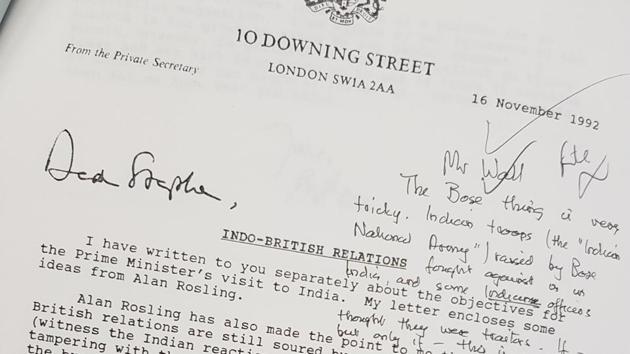
Newly released classified documents at the National Archives show the occasion was considered appropriate to reconcile with Bose in the way the British had with others who rebelled in former colonies, such as Aung San in Myanmar and Nelson Mandela in South Africa.
Major visited New Delhi in January 1993, when India was dealing with the aftermath of the Babri mosque demolition at Ayodhya on December 6, 1992. He was the first British premier to be invited as the chief guest since 1947 and the visit was seen as the West showing confidence in post-Ayodhya India.
Proposing the gesture of reconciliation during the visit, Alan Rosling, special advisor in Downing Street, wrote to Rodric Braithwaite, Major’s foreign policy advisor: “(Prime Minister PV Narasimha) Rao has gone out his way to resurrect Bose as a figure to counterbalance the Nehru mantle.
“We are quite happy to rehabilitate other ex-colonial leaders who fought us. Aung San had a comparable career to Bose but that is forgotten. Mr Mandela is forgiven his armed struggle…(My) experience of India is that such a gesture would be welcomed as closing an uneasy chapter in Indo-British relations.”
The idea was that Major could “capture massive publicity and goodwill” in India by signalling the reconciliation with Bose, whose Indian National Army aligned with the Japanese and fought British forces in Myanmar and the northeast during World War 2.
The proposal, however, was opposed by Foreign Office officials, including the then British envoy to India, Nicholas Fenn, who “strongly” advised against the attempt at “retrospective reconciliation with Bose, a controversial figure in Indian history”.
JS Smith of the Foreign Office wrote: “A move to rehabilitate Bose…would be likely to provoke protests in Britain of the kind that dog our relations with Japan and be met with more bafflement than enthusiasm in India.”
An official identified only as “RP” wrote to JS Wall, private secretary in Downing Street, in a letter dated November 16, 1992: “The Bose thing is very tricky. Indian troops (the ‘Indian National Army’) raised by Bose fought against us in India and some…thought they were traitors. If – but only if – this is no longer true would this be doable.”
Major, chosen as the chief guest at the Republic Day event as a gesture of thanks for signing the India-UK extradition treaty in 1992 and his pro-India remarks on the Kashmir issue, did not signal any revision of the British view of Bose as a “traitor” during the visit.


