
 E-Paper



‘No tears left’: A family in Gaya grapples for answers after revenge killings
Maoism in Bihar started in the late sixties, but was at its peak in the eighties and the nineties when a number of violent incidents occurred in central and south Bihar and their tussle with the upper caste landlords was common


Sobha Kumari, 15, looks dazed, her expression stony faced. There are no tears anymore. They have run dry. For the past five days, Sobha has lived with her aunt in the village of Chanchal Goriya, as she had to leave after threats from the Maoists, around two kms away. Yet, in her mind she is right there. She can still hear her own screams as she was locked inside a neighbour’s home. The sound of her home being blown up by an IED still reverberates in her ears. And she can still see the bodies of her father, mother, uncle and aunt, hanging outside her home, in one of the first Maoist killings of this nature in Gaya in the last six years.
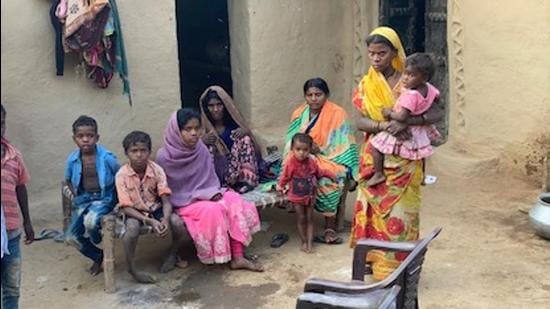
She does not remember exactly what time it was, except that it was the night of November 13. There were 10 persons in the six-room house, and as usual the family was preparing dinner at the time. Sobha remembers a sudden melee, and at least 12-15 men entering her home. They wore clothes that looked like dark battle fatigues and spoke in loud, irate, abusive voices. She heard the date March 17 often, and they asked her father and her uncle why they had informed on the Maoists, but listened to no answers. “They tied the hands of my father, Satyendra Bhokta, mother Manorama Bhokta, uncle Mahendra Bhokta and aunt Sunita Devi, and took the others to an adjacent house, and bolted it from outside. After that, we heard their screams and then the screams stopped. We don’t know why they killed them all. All the bodies were hanging outside the house,” she said.
Three days later when HT reached the village, there was little evidence that there was life that once existed in the Bhoktas’ home, and indeed in the village. The smell of smoke still hung in the air, and just outside the charred home were leaves of plants and trees that had wilted in the fire. Inside, in the black mulch were destroyed utensils, boxes, and furniture. One hen frantically walked through the debris, stepping through the remnants of the explosives, packed in can-like containers. Even the home where Sobha was locked in, was completely deserted, its occupants too afraid to come home.
The family and the terrain
Satyendra Bhokta was a farmer, as were the rest of his family, cultivating paddy in their one acre of land. In Monbar now, a little distance away from their home, their paddy crop now stands, and Sobha remembers her father was happy that there was a good harvest this year. But a Maoist diktat that forbade them from cultivating the crop, on the day they struck, now means that the fields lie untouched. The ramifications of resistance are now clear. Sobha, an intermediate student, said that she had always wanted to be a teacher. “I have taken arts in intermediate. I am a first-year student after having cleared matriculation from a local school with second division. But now I don’t know. We don’t even have clothes to wear, as everything was burnt with the house. All my books, copies, certificates, and uniform are now ash,” she says, as her three infant brothers stand close by.
Unlike the popular caricature of Bihar as a crowded urban jungle, loud and chaotic, Munbar is quiet, along the foothills in Gaya. Trees abound and small streams intersperse the mud roads that leads to Munbar. But this brings with it a set of unique problems. Around eight kms away is the Dumaria market, with its well-connected roads, cement homes and functioning telephone network. Munbar though, six to seven kms away from the closest black tarred road, has around 35-40 homes with a population of around 200 people. The homes are made of mud and thatch, and are scattered, far away from each other. The residents are mostly from the Bhokta community, counted among scheduled castes. Agriculture is the only means of sustenance, and most still live on subsistence. Electricity only arrived a year ago, but a road still hasn’t and there is no mobile connectivity.
Parves Singh Bhokta and Balak Singh Bhokta, sitting in a field with their goats grazing nearby, said the incident had created a lot of fear, but there was no escape. “Where can we go? It is not easy. We never expected that such an incident will happen,” they said.
There is no telephone connectivity, perhaps why the police only found out about the killings the next morning, and why there has still been no help from the administration thus far. “Had they known, the police would still not have moved at night,” said a villager, indicating the fear that exists from a combination of the geography and the presence of Maoists.
Though there are panchayat elections due on November 24, and Dumaria is abuzz with the criss-crossing of campaign vehicles, nobody comes to Monbar. “Who will come here?” asks Amrita Devi.
The revenge killings
On the night of November 13, the Bhoktas that survived to tell the story say that the Maoists made it clear that this was a revenge killing, and they suspected that the family had informed on their cadres. On March 17 this year, personnel of the CoBRA, the CRPF’s specialised unit, and the Bihar police launched a special operation in Monbar. In the encounter, four alleged Maoists were killed, and three AK-47s, and one INSAS rifle were recovered. It was said to be a big success for the CoBRA, as the four Maoists were said to be of the ranks of zonal commander and sub-zonal commander of the Magadh zone of the CPI (Maoist). They were identified as Amresh Singh Bhokta, Shivpujan Yadav, Sita Bhuiyan and Uday Paswan. Police said they faced several cases of crime, including extortion, attempt to murder and those under the Arms Act.
However, this big reverse for the Maoists sowed the seeds of revenge. They believed that the family had informed on them, and that was the only way the forces would have known exactly where to find them.
Suraj Singh Bhokta’s eyes well up as he narrates the story, having lost both of his sons. Now having to provide for both his sons’ families, when HT met him, Bhokta was carrying a polythene bag with food and some old clothes, given to him by a benefactor. He does not deny that the Maoists had come to his home in March, just that he had no inkling that they would, and that they had informed on nobody. “If someone comes to your house, what would you do? In March, a relative, Samod Singh Bhokta, a resident of the neighbouring Kokana village, came with some Maoists at night. My sons had no idea who they were. They had food and we thought they would leave. But they didn’t. Can anyone tell them to leave? They said they would go the next morning. In the meantime, CRPF personnel arrived and killed them in an encounter. Samod, who brought the Maoists to our house, vanished after that and we are paying a heavy price for that every day. Maoists also torched his house after they did not find Samod there. But the Maoists felt that we poisoned them and informed the police. Why would we?” he asked in a trembling voice.
Bhokta says that he has heard that the administration will provide help, but he does not know when. “They say the financial assistance will be sent to the bank account, but we don’t even have a passbook. Forget the passbook, there is nothing left in the house. Now only minor children and elderly grandparents are left. Only God will take care of the children, as our days are numbered too,” he says, wiping his tears.
Maoism in Bihar
The killings have shaken a government narrative of decreasing LWE (Left Wing Extremism) in Bihar, with the number of deaths, both in terms of civilians and security forces coming down consistently. Maoism in Bihar started in the late sixties, but was at its peak in the eighties and the nineties when a number of violent incidents occurred in central and south Bihar and their tussle with the upper caste landlords was common.
Most recently, however, government of India statistics show that LWE-related violence has been on the downswing in Bihar with the number of deaths, both civilians and security force personnel, coming down consistently. While the number of LWE-related deaths was 22 in 2017, they came down to 15 in 2018, to 17 in 2019 and to just two till August 15, 2020. The geographical influence of Maoists is also said to have reduced to just 41 districts in the country, as per MHA statistics released in September this year. It removed six Bihar districts from the list this year to bring the number of LWE-affected districts to just 10 in the state.
Gaya district, however, remains one of the ten districts and the Dumaria, the police station where Munbar is, still has remnants of the Maoists. The police station has one section of Bihar Special Armed Police (BSAP) and two sections of district armed police, beside five officers. Despite this, the Maoists chose their time, struck with ease, killed four, set fire to homes, and left with ease.
ADG (Operations) Sushil Kumar Khopde said that the Maoists were getting desperate due to their vanishing influence and were thus trying to “terrorise people”. “The government’s development and police actions had left few takers of their ideology,” he said.
Khopde said that the special task force (STF) has been carrying out regular operations against the Maoists in Gaya and Jamui, which has resulted in the killing of 10 Maoists since 2020 and arrest of 91 of them. “This included three carrying rewards on their heads, self-styled zonal commanders Ram Iqbal Mochi, Vishwanath Murmu and Bhargav Koda. STF also recovered 31 regular firearms, including AK47s, AK56s, 39 detonators and three hand grenades. Of the 31 recovered weapons, seven firearms were looted from the police,” he added.
Chakabandha hills on the Gaya-Aurangabad area bordering Jharkhand, where four alleged police informers were killed earlier this year, remain a challenge, as is the hilly terrain of Jamui, Lakhisarai and Munger. In November 2018, Maoists had kidnapped and killed a youth, Upendra Sao, at Sondaha village under Banke Bazaar police station on Diwali night on the suspicion of being a police informer. A group of Maoists picked him from the midst of a cultural programme and later his bullet-riddled body was found along with handwritten notes carrying warning messages.
The area legislator of the Imamganj assembly constituency where Monbar falls, is former chief minister Jitan Ram Manjhi. He admitted that the incident was a sequel to a lack of trust in both sides – the police as well as the Maoists – and poor villagers were becoming the pawns in the hands of both. “The CoBRA battalion elicited information from them to carry out the killing of four Maoists in March this year and left them unprotected once the mission was accomplished. The result was that the unsparing Maoists took revenge to send a stern message across. The poor villagers have been caught in the crossfire of the CRPF and the Maoists. If they don’t cooperate with the forces, they are branded sympathisers of the Maoists. And if they do, they come on the hit list of the extremists,” he added.
The former CM said that he would ensure that all the four victims got ₹11 lakh each – ₹4 lakh from the CM relief fund and ₹7 lakh as per the provisions under the SC/ST Atrocities (Prevention) Act. “I will also talk to the CM in this regard. They must be safely rehabilitated and given help. I have gathered that the Maoists had also gone to Kokana village in Chakrabandha area looking for another suspect, who had taken the Maoists to Monbar in March, but he was not there and they set his house on fire,” he said.


