
 E-Paper



Can India export ideas to the world?: A Wknd Independence Day special

 Prefer HTon Google


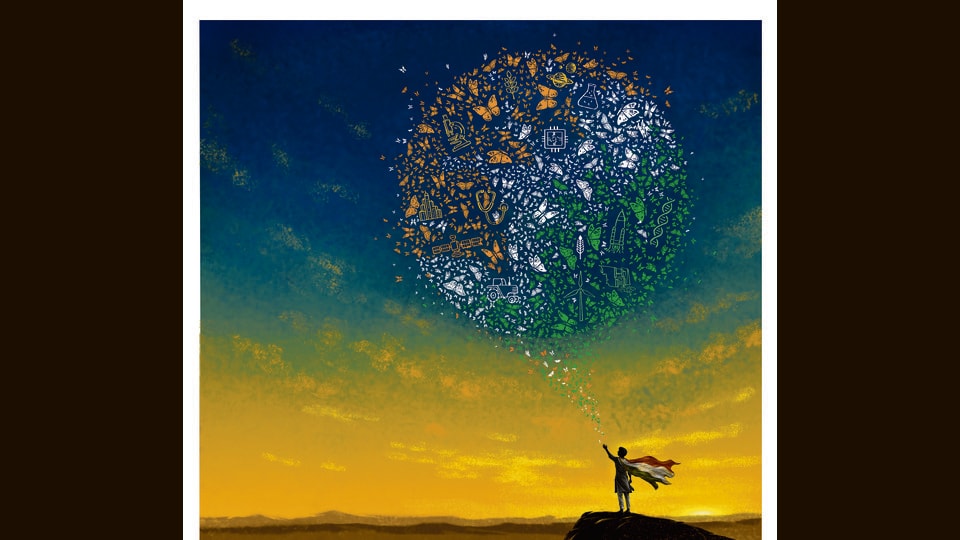
Some of the world’s most pressing issues have already been solved here, says Kashyap Kompella. See which ones he means, and what it will take to churn out more.
It’s time to think about who we want to be, as the world shape-shifts again.
We are currently makers, and doers.
India supplies the world with software engineers, doctors, CEOs and blue-collar workers; films, food, a spiritual vocabulary; medicines and affordable satellites.
At 79, it’s time for an intellectual leap.
Ask not what the world can do for India. Ask what India can imagine for the world.
Can this be the place ideas come from; and inspiration? Can we communicate those ideas so effectively that they travel the world?
To answer that, it helps to be clear about what makes an idea Indian, and what makes it export-ready. An idea is not Indian simply because an Indian thought of it. A text full of wisdom is not automatically a manual for the modern world.
What should we look for? I propose four simple filters.
First: Origin. Did Indian conditions actually shape the idea?
Second: Formulation. Can it be stated clearly enough that someone could encapsulate and adopt it; argue for and against it?
Third: Performance. Has it shown real value and quantifiable impact?
Fourth: Portability. Could a country or region outside India use it without a shared history or context?
UPI FOR ALL?
If we can agree on these filters, then a map of existing ideas begins to take shape.
UPI. Social security at scale. Affordable healthcare. (Admittedly all works in progress; but also schemes in operation.)
Let’s take UPI, because it didn’t exist before India thought it up.
Today, when we travel abroad, we cannot believe how much harder it is to use digital payment gateways. Platforms do not talk to each other. Servers falter or fail. Currencies cannot be converted.
Here at home, the Unified Payments Interface (UPI) unites a street vendor and a CEO. Any two people can swap money, no matter who they bank with or what app they choose.
This wasn’t a matter of technology and innovation alone. It was a matter of conviction.
India decided at the start that every payment app would have to talk to every other payment app operating in the country. It was the only way to ensure that the street vendor didn’t get left out; or the senior citizen; or the remote user with the nearest bank a day’s bus ride away.
The shared system underneath it all, sometimes called a common rail, operates like a public street. Everyone can use it — because the government built it to be so.
(Credit is due to the National Payments Corporation of India, Reserve Bank of India, and Nandan Nilekani, the architect of India’s public digital infrastructure.)
The government has since done the same for documents, with DigiLocker, allowing any Indian anywhere a uniform level of access to their government records.
This idea is all dressed up and ready to travel. Many of us have been to at least one country that could use it.
UNITY WITHOUT SAMENESS
Let’s pause now, and move in a whole new direction.
Infrastructure is vital, and underpins everything. But there is an idea we have — and have held on to — for centuries that could quite literally change the world.
India’s most important political idea may be this: a country can stay united even when most of its people have little else in common but that idea.
Many nations in the world are built on one language, story, faith or identity.
Few are built on the idea that we can be many, and still be one.
Reorganisation of states by language 70 years ago did not split the country apart, as many feared it might. Instead, we revel in our differences, enjoying each other’s cuisines and cultures, songs and stories.
How did this happen?
The freedom movement served as a reminder, and an act of coming together: many faiths, cultures and identities marching under one demand. Further back, our first war of independence in 1857 saw soldiers from different regions and religions rally around a Mughal, Bahadur Shah Zafar, as a shared symbol of self-rule.
The exportable idea is this: political unity does not require cultural sameness, but it does require institutions that let real differences find a fair political voice.
This matters for any country with many languages or many newcomers. It applies to many countries that were once made up of outsiders and newcomers, and have forgotten that this is so.
FAMILIES THAT STAY TOGETHER
The old joint family concept in its entirety is not the thing to export, I would argue, because it invariably rested on the forced, unacknowledged labour of women; and on unreasonable control over family members by those above them in the hierarchy.
The useful idea underneath is that we depend on each other. And we have largely found ways to still do that, while making room for greater individual choice.
Call it interdependence with wings.
In practice this means homes designed for both proximity and privacy, public support for people who care for relatives, legal protection for those whose dependence makes them weak.
This too is an idea primed for export, as aging populations around the world struggle with loneliness, and sandwiched adults juggle childcare and eldercare.
As India modernises, without fully surrendering to the nuclear family, perhaps countries struggling to navigate aging populations and slowing growth might admit that leaving home as a college student and barely looking back is not the only way to give youth its space.
LIVING WITHIN ONE’S MEANS
India has a rich language of restraint, repair, and enough.
Indians tend to live within their means; save; help families and communities in times of financial need; and aim to be free of debt at least halfway through their careers (rather than a few months after their death).
We tend to build prosperity around ideas of durable goods, shared services, lower waste.
How would this fit into the economies of countries that rely very differently on consumer spending and high levels of debt? That is an argument to be made. But the idea is ready for export — and it’s an idea the world dearly needs.
THE MISSING WORKSHOP
What’s an idea we can work on next? I’d say: the machinery that turns ideas and experiments into models worthy of emulation.
A teacher invents a method for a mixed classroom. A women’s group builds a reliable way to lend and repay. A man builds an artificial glacier; a woman runs a mobile health clinic. The formulas work, but often go unnoticed and undocumented.
India produces experiments faster than it produces explanations of them.
No one is deputed to seek them out, criticise, translate and scale them.
We aren’t alone in this. Most cultures under-invest in the dull work of writing up each experiment, testing it over and over, carrying it across contexts. Humanity tends to reward the grand, visible mission over the excellence of routine institutions.
Universities, journals, translators and honest critics are the missing workshop.
We haven’t figured out the currency and calculus of intellectual property, which is the lifeblood of the modern economy.
DOING THE MATH
This means we are losing ideas that could redraw our own future.
Somewhere out there could be new ways forward on recycling, groundwater recharge, the future of food. The next UPI.
This is a tragic loss, because we are far from done.
Our women are still too burdened; caste continues to rear its head and hold us all back. We have millions of struggling poor and seniors, differently abled and marginalised.
There is so much to be done that, drawing inspiration from Rabindranath Tagore’s Nobel Prize-winning Gitanjali (1910), I pray:
Where an idea is shaped by our soil, yet ready for any land;
where what we offer can be argued, tested, and still stand;
where we neither boast of wisdom unproven, nor bury the wisdom we hold –
into that heaven of honest thought, may our country awake.
(Kashyap Kompella is a CFA charterholder, tech industry analyst and author of three books on AI)
Also by Kashyap Kompella:
The path to Inevitable India: A Wknd Independence Day special
Networks issues: Who we trust as Indians, and why that matters


