
 E-Paper



Libyan family opens first modern art museum in Tripoli showcasing works of late artist Ali Gana

 Prefer HTon Google


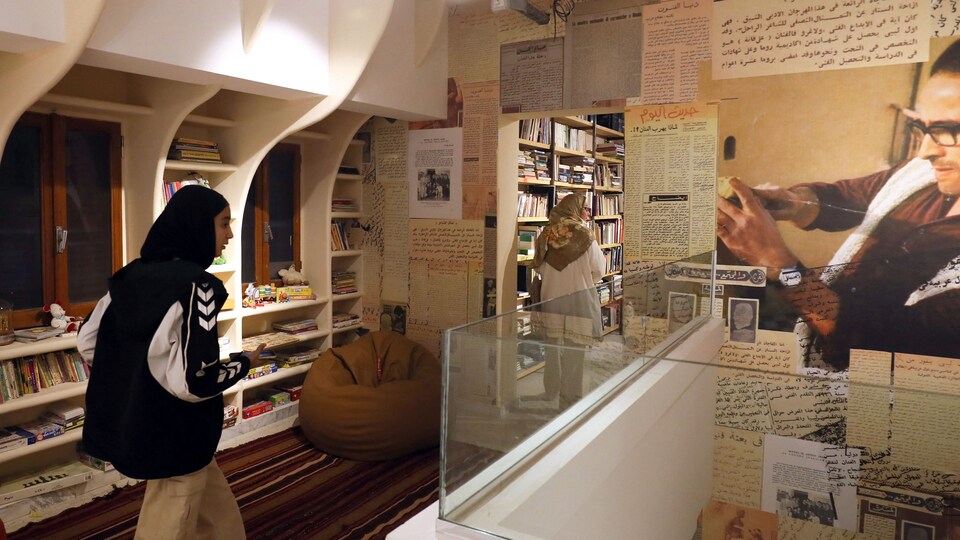
In Tripoli, a villa has become Bayt Ali Gana, Libya's first modern art museum, created by Hadia Gana to honour her father, the late artist Ali Gana.
A seemingly ordinary villa in the heart of Tripoli holds a lifetime of works by the late Libyan artist Ali Gana, whose family has turned his house into a unique museum. In the North African country still grappling with divisions and conflict after the fall of longtime dictator Moamer Kadhafi in 2011, "art comes last", said Hadia Gana, the youngest of the artist's four children. A decade in the making and with the help of volunteers, she had transformed the classic-style Tripolitan villa her father had built, before passing in 2006 at age 70, into "the first and only museum of modern art in Libya", Gana told AFP.
Bayt Ali Gana ("Ali Gana's House" in Arabic) finally opened this year, and seeks to offer both retrospection and hope in a country constantly threatened by violence and where arts and culture stand largely neglected. "It is seen as something superfluous," Gana said, adding that galleries in the war-torn country often focus solely on selling pieces rather than making art more accessible.
Once past a lush garden, visitors reach the museum's permanent exhibition of paintings, sculptures and sketches by the masterful Ali Gana. Other rooms include temporary exhibitions, and offer space for seminars and themed workshops. Set on a wall, an old shipping container houses an artist residency for "curators and museologists" whose skills are scarce in Libya, said Hadia Gana.
‘Losing everything’
Libyan artists had long been subject to censorship and self-censorship under Kadhafi's four-decade rule, and "we couldn't express ourselves on politics", recalled Gana, 50, a ceramic artist. Art "must not have barriers", she said, proudly standing in the family-owned space for artistic freedom. Bayt Ali Gana appears timeless, though the villa bears some signs of the unrest that followed the overthrow and death of Kadhafi.
A road sign riddled with bullets hangs from the gate that separates the museum from the private residence. Mortar shells turned upside down sit among flowers in the garden, where visitors are offered cold drinks or Italian espressos in a setting that replicates Cafe Said, once owned by Ali Gana's father in the old medina of Tripoli.
During the unrest that began in 2011, Hadia Gana said she feared "losing everything if a rocket hit the house". Then came the idea of creating a museum in the hopes of conserving her father's precious works and archives. Sporadic fighting, water or electricity cuts, and forced isolation due to the Covid pandemic have piled challenges on the family's mission, while the Ganas steered clear of state funding or investors to maintain the independence of their nascent institution.
‘Curiosity in all its beauty’
Gradually, the house morphed into a cultural centre celebrating Ali Gana's calling to "teach and educate through art", said his daughter. It "is not a mausoleum", but a hub of creativity and education, she said. Gana's archives also document traditional crafts and trades, some of which have completely disappeared by now.
After taking power in a 1969 coup, Kadhafi had imposed a ban on all private enterprise, and "for 40 years, crafts became an outlawed activity", said the late artist's oldest son Mehdi, who now lives in the Netherlands. He told AFP that in his lifetime, Ali Gana took on a mission to "build archives in order to link Libya's past to a possible future".
It is "the nature of the family" to preserve and share knowledge, said matriarch Janine Rabiau-Gana, 84. Hadia Gana lamented that while museums should be educational spaces, "here in Libya, we don't have that notion yet". She said she wanted to avoid “making it a museum where everything is transfixed”. Instead, "I wanted something lively, almost playful, and above all a place that arouses curiosity in all its beauty."


