
 E-Paper



Read an exclusive excerpt from Nuts & Bolts by Roma Agrawal

 Prefer HTon Google


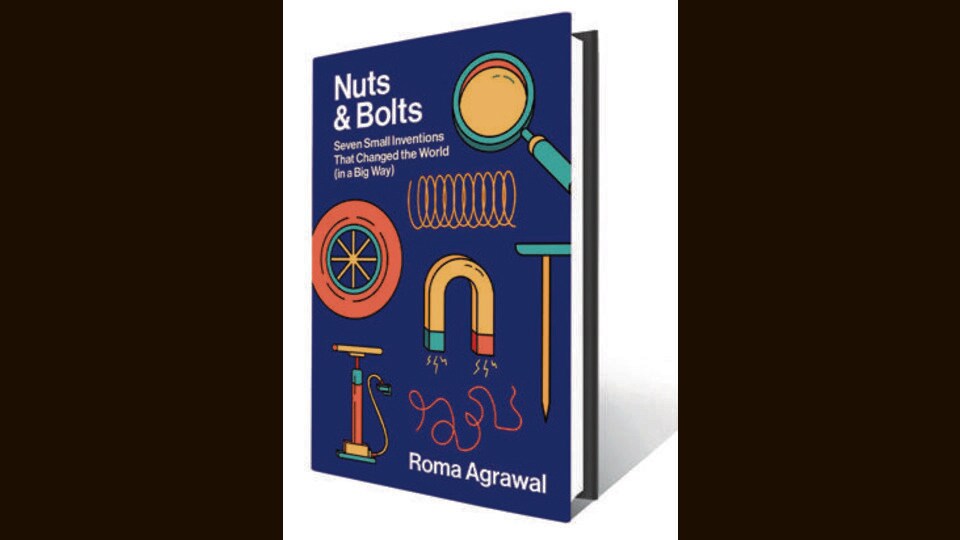
The structural engineer wants her curiosity, as a child and as an engineer, to be infectious. Her new book examines tiny building blocks of the man-made world.
Numerous severed crayons lay in disarray before me. I sighed. The results were disappointing.
I must have been about five years old, and was living with my parents and sister in snowy upstate New York. It was the 1980s, and I owned a huge collection of crayons: long, short, thick, thin, in every shade available. Like most children, I was continuously curious, and one day decided to ‘discover’ what was inside my crayons. So, I peeled off the paper that enveloped them, and snapped them in two. My great anticipation was rather dampened to find, well, just more crayon inside.
When I was a little older, I graduated to pens, dismantling these to reveal rather more exciting interiors. Far from the disappointing crayons of my early childhood, the insides of fountain pens and ballpoints contained slender cartridges and helical springs, held together with a top that threaded, screw-like, on to the rest of the pen.
In addition to taking things apart myself to satisfy my curiosity, I poked my nose in when others did it, too. Growing up in India, I saw my television taken apart when the picture ended up with black lines across it. The boggling innards only made sense of when I did a degree in physics. In fact, the reason I chose to study physics was because I wanted to understand the building blocks of our universe. Whether or not I understood it at the time, I was on a mission to understand what things were made from, and how they came to be.
Whether it’s the matter that makes our universe, living biological creatures, or the human-made objects we invented, complex compositions are made up of smaller and simpler, well, things. I have been lucky enough to carry my childhood curiosity about what makes up objects with me into my career.
As an engineer, I am endlessly fascinated by how our machines, buildings, and everyday objects came to be, and what lies at their heart – a fascination that, no doubt, many of you share.
Engineering is a vast discipline but some of its mightiest achievements have been small in scale. Inside all the humanmade things around us are fundamental building blocks without which our complex machinery wouldn’t exist. At first glance, they might seem uninteresting. Often small, and sometimes hidden, the truth is that each of these elements is an extraordinary feat of engineering with fascinating stories that go back hundreds, if not thousands, of years. During the Renaissance, scientists and engineers defined six ‘simple machines’, described as being the basis of all complex machines. These were the lever, the wheel and axle, the pulley, the inclined plane, the wedge and the screw. But today, those six feel outdated and insufficient. So, I got rid of a few and added some others to showcase seven elements that I believe form the basis of the modern world. They encompass a vast range of innovations in terms of their underlying scientific principles, the fields of engineering they touch, and the scale of objects they have enabled.
Each of the seven objects I’ve selected – the nail, the wheel, the spring, the magnet, the lens, string and the pump – are wonders of design that went through many different iterations and forms. They have endured ever since their first appearance. As they evolved, as they were combined in different permutations, the complexity of the machines we could make escalated in a cascading butterfly effect of invention and innovation.
Every single one of these objects has touched us individually, and made an indelible mark on our world; without them, our lives would be unrecognisable. They have created and changed our technology, of course, but have also had a sweeping impact on our history, society, political and power structures, biology, communication, transportation, arts, and culture. The invention or discovery of each involved a process of failure and iteration: of having a need, then trying out different materials, shapes, and forms, until something worked. Sometimes we use the same technology for centuries before we suddenly invent a new material or process, and realise that we need to adapt existing technology to suit. Other times, it’s the other way around. Some of these inventions developed independently in different parts of the globe with very similar designs, like the wheel, but others, like the pump, looked very different. And so, these inventions were born, then changed and evolved in their own ways, often going on to have unexpected applications and implications far beyond their original purpose.
While we think of engineering as a field littered with inanimate objects and complex pieces of technology that often feel alien or beyond our understanding, at the heart of engineering is people: those who create it, those who need and use it, those who sometimes inadvertently make a contribution to it. They are the seamstress in Delaware worrying about Neil Armstrong’s gusset holding, the doctor who passed electrical current through his hands, the shop-owner who studied his sperm under a microscope, and the poorly recipient of a pig’s heart. They are the Indian polymath who directed radio waves through the body of an important governor, the immigrant chemist who thought she’d made an error but invented something incredible, the Islamic scholar who changed the way we see, and the housewife who got frustrated with broken china.
In Nuts and Bolts, I will show you that engineering is the meeting of science, design, and history. It’s about human need and creativity, about finding problems and creating solutions to them in ways that haven’t been attempted before. It’s about trying to make our lives better, but knowing that, conversely, our inventions can have a devastating impact on society when not used responsibly. I will show you how engineering at its most fundamental is inextricably linked to your everyday life, and to humanity. My hope is that I will reignite your childhood curiosity, and inspire you to investigate the increasingly complicated black box of engineering, in order to understand the building blocks of our world a little bit better.
(Excerpted with permission from Nuts & Bolts: Seven Small Inventions that Changed the World (In a Big Way) by Roma Agrawal, published by Hodder & Stoughton; 2023)


