
 E-Paper



Inside Kerala's Indian Coffee House that looks like a giant red cake: No windows, no stairs, just a cool brick spiral

 Prefer HTon Google


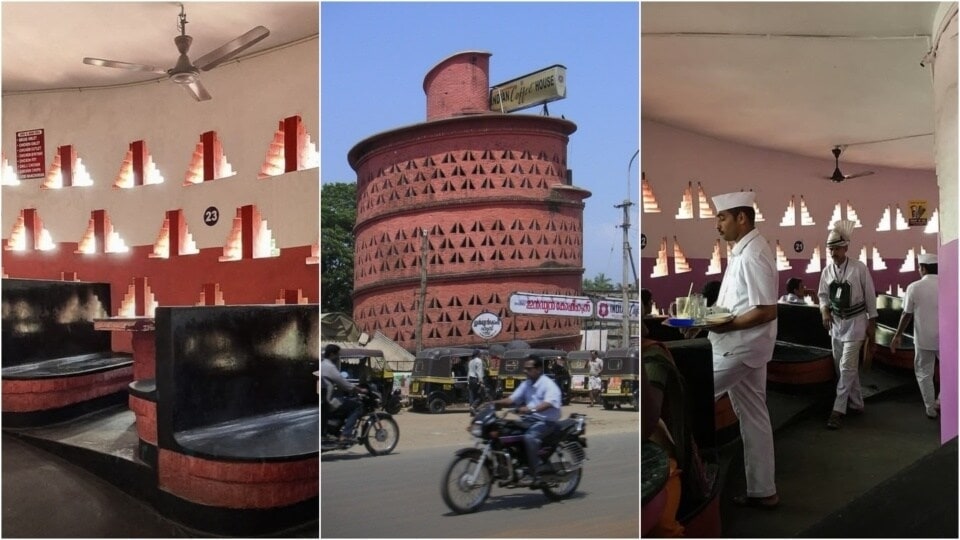
Forget cafes — Thiruvananthapuram's Indian Coffee House is one giant red brick spiral. Jaali walls, built-in booths, zero AC and still cool inside. Take a tour.
In the heart of Thiruvananthapuram, where frantic traffic meets the daily rush of commuters, stands a cylindrical red-brick tower that reimagines what a public space can be. Built in the 1950s, this Indian Coffee House (ICH) turns a routine filter coffee-and-cutlet stop into an architectural experience. Also read | Step inside 'world’s largest cafe' in Bengaluru spread across 90,000 square foot with a unique south Indian temple theme
Outside: the red cylinder everyone clicks
The landmark drew renewed attention after an August 21 post from the Instagram handle Somewhere India, which showed how the structure turns a simple restaurant into a continuous, ascending spiral. Commissioned by the Coffee Board on a tight urban plot, it was designed by Laurie Baker, the British-born Indian architect known for low-cost, climate-responsive buildings.
Instead of conventional floors and staircases, he created a gently rising ramp that wraps around a central core. Visitors walk up the slope to built-in stone tables and benches hugging the outer wall, eliminating the need for loose furniture. The tower tapers slightly as it rises, a practical trick to keep it stable.
Inside: black stone benches and numbered nooks
The exterior you see from the road is a deep-red, unplastered brick cylinder punctured by hundreds of triangular jaalis. The pattern isn’t decorative alone — the gaps become the windows, ventilation and light. Also read | Brewed with nostalgia: Photo exhibition celebrates the appeal of the Indian Coffee House
Inside, the decor is starkly minimal and entirely built-in, just as Laurie Baker intended: continuous, curved banquettes in black stone with a red-brick base, set into the floor at different levels along the ramp. Small, round-topped tables are fixed between them. No movable chairs at all. The lower half of the walls is exposed red brick (or mauve), while the upper half is painted off-white, making the brick lattice pop.
Light and shadow courtesy of jaalis
Light from the jaalis, or triangular openings, casts patterned shadows inside during the day. Each nook is numbered, and ceiling fans hang low from the curved white ceiling. It is bare, functional and cool without any AC — the jaalis do all the work. The floor itself is the polished ramp, so you are always on a gentle incline. Waiters in crisp all-white uniforms and distinctive pleated turbans and topis carry steel trays up and down the slope, preserving the old ICH dress code.
While Laurie Baker reportedly envisioned a self-service system — grab food on the ground floor and find a spot along the ramp — the cafe adapted to traditional table service. Decades later, the red-brick spiral proves that functional, eco-conscious design need not be confined to luxury resorts or museums. It can serve as a place for everyday people to meet over a cup of coffee.
Note to readers: This report is based on user-generated content from social media. HT.com has not independently verified the claims and does not endorse them.
This article is for informational purposes only.


