
 E-Paper



Step inside Zetu Delhi's first Sri Lankan restaurant, where architecture and art come alive under 525-year-old banyan tree

 Prefer HTon Google


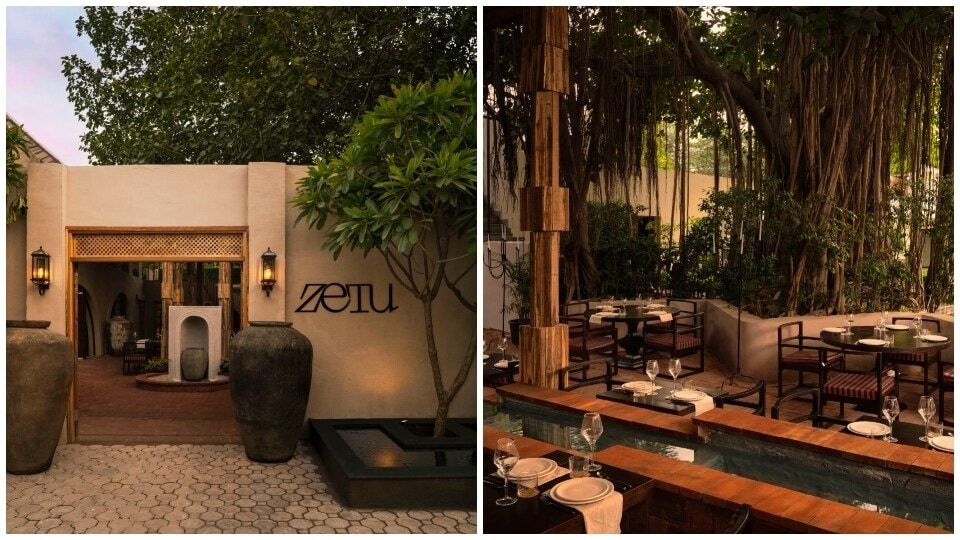
Zetu focuses on creating a serene dining experience under a 525-year-old banyan tree, blending Sri Lankan cuisine with a stunning ambience.
In August, the high commissioner of India to Sri Lanka, Santosh Jha, visited Delhi’s first Sri Lankan restaurant and talked about savouring the flavours of the neighbouring nation right in the middle of the capital. He posted his experience on X, which piqued our interest and led us to Zetu.
Zetu is a 175-seater restaurant at 1AQ in Mehrauli, New Delhi, co-founded by Sarah Nikahetiya, Anurag Dania, and Abhishek Mathur, with a focus on introducing contemporary Sri Lankan cuisine to the capital. As for the interiors, it draws on personal experiences and travels in Sri Lanka to create a haven in the heart of the capital.
In an exclusive interview with HT Lifestyle, the founders, Sarah and Anurag, talked about the conceptualisation of Zetu, their idea behind creating it, and more.
Inside Delhi’s first Sri Lankan restaurant Zetu
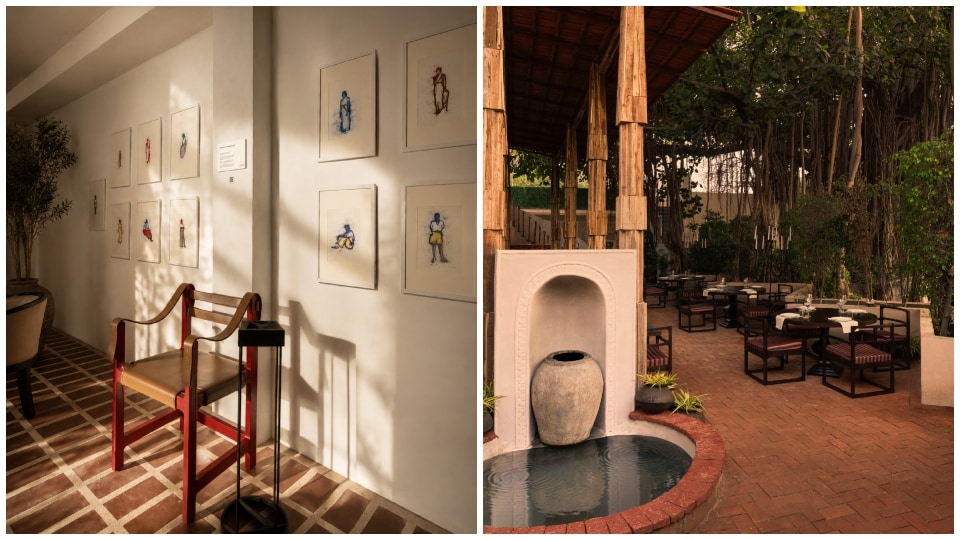
Beneath a sprawling 525-year-old banyan, with water running nearby and air moving through the courtyard, Zetu feels less like a building and more like a landscape. The architecture—brick, reclaimed wood, arches, pillars, and priceless artwork—forms a restrained backdrop that is present but deliberately quiet, allowing conversation to flow freely and organically.
It is all rooted in one place: Sri Lanka, but with certain beautiful touches of India, particularly Delhi. The design language perfectly captures memories of Kandy, Colombo, and Sri Lankan architecture filtered through the founders' experiences and reinterpreted for Zetu in Delhi.
A courtyard made for Delhi
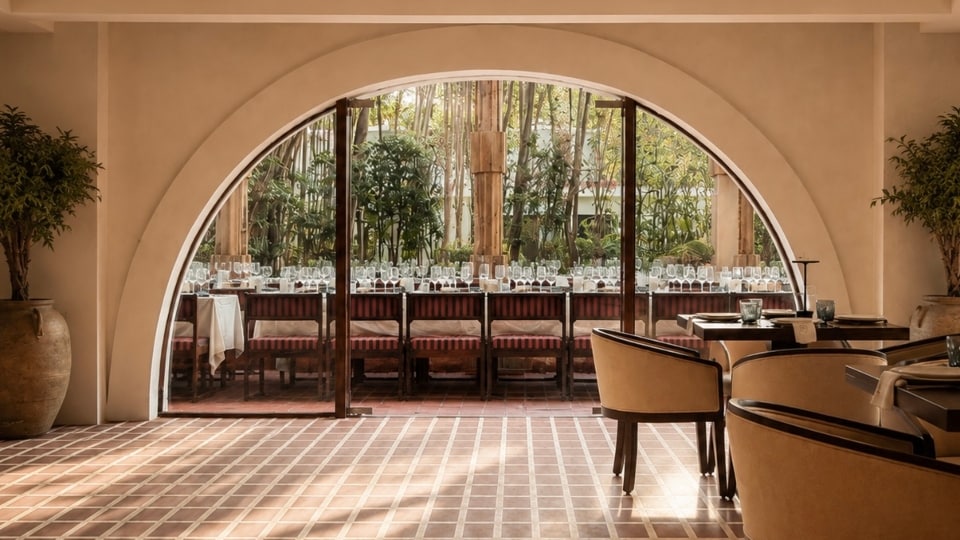
At Zetu, the experience begins right at the threshold. There are stunning arched doorways, layered borders, a sense of crossing a threshold, a courtyard with a 525-year-old banyan tree, flowing water, filtered light, natural air through the outdoor seating, and pillars inspired by Kandy. The highlight, however, is the way the landscape continues indoors.
Climate is an important part of Sri Lankan architecture. The courtyard, therefore, became central to the design. Anurag shared, “For Delhi, this also required an active approach to cooling. We introduced four water-based cooling units with HEPA filtration to create a more comfortable courtyard microclimate. The design target was approximately 26°C in the seating areas during extreme summer conditions.”
They also considered how air moves between the covered and uncovered sections, focusing on airflow that is directed through both sides of the courtyard, allowing warmer air to rise and escape through the open areas.
Inspiring details
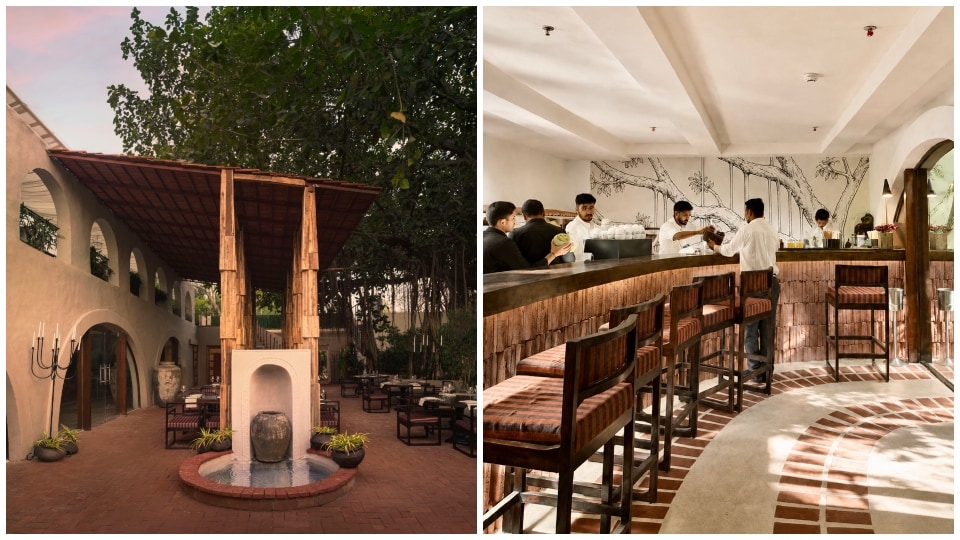
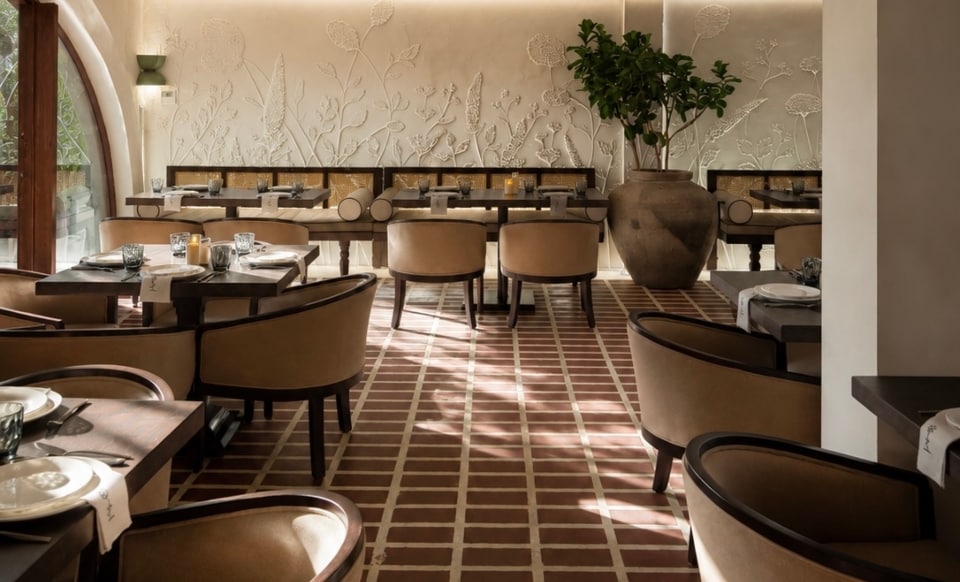
According to Anurag, the exposed brick, reclaimed wood, and locally crafted timber create continuity throughout the space, with repeated arches and pillars establishing a rhythm, while carved floral details, woven cane seat, Batik artwork, and planting add some texture. “For me, minimalism is about choosing a few materials and using them consistently. Each material has room to express its character without overpowering another,” he explained.
Zetu borrows less from Sri Lankan architecture, literally, than it does from its principles. From Kandyan architecture, it takes pillars, bas-relief, rhythm, and sequencing; from Sri Lanka, it takes a climate-responsive architecture like shade, airflow, courtyards, and filtered light; and from Sri Lankan craft, it adds batik, cane, timber, and handwork. To these inclusions, Sarah shared that they have given a touch of Delhi, adding a degree of whimsy and reinterpretation.
The Minnette de Silva, Bevis Bawa and Geoffrey Bawa influences
According to Sarah, one of the co-founders of Zetu, memories, landscapes, or spatial experiences from Sri Lanka became the starting point for the restaurant's architecture. She absorbed these spaces before she knew she would one day need them.
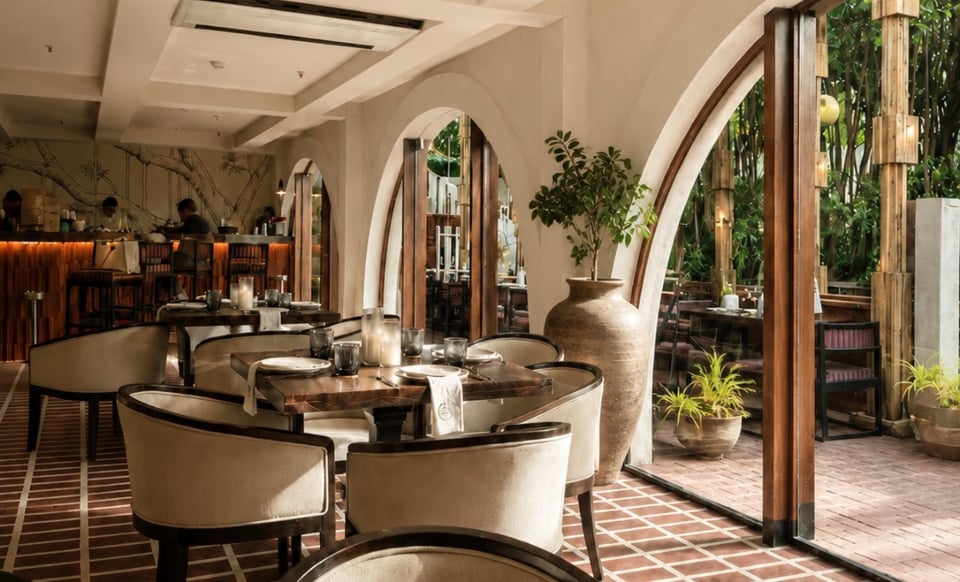
She told us that the idea most personal to her while designing Zetu was Geoffrey Bawa's (Sri Lanka's most celebrated architect) tropical modernism and the philosophy of “the indoor meeting the outdoor and things being very well ventilated but very naturally.” She was also inspired by the early pioneering work of Minnette de Silva, a Sri Lankan architect, who, according to her, is slightly overlooked. “Minnette did quite a few different buildings in Kandy—the simple lines, the restraint, and the geometry—and that provided somewhat of a blueprint for the later things to follow,” she told us.
Meanwhile, for Anurag, Zetu began with the relationship between architecture, materials and landscape in Sri Lanka. He told us, “Geoffrey Bawa’s approach to local materials was an important influence, particularly how simple materials could create spaces with symmetry, warmth, and a modern tropical sensibility.”
Some of the more personal references came from objects he had encountered at the Colombo National Museum: “The arches were inspired by an architectural sketch depicted on a Dutch box, and the entrance and furniture were inspired by the museum’s doorway displays and a carved royal seat.”
Additionally, Bevis Bawa’s approach encouraged Anurag to consider how local materials could establish proportion, symmetry, and atmosphere, leading them to adopt a limited palette throughout the restaurant, allowing repetition to create a sense of calm.
The artwork
In Zetu, one can find several brilliant artworks sourced from Sri Lankan artists. For instance, the works of Austrian-Sri Lankan artist Raki Nikahetiya, which explore nostalgia and memory or the Batik Sarong stretched over the canvas from the Lovebirds collection.
Sarah shared that, for her, the Batik Sarong was a perfect inclusion for Zetu because it's like taking a centuries-old craft that was brought to Sri Lanka from the Indonesian Islands and evolving at a similar pace. “It's a deep craft, one that takes a lot of time to develop,” she added.
The 525-year-old Banyan tree
The banyan tree has to be a defining presence at Zetu. Its scale and history give the whole setting a character. “We were particularly careful about lighting. The tree is deliberately dimly lit because it has its own natural rhythms. More illumination might create a stronger visual effect, but I wanted to limit unnecessary disturbance. For me, respecting the landscape includes knowing how much to leave alone,” Anurag told us.
What do they want diners to feel when they are at Zetu?
Sarah shared that she wants diners to feel like Zetu is a haven they can go to, full of nature, which is why they built the restaurant around the banyan tree, where diners can sit under. She adds, “It's restrained, not too busy, relaxing for the eyes, and a place to dine with running water. We were very careful with the acoustics as well. Essentially, with the music volume, we were keen to keep it very low to enable people to have conversations. It's encouraging people to put down their phones and to think, reflect, and absorb the experience they have gone through, to be present. That's the kind of feeling that we want people to go away with.”
Ultimately, Anurag says that he wants diners to feel comfortable, curious and connected to their surroundings when they come to Zetu. “There are details to discover, but the space should also allow you to relax. Light, airflow, temperature, texture and sound all contribute to how you experience the food and the people around you,” he adds.


