What are the Olympics like for a competing athlete?
For months in the lead-up, even the most gregarious retreat into a shell where nothing else exists. Many return from the Games not having attended a single event as spectator either.
What are the Olympics like for a competing athlete?
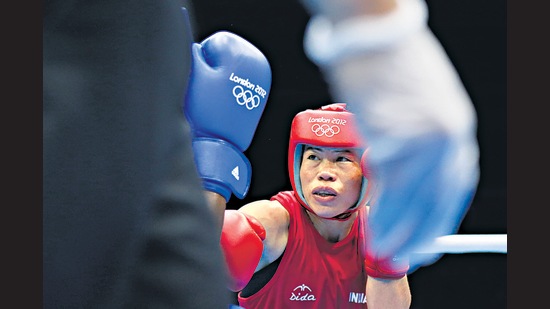
Mary Kom at the London Olympics in 2012. Training ahead of these Games, she barely spoke. “What will I talk about? I am just full of thoughts of how I’m going to beat up the person in front of me,” she said. (AFP via Getty Images)
It’s a fortnight of tuning out the outside world — blanking out noise, email, text messages, phone calls, unsolicited advice, fan talk, alien food, foreign music, other athletes, anything that might cause the slightest deviation in the mind. As long as the athlete is in competition, the Olympic Village is his or her prison.
Wrestler Sushil Kumar, India’s only two-time individual Olympic medallist, now in prison for alleged murder, once told me he’d seen nothing of the Olympics while competing in three editions. “I only know my room, the gym, the corridor outside the room or the running track nearby where I would run for hours wearing layers of clothes to lose weight, and the bright lights of the stadium,” he said.
He didn’t attend a single event. Didn’t see Michael Phelps swim or Usain Bolt run in Beijing or London. The only time he met Bolt, in 2012, was when the Jamaican was leaving the gym and Kumar was entering it. Of his final bout in London, in a stadium where the sound of the crowds was deafening and the lights blinding, Kumar remembers only the sticky sound of his and his opponent’s bodies slipping and sliding on the mat.
The process of tuning out the outside world begins much before the Games kick off. I’ve had the privilege of witnessing a few of our medal-winning athletes enter their pre-Olympic cocoon. I was in Abhinav Bindra’s sprawling mansion on the outskirts of Chandigarh, a couple of months before the 2012 London Games. India’s only individual Olympic gold medallist was in training at his private shooting range, a long and narrow room with white walls and a floor of pale wood. At one end, Bindra stood with his rifle. At the other was a glowing electronic target with an almost imperceptible black dot in the middle. There was a table in front of Bindra with three silent monitors, boxes of bullets, screwdrivers, Allen keys and other detritus of his craft stacked in neat rows. Everything about the room was inert, clinical.
Bindra acknowledged my presence more than five minutes after I entered, after he’d gone through the slow-motion sequence of steadying himself, homing in on the target and squeezing the trigger. He said “Sit down” in a faraway voice, made no eye contact, and then erased me from his mind for the next two hours, as he took shot after shot without a word.
“At the range, I’m in a very inward state of mind,” he told me later. “There’s a neurotic quality in it. I’m completely cut off. I don’t know if it spills over to my normal life… I’m not concerned about it.”
I was inside the boxing hall at the National Institute of Sports, Patiala, a few days later. It was abuzz with boxers at work, hitting pads and bags, sparring in the ring. Then Mary Kom entered and abruptly there was a hush. Everyone turned towards her. She nodded in acknowledgment and began taping her hands and putting her helmet and gloves on. She made no eye contact and spoke to no one except her trainer. Then for an hour she was in the ring, fighting in a frenzy. When it was over, she left without a word.
“I don’t like talking when I enter the gym,” she told me later. “Anyway, what will I talk about? I am just full of thoughts of how I’m going to beat up the person in front of me. Everyone’s an enemy at that time.”
Boxer Vijender Singh is a socially affable person and one of the few athletes I know who likes to talk and joke and play music when he’s training. But even he would start to withdraw into a shell as the Olympics approached.
Sometimes he would pretend to listen to what you were saying and then you would realise his eyes had glazed over and he was making intricate patterns in the air with his hands.
“What’s that you’re doing?”
“Oh, sorry,” he would break out of his trance with a smile. “I was just visualising a combination.”
“What kind of a state of mind do you like to be in before a bout at the Olympics?”
“Very quiet, very calm, as few thoughts as possible,” Singh told me before the London Games. “Then your mind starts to make decisions without you consciously having to think about them, and your body executes. That’s where you want to be.”

 E-Paper