E-Paper


Saffron flower blooms in Ladakh in record 30 days, nearly 22 grams harvested in just 4 days
An experimental saffron cultivation project in Ladakh has recorded its first bloom within 30 days of plantation, significantly ahead of the 2-month timeline.

 Prefer HTon Google


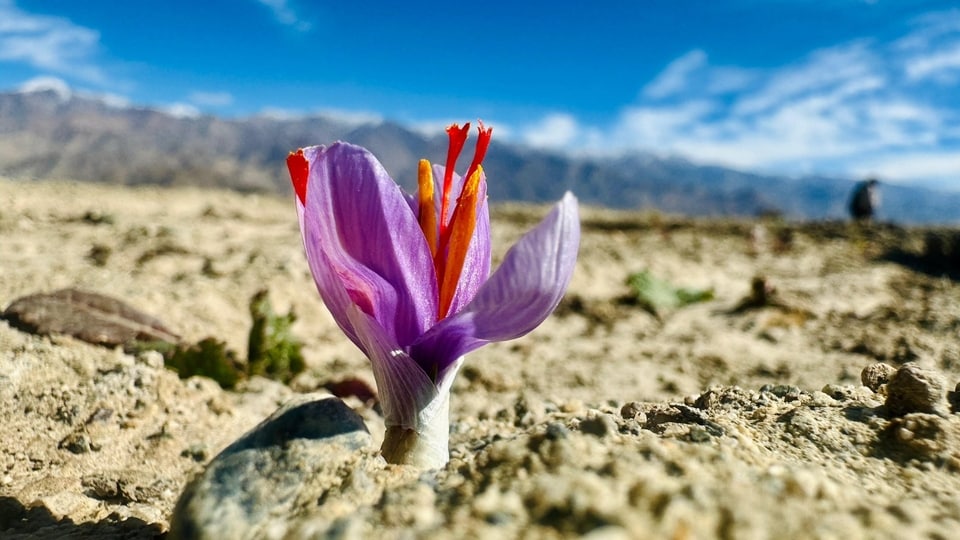
An experimental saffron cultivation project in Ladakh has recorded its first bloom within 30 days of plantation, significantly ahead of the usual two-month timeline. The pilot project, launched on recently restored degraded land in Leh, has also yielded nearly 22 grams of saffron in its first four days of flowering.
Ladakh Lieutenant Governor VK Saxena inspected the experimental saffron field on Sunday to witness the first bloom.
“Proud to announce that the experimental saffron cultivation, over recently restored degraded land in Leh, has begun to blossom, in a record-breaking 30 days, against the usual two-month timeline for the first bloom. Inspected the saffron field today to witness the first saffron bloom,” he later posted on X.
(Also read: Saffron cultivation gains interest among farmers and young entrepreneurs as high-value farming opportunities expand)
According to the Ladakh administration, the site is currently recording an average of 20 to 25 blooming flowers daily, with 72 flowers blooming on Monday morning alone.
90,000 saffron corms planted in Leh
The experimental project involves the cultivation of premium Iranian saffron over approximately 4,000 square metres of land. Nearly 800 kg of saffron corms, numbering around 90,000, were planted on October 1.
A saffron corm is an underground, bulb-like plant structure from which the saffron plant grows. It is used to propagate new saffron plants.
The land, which was previously barren, was restored and rejuvenated under Project Him Sarovar, an initiative undertaken under Saxena's guidance. The first flowers appeared in less than 30 days, against the approximately two months generally required for the first bloom.
Why is saffron being cultivated in Ladakh?
Saffron (kesar) is a high-value agricultural crop that commands premium prices in the market, making it a potentially lucrative source of additional income for farmers. In India, Jammu and Kashmir accounts for approximately 90% of the country's saffron production.
Real Kashmiri saffron starts at ₹300 per gram for retail buyers, but the cost can go much higher depending on the quality and variety of saffron.
The Ladakh administration is now exploring whether the crop can be successfully cultivated in the region's high-altitude climatic conditions and whether it could offer new economic opportunities to local farmers.
(Also read: Battling weather swings, Kashmir’s ‘red gold’ sees surge in output, profit)
The pilot project is part of broader efforts to diversify traditional agricultural practices and promote high-value cultivation in the Union Territory. The administration has previously experimented with floriculture, including large-scale cultivation of Lilium and Gladiolus in Leh, creating livelihood opportunities for farmers, self-help groups and local entrepreneurs.
LG VK Saxena on saffron cultivation
Calling the development a significant achievement, Saxena said the experiment demonstrated the potential of high-altitude farming in Ladakh and could pave the way for commercial-scale saffron production.
"This remarkable achievement is a powerful testament to the resilience of our environment and the immense, untapped potential of high-altitude farming in our region.
“This breakthrough lays a promising foundation for commercial-scale production, thereby, opening up new avenues for cultivation, agro-based entrepreneurship in Ladakh and paving the way for a stronger, thriving, self-reliant local economy.
“My deepest appreciation and congratulations to the Agriculture Department of UT Ladakh, our dedicated and hardworking field staff, for significantly contributing to the success of this pilot project,” Saxena wrote on X.