
 E-Paper



Inside BJP’s 2019 war room
The countdown to the 2019 general election has begun and all eyes are on the campaign, which is expected to be a notch higher in decibels, optics and substance.


On June 9, 2013, Narendra Modi was appointed chairperson of the campaign committee of the Bharatiya Janata Party (BJP) and tasked with steering the electoral battle against the Congress.
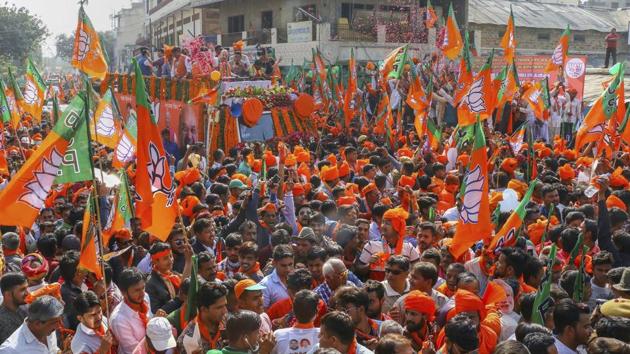
“On that very day, the campaign to wrest power began,” said a party functionary who has worked closely with Modi, and who asked not to be identified.
What followed was a high-octane campaign, planned with surgical precision, high on technology and innovation, but married to the traditional door-to-door canvassing that is the hallmark of the BJP and its ideological fount, the Rastriya Swayamsevak Sangh (RSS). Peppy slogans, catchy songs and an avalanche of advertising across platforms came next.
The countdown to the 2019 general election has begun and all eyes are on the campaign, which is expected to be a notch higher in decibels, optics and substance.
There’s one difference, though. In 2014, reams were written about the campaign and the strategy: how it was buttressed by the spin doctors at the party’s war room at its then headquarters in Delhi’s Ashoka Road; and how the message reached masses through offices at as many as 5,000 districts and through mobile phones and digital platforms. This time, there is a shroud of mystery on the operations so far.
Sure, some efforts have been launched and publicised, but these are largely in the form of support groups that drum up support for the Prime Minister online, such as ModiForPM, ModiOnceMore and IITiansforModi. Most of these have a mix of volunteers as well as party functionaries in an advisory capacity.
Also read: AIADMK hints at alliance with BJP for Lok Sabha polls
According to people who are part of the campaign strategy, some of whom were involved in the 2014 campaign as well, there are two aspects that stand out: several people who played a critical role are no longer part of the mammoth exercise; and the campaign itself has been tailored to fit the party’s changed position — from that of the opposition to the ruling party. None of these people wished to be identified.
“One big change this time is that the campaign in-charge is the party president, Amit Shah, who has his own style of functioning. He may borrow from the template that was set by Modi, or plan afresh, but so far, things are yet to take shape,” said the functionary cited above. Shah was involved in the campaign back then, but was not the party president at the time.
Recently, the party announced 17 committees under the leadership of senior leaders such as Arun Jaitley, Sushma Swaraj and Nitin Gadkari to prepare the manifesto, reach out to the beneficiaries and make contact with the electorate, but there is no clarity on who the backroom men and women anchoring the campaign will be.
The people involved in the campaign, as well as other functionaries, say that work is yet to pick up pace, but that the focus will clearly be on the achievements of the Modi government.
Also read: In poll season, Rahul Gandhi, 3 Congress CMs fly cattle class to Patna for rally
“The BJP is now on the defensive, it has to go all out to protect its record and present its credentials to the voters. So while the government will mount a blitzkrieg to advertise its achievements, the party will have to not only defend its positions against the allegations of the opposition, but will also have to go to people with an idea that will again pitch BJP as the only credible option,” a second party functionary, who was also part of the 2014 campaign, said on condition of anonymity.
Among the faces missing from the campaign this time are Prashant Kishor, Ajay Singh, Rajesh Jain, and Arvind Gupta.
Kishor hit the headlines after his Citizens for Accountable Governance (CAG) was credited for coming up with the hugely popular interaction, Chai Pe Charcha, and the Modi Hologram. The former was in response to a jibe by Congressman, Mani Shankar Aiyar, whose scurrilous comment about Modi being a chaiwallah set off a storm. He is now the vice president of the BJP ally, JDU, and according to those aware of the developments, is maintaining a distance from the campaign. “Even though he is with a party that is an ally, there is no contact on the strategy front,” said the second functionary.
Gupta, now the head of MyGov, a government-run platform for interaction between the citizens and the administration, was the key functionary who ran the IT cell.
It was under his charge that the party came up with technological intervention to bridge the gap between Modi and the electorate. A mobile or the humble radio, were used to relay the messages in the 160 Lok Sabha seats where elections were fought using digital technology and social media.
Jain, Gupta and Kishore declined comments.
Ajay Singh, the big boss of SpiceJet, has moved on too. Credited for coining the slogan “Abki Baar Modi Sarkar”, Singh was one of the core members of BJP’s campaign team and, according to those who worked with him in the past, “honed his skills under Pramod Mahajan, known for his dexterity in organisational tasks.” It is not known whether he will be on board.
Rajesh Jain and BG Mahesh, the brains behind Niti Central, a news and views website, and India-272, that was aimed at encouraging and persuading the youth to register as voters, and vote for the party.
The duo, key resources in galvanising support for Modi online, is also not part of the campaign so far.
“Both Jain and Mahesh strategised to bolster support through the digital outreach, since the young and media savvy were an important constituency that the party was trying to reach,” said a former team member, who has now been given a berth in one of the 17 committees.
Consultancy firms, marketing communications agencies, such as Madison, and advertising gurus, such as Piyush Pande and Prasoon Joshi, were also drafted for the high-voltage outreach in 2014.
That may happen again this time, although no announcements on that front have been made so far.
A BJP leader who asked not to be identified said not much should be read into the relatively subdued atmosphere at the party office. The second party functionary denied that there has been a decline in the number of volunteers signing up to be part of the campaign.
Political analyst, Sanjay Kumar, of the Centre for the Study of Developing Societies, said the buzz around the party’s campaign in 2014, which was marked by a high turnout of volunteers, could be attributed to the political situation, where the Congress’s “image was at an all time low and the sentiment was in the BJP’s favour”.
“Before 2014, people were very angry with the Congress; and many people wanted to campaign for Modi. What has changed is that the hype has gone down though Modi’s charm has not faded,” he said.


