
 E-Paper



Lok Sabha Elections 2019: Jobs, colleges, skill centres in wish list of Delhi’s youth
Delhi has around 11.2 lakh young voters, aged between 18 and 23 years, who will cast their votes in the national capital on May 12. Of these, 2.5 lakh are first-time voters.

 Prefer HTon Google


Politics is the flavour of the summer and Delhi’s youth are making sure their voices are not drowned out by the cacophony of electioneering. On May 12, around 11.2 lakh young voters, aged between 18 and 23 years, will cast their votes in the national capital and they are clear about their expectations — new undergraduate colleges, skill training centres and more employment opportunities.
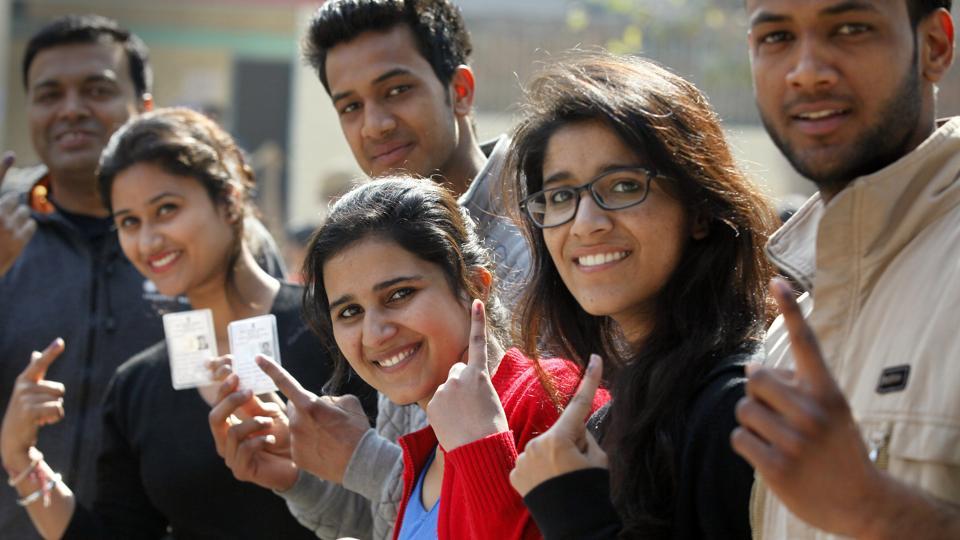
Of the 11.2 lakh, 2.5 lakh are first-time voters.
Pranav Singh, a first-time voter and an undergraduate student at Delhi University’s (DU) School of Open Learning (SOL), said he wanted to join a regular college. “I had scored 67% marks in class 12 that was not enough to get me admitted to a regular college. I had no option but to join the distance learning school. The competition might be less if there were more undergraduate colleges in the city,” the Mayur Vihar resident said.
In the last four months, students pursuing graduation through the SOL have held several protests demanding new colleges. “Ahead of every election, parties promise more colleges to accommodate all students in the regular stream. The Aam Aadmi Party (AAP) had also promised to build 20 colleges in Delhi but nothing has happened,” Dinesh Singh, a second-year student at SOL, said.
DU is the only central university in the capital that can affiliate colleges. Presently, it offers 56,000-odd undergraduate seats across 63 colleges, for which there are around 2.5 lakh aspirants every year. There are only two Delhi government-run universities in the city, of which only Guru Gobind Singh Indraprastha University affiliates colleges and that, too, technical ones.
Manoj Sinha, principal of Aryabhatt College, said no new college has been added to DU since 1997. “Over these years, the difference between demand and supply has widened enormously. There is an immediate need to open new colleges as the existing ones are saturated,” he said.
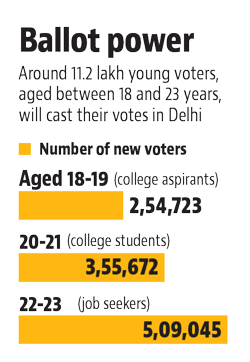
The voters, aged 22-23 years, said “lack of jobs” is their concern. “Ever after securing a seat in a DU college, there are not many employment options. Things are still better for those pursuing technical or professional courses. What about those who have done their graduation in humanities and are working as contractual teachers? There have been no appointments to permanent teaching posts in government schools,” Praveen Singh, a BA (honours) History student at Kirori Mal College, said.
Young voters residing in unauthorised pockets of the city are demanding “skill centres” in their neighbourhoods. Waseem Akhtar, 22, a resident of Seelampur, said, “Most youngsters in our area are school drop-outs. The government should provide some skill training centres to help us learn a livelihood,” Akhtar, who works in a small shoemaking unit, said.
The three major political parties in Delhi – the AAP, the Congress and the Bharatiya Janata Party (BJP) — are trying to woo these voters.
AAP’s East Delhi candidate Atishi, who worked as the former advisor to Delhi education minister, said her party is batting for “full statehood” to address the issue. The party, in its manifesto, has already promised 85% reservation for Delhi residents in all city colleges and government jobs. “With full statehood, we will be able to get a new university in Delhi wherein 85% seats will be reserved for Delhi students. If we attain a full statehood, we will also provide an additional 2 lakh government jobs to Delhiites,” she promised.
BJP’s Chandni Chowk candidate Harsh Vardhan said “youth are with the BJP this time”.
“If elected, we will bring in all youth-oriented schemes such as Make in India and Startup India to create employment opportunities for the youngsters here,” he said.
Rajesh Lilothia, the Congress candidate from North East Delhi, said his party is planning to build skill training centres across the city. “It’s very important to give students a platform to brush up their skills and make them job ready,” he said.


