
 E-Paper



Preserving folk music heritage of a western UP village
For ages people in western UP villages sang ‘Ladli do do chike dalan’ (our girl now has two houses) to celebrate their daughters’ marriage. But today, with the new generations busy in their world of gadgets, technology and instant entertainment, such songs are on the verge of being lost forever.


For ages people in western UP villages sang ‘Ladli do do chike dalan’ (our girl now has two houses) to celebrate their daughters’ marriage. But today, with the new generations busy in their world of gadgets, technology and instant entertainment, such songs are on the verge of being lost forever.
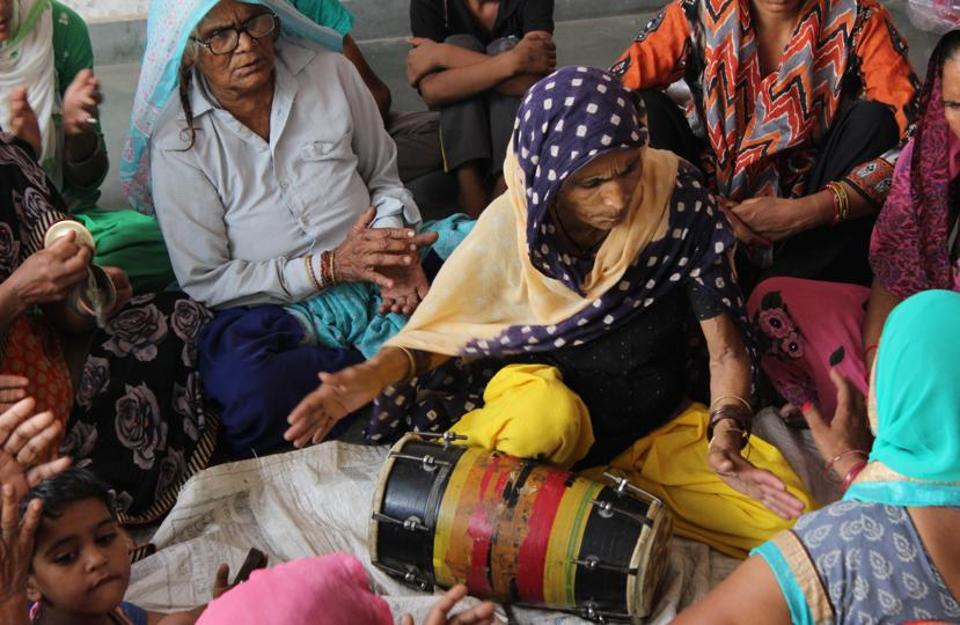
To prevent the loss of this cultural heritage, a group of three experts from the Centre for Environmental Sciences and Engineering, School of Natural Sciences at the Shiv Nadar University, Greater Noida, have set out on a unique mission. They are creating digital records of the folk songs of Chithara village panchayat in Dadri tehsil of the Gautam Buddha Nagar district.
The team comprises Prof Jyoti K Sharma, research associate Amit K Tripathi and senior research assistant Mohd Ahmad.
“We are documenting the traditional knowledge, including folk songs, of the different ‘mohallas’ of Chithara village panchayat, which has a total population of 7,656 and a geographical area of 770.78 hectares. We came across a rich tradition of folk songs, resulting from the strong cultural diversity here,” said Jyoti K Sharma.
“One of the leading folk singers of the village, Sheoraj Singh, has a large collection of folk songs in printed format as well as handwritten notes. This helped us a lot in our documentation work. Both the men and the women of the village actively take part in folk singing. Mrs Shashi is another renowned folk singer of the village,” said Sharma, adding that the songs were being documented as audio and video files too.
“Despite folk songs losing out to the impact of popular music and media in the recent years, Chithara village and its surrounding areas have managed to keep alive the tradition even today,” he said.
People of the region take active part in promoting folk music and dance during occasions such as Krishna Janmashtami, Dussehra, Katha, Kirtan, Jagran, Holi, marriages, births, etc. “The villagers say they receive inner happiness by singing and listening to folk music and sharing folklore. The elders say they want the rural society to maintain their folk traditions,” said Sharma.
The team documented the songs in the form of audio recordings, handwritten lyrics and printed books of the songs in Devnagari script -- documenting a total of 193 folk songs in 239 parts.
“These folk songs were categorised as ‘aarati’, ‘bhajan’, ‘bhet’, ‘dhola’, ‘geet’, ‘kissa’, ‘ragini’, etc. During the recording sessions, groups of village artistes -- women and men -- used to arrange their traditional musical instruments and accompaniments such as harmonium, dholak, manjira, chimta and khartal at a central location. They also dressed up in traditional attires,” said Sharma.
He said the people in different ‘mohallas’ were contacted personally and requested to extend their support in the documentation work. “A set of formal and informal semi-structured interviews, workshops and group discussions with villagers were conducted across Chithara village,” said Sharma.
“During the interactions, the key persons responsible for keeping alive the tradition of folk singing were identified. Prominent singers were personally interviewed, which revealed that the many songs had been passed down generations orally, while some new compositions included contemporary references too,” he said.
Sharma said the area is inhabited by people belonging to different castes but interestingly, while the communities had diverse traditions, the folk songs were a common treasure. “Gujjars and Jatavs are the prominent communities here, but there are Kolis and Brahmins too along with other castes such as Thakur and Rajputs. The folk songs have rich influences from all these communities,” he said.


