
 E-Paper



SRCC students pitch for provision of clean drinking water for all
Project Asbah, undertaken by the students of SRCC, that provides potable water to rural households and empowers local potters, has many takers.


The entrepreneurial society of Shri Ram College of Commerce (SRCC), Enactus, has come up with the novel idea of making clean drinking water a reality for those who can’t afford expensive water purifiers.

Their project, Asbah, empowers local potters, who have been roped in to make clay filters that can be used inside earthen pots.
Read: Have your bowl and eat it too
Priyal Choudhury, PR director and 2nd year student at SRCC, says, “We launched this project last month with an aim to provide clean, pure drinking water to rural households. These filters are environment-friendly, economical and do not alter the taste of water stored in clay pots.”
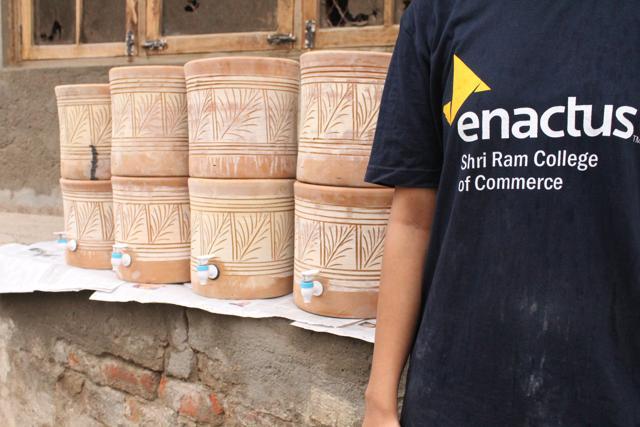
Potters from Uttam Nagar, a locality in West Delhi, are employed in this project. Sooraj Kumar Prajapati, a potter, says, “The filter is easy to make and I have made 25 pieces so far. I am also planning to install one for myself as the quality of water certainly improves.”
However, one of the challenges that the members faced was the fragility of clay filters. They collaborated with the Council of Scientific and Industrial Research (CSIR) to get a prototype of the filter, and took that to the potters. “There are two Terafil candles that go between two clay pots placed one upon the other. A tap is attached to the pot, for easy flow of water,” she adds.
Read: Empowering rural women through skills training
It takes three days to get one filter ready, and the entire process is eco-friendly. “While the manual labour does not take much time, it is the baking process of the clay that is time consuming,” informs Choudhury. A filter can last up to 6 months. After that, the candles need to be changed.
While the project has brought clean drinking water to people, it has also helped the potters generate more income. “There is a proper channel through which the filters are made, sold and maintained in each community. We have dealers who sell the filters and take responsibility of maintaining, cleaning and changing the filters,” says Choudhury.


