
 E-Paper



Mumbai blood banks’ stock may last only for a week: SBTC
All blood banks, whether in private or government hospitals, or those run by charities, are down to their last few bags

 Prefer HTon Google


When the Assam-based Rehmans landed in Mumbai on November 16 for the treatment of their nine-year-old daughter Fariha Amina Rehman who suffers from leukaemia, a cancer of blood-forming tissues, little did they know that the city’s supply of blood was running dry.
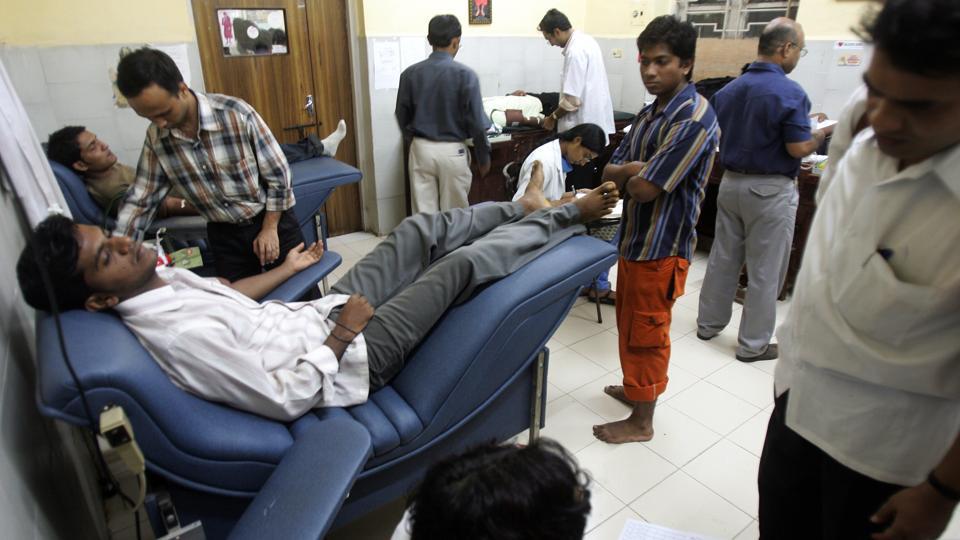
Data collated by State Blood Transfusion Council (SBTC) — which monitors the functioning of blood centres in the state — showed that as of November 27, the total units of blood available across the city was around 3500 units, prompting its director Dr Arun Thorat to state Wednesday that the city had barely a week’s stock of blood supply. The average requirement of blood during the pandemic has been up to 600 units a day.
“Since the outbreak of the virus, there’s been only a 50% response from the public to blood donation camps. Even though Mumbaiites are stepping out with the gradual relaxation of the lockdown, they refuse to donate blood for a good cause. We have blood stock only for a week,” said Thorat.
To be sure, blood banks have still been receiving blood through donations, albeit in a depleted form. However, the Covid-19 pandemic has put a stop to mega blood donation camps as a result of which the stocks are not being replenished as before. An unintended consequence of this is that blood banks are now asking persons in need of blood to arrange for replacement blood — a practice that is in violation of the National Blood Transfusion Council rules.
The Rehmans, who had never visited Mumbai before or had any family in this city to help them, had no choice but to find replacement donors for Fariha, a student of Class 3 in Nagaon. And then, another complication struck. Fariha, whose white blood cell count was already low developed haemorrhoids serious enough for her doctors at the Tata Memorial Hospital (TMH) in Parel to consider surgery before starting chemotherapy. Though she is on antibiotics at present, her family has been looking for replacement donors to donate either her blood type — B positive — or any other type in the eventuality that she undergoes surgery.
“Her chances of survival are already less, but we are doing everything we can to save the girl. Through my friends, I am trying to contact people in Mumbai to arrange for replacement blood but that’s not enough. We need more to keep her alive,” said Anjum Mehmed, her uncle, who accompanied her father Hizbur Rehman, an inspector at a cooperative society, and her mother Shajina Ahmed, to Mumbai. Mehmed eventually found a list of regular donors and he began to call them, one number at a time. Seven people have donated blood so far. But it’s not enough. Regular blood transfusion is what will keep Fariha alive.
When asked whether TMH was asking patients to arrange for replacement blood, Dr Sunil B. Rajadhyaksha, head of the transfusion medicine and SBTC member said that patients were not being forced to arrange for donors. “We have often noticed that the relatives of patients don’t donate blood. So, to encourage the habit of donation, we ask them to donate. But it is not forceful. So, rather than saying replacement blood, we prefer the term relative blood. Many a time, these relatives turn into a regular when their fear of blood donation gets over. It is aimed at developing a good habit among people.”
The hospital, which is renowned for its cancer treatment, requires on average 28,000 units of blood annually, and 80 units of blood daily. However, anticipating a crisis soon after the lockdown was declared in March, the hospital turned to residential societies to collect blood.
“In the initial days of the pandemic, other hospitals didn’t have to worry about blood shortages as the footfall of patience declined by almost 80%. Whereas at our hospital we had enough number of in-house patients who needed a regular supply of blood. So, we decided to collect blood from nearby residential societies. Our hospital staffers contacted their buildings and arranged for blood camps,” Rajadhyaksha said.
TMH is still holding camps at residential complexes, community halls and sports clubs with social distancing measures in place, he said. However, the response remains tepid. “If 75 people register to donate blood, only 30 of them actually come forward for donation. Earlier, at each camps, we used to get around 100 units of blood. But now, it has fallen to around 40 units of blood,” he said.
All blood banks, whether in private or government hospitals, or those run by charities, are down to their last few bags. SBTC data from November 27 showed that King Edward Memorial Hospital, Parel, which uses more than 150 units of blood every day had only 90 units of blood components and not a single unit of platelet, while JJ group of hospitals (which includes St George, Cama Maternity and Gokuldas Tejpal Hospital hospitals) which require more than 250 units of blood every day had only 31 units of whole blood, 83 units of blood components and four units of platelets.
The various components of blood — plasma, red blood cells, white blood cells, and platelets — have different uses for patients. While platelets are essential for persons suffering from cancer, red blood cells are needed during surgeries and white blood cells are needed for transfusion.
Officials of the SBTC and the Food and Drugs Administration have been holding regular meetings on the crisis. At a recent meeting held earlier this week, FDA minister Dr Rajendra Shingne appealed to political parties and government servants across the board to celebrate events and festivals by donating blood.
“Earlier, corporate companies and religious organisations would hold mass blood donation camps that have stopped due to the pandemic. Housing societies too are no longer conducting blood donation camps. This has affected smooth collection of blood,” he said.
“Almost 30% of the blood donated comes from camps held at corporate houses. That source of donation has been cut off completely. Presently, most blood donors are relatives of the patients. Since the pandemic, our blood stock has decreased to 15% capacity. It’s an everyday struggle now,” Dr Devang Shah, a blood bank officer at privately-run Anviksha Blood Bank in Ghatkopar.
The worst affected are people who require blood regularly. This includes leukemia patients like Fariha, and those suffering from thalassemia, like the Pushkarnas.
“For many years, I have been undergoing transfusion at Dr MB Agarwal day care centre at Dadar TT by arranging blood from JJ Hospital blood bank since my children have SBTC thalassemia cards. But there has been a severe shortage for the past four months, and the blood bank has been unable to help us,” said Sandeep Pushkarna, who along with his teenage children, aged 13 and 18, are thalassemia majors and need blood transfusions every 15 days. They were able to receive blood units from Anvishka Blood Bank once, but are now seeking donors much like Fariha’s family.
According to SBTC, there are 2,400 children suffering from thalassemia in the Mumbai Metropolitan Region.
Kandivli-resident Abhay More, 34, who has been donating blood regularly for the past 12 years, received an emergency call on November 14 from the Wadia Hospital in Parel to donate AB- blood for a pregnant woman who had been admitted with delivery-related complications. Due to restricted public transport available, More had to request a neighbour to ferry him to the hospital as he couldn’t afford to pay taxi fare. “Earlier, I used to donate blood 2-3 times a year. But since the pandemic, I stopped donating blood as my father is a diabetic and I didn’t want to take the risk [of contracting Covid-19],” he said.
According to Vinay Shetty, vice-president of Think Foundation, a non-governmental organization that works for patients suffering from blood-related ailments with the state health department, donation camps need to be made more accessible. “People will donate if we can bring the process of donation at their door steps. For that, we need to focus more on residential buildings,” he said.
“Since November, we started organising smaller blood camps in neighbouring areas,” said Dr Arun Ghule, president, Maharashtra Association of Medical Doctors at KEM Hospital. “Every day, medical students are donating blood for patients. They mostly donate blood during their day off. We can’t see patients who die for lack of blood.”


