Climate and Us | How green energy infrastructure is proving fatal for birds
A research study led by Wildlife Institute of India last year estimated 87,966 bird mortalities per year due to collision with power lines in only a 4200 sq km area of the Thar desert.
There are less than 100 Great Indian Bustards left and many die by colliding with power lines that are largely a part of renewable energy projects in the desert areas of northwest India. Several other birds, particularly raptors, die by colliding with wind turbines. Alarming data on bird collisions with the infrastructure of renewable energy projects has led BirdLife International and the Asia Development Bank to launch a new eSensitivity mapping tool called AVISTEP (Avian Sensitivity Tool for Energy Planning) last week, which will help determine which areas have the most impact on bird populations from renewable energy projects.
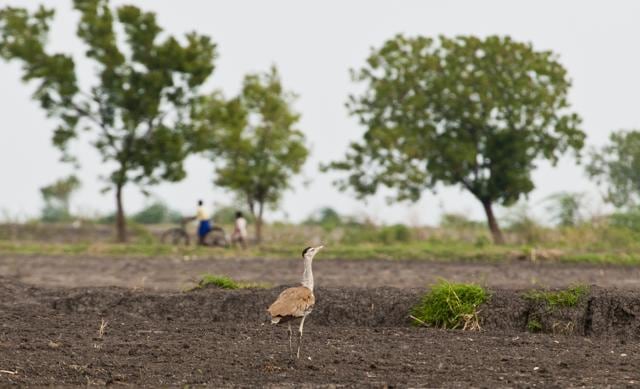
the Great Indian Bustard is particularly vulnerable to power line collisions due to its narrow frontal vision and heavy flight. (Samad Kottur)
Renewable energy projects, like other conventional energy projects, have a huge footprint on land and biodiversity.
The beta version of the tool was launched at the ADB’s 2022 Asia Clean Energy Forum in Manila and the portal will become operational in a month or two.
The open-access tool that the Bombay Natural History Society (BNHS) helped create will help power developers and regulators identify sites suitable for wind and solar energy and that are unlikely to negatively impact birds as well as areas that are highly sensitive and should be avoided. It's time that the government and renewable energy developers considered ways to mitigate the impact on birds and other flora and fauna. While India gradually undergoes an energy transition, moving away from coal towards more and more clean energy, it cannot do so at the cost of extinction of certain species.
A research study led by the Wildlife Institute of India (WII) last year estimated 87,966 bird mortalities per year due to collisions with power lines in only a 4200 km2 area of the Thar desert. The paper published in Elsevier’s Biological Conservation journal last year said the Great Indian Bustard is particularly vulnerable to power line collisions due to its narrow frontal vision and heavy flight.
The WII team estimated that the most frequently crossed 200 km transmission lines in Thar lead to a population-level mortality of 16% per year for Great Indian Bustards. This could cause extinction in the metapopulation of Great Indian Bustards within 20 years, according to a population viability analysis by the team. Authors had recommended burying overhead power lines in high-risk areas, installing diverters in low-risk areas, and fencing-off breeding habitats to prevent disturbances, among others. The availability of solar radiation alongside large, open, free spaces has attracted many wind turbines and solar plants in the last decade in Thar. Consequently, power lines have expanded rapidly. A mapping exercise by WII shows 1200 km of less than 33 KV and 500 km of more than 33 KV power lines in the area.
Another research study published in the Current Science journal in 2020 reported bird collisions from two wind farms: one at Kutch and another from Davangere, Karnataka. A total of 47 bird carcasses belonging to at least 11 species were reported in a three-year period from Kutch and 7 carcasses of at least 3 species in a one-year period were recorded at a Davengere wind farm. Raptors are the most affected group of birds worldwide by wind turbines, the paper said.
“The global transition from fossil fuels to renewable energy presents an opportunity for positive change but, if poorly planned, could come at the expense of biodiversity. Renewable energy projects require large areas of land, and if developers only consider the availability of wind and solar resources, we could lose many millions of hectares of natural land- areas that store millions of tons of carbon and provide habitat to thousands of threatened species,” a statement by ADB said last week.
“Renewable energy is not truly ‘green’ unless efforts have been made to limit negative repercussions for biodiversity,” said BirdLife’s Tris Allinson, who has led the project.
BNHS has provided information on bird distribution and ground realities throughout India for the open access tool. “Raptors are at very high risk. We have reports from Gujarat, Maharashtra, Karnataka and West Bengal that show that several species of birds tend to collide with both power and transmission lines and with rotating wind turbines. Raptors are at the top of the food chain and when their numbers reduce it affects several other species. For example, there are reports of lizard populations going up near wind farms due to the loss of raptors. There are also reports that certain small bird species do not come back to areas where wind or solar farms have developed. The impact on Great Indian Bustards in Rajasthan is very high. This tool will help renewable energy developers and the government avoid bird-rich areas. It has information for India, Vietnam, Thailand and Nepal for now,” explained Ramesh Kumar, a scientist at BNHS, to me.
High collision risk birds include Gyps vultures, Great Indian Bustard, raptors and water birds like flamingos, pelicans, and cranes. “Some passerines and ground birds also will benefit from the tool as they are reported to be affected by displacement due to the renewable energy infrastructure. The ecological imbalance due to the habitat loss of species which are at the top of the food chain could be minimised to a large extent especially in areas like the Western Ghats, west and east Coasts of India by using this tool,” Kumar added in a statement.
When I asked Sumit Dookia, a wildlife biologist specialising in biodiversity of the Thar desert and an assistant professor at Guru Gobind Singh Indraprastha University about the impact of renewable energy projects on birds, he said: “Jaisalmer and Bikaner area lies within the Central Asian Flyway, recognized under Convention of Migratory Species. The very same area is under consistent development to establish renewable energy parks for the last 2 decades. Earlier wind energy parks and now in the last five years, a large number of solar energy parks are being established and more are going to be established in due course of time. The energy generated through renewable energy is connected through the state grid and national grid with a huge network of different levels of power lines. In the last two-three years, almost every power line is responsible for killing birds, ranging from vultures to Great Indian Bustards, Demoiselle cranes and pelicans. Around 1 lakh birds die due to collision or electrocution in the Thar desert, according to research papers.”
From the climate crisis to air pollution, from questions of the development-environment tradeoffs to India’s voice in international negotiations on the environment, HT’s Jayashree Nandi brings her deep domain knowledge in a weekly column

 E-Paper