
 E-Paper



Distantly Close | In India’s platinum year, recalling cinema’s golden age
A book that serves as a time capsule for posterity, portrays the human side with all their strengths and frailties, of the architects of our filmdom’s memorable past.


A time capsule dug up for posterity which is now, a compendium of memoirs, of narratives, essays and recollections from the golden period of Indian cinema. What exactly does one call a book that includes it all and more; the raconteurs among those who lived the era that saw the making of magnum opuses which defied time to transcend generations?
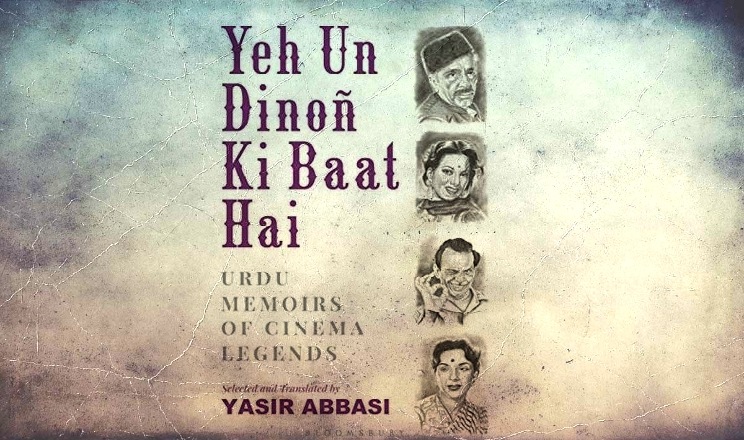
As India celebrates 75 years of its Independence, it’s only fitting to recall the glowing passages in the 110-year-old journey of our moving pictures — from the silent era’s inaugural year (1912) to the 1931 release of the first Talkie, Ardesher Irani’s Alam Ara. The period covered by the book in discussion is closer in history, coinciding with our freedom from the British yoke.
What draws the Hindi (Hindustani) film aficionado to Yeh Un Dinon Ki Baat Hai, Urdu Memoirs of Cinema Legends, is the testimonial it gained from the iconic lyricist-film-maker, Gulzar: Iss Kitab ne mujhe eik zamaana tohfe mein diya hai, mere haathon mein dua ki tarah rakha hai (This book has gifted me an era, placing it in my hands like a blessing).” Still a prolific writer, Gulzar, 88, first wrote for Bimal Roy’s 1963 classic Bandini (to the music of SD Burman) and never looked back.
Much of the material used by the author, Yasir Abbasi, a professional cinematographer, has been culled from Urdu film magazines he accessed from private collectors across the country. Most of those periodicals that ceased publication two decades ago were discarded as ‘filmy stuff’ rather than being catalogued for their rich literary sections. The only exception to the rule was Patna’s Khuda Baksh Library. “The out-of-print Urdu magazines I sourced were with private collectors who were unwilling to lend. I worked out of their homes to prise out texts for the book,” recalled Abbasi. The result was gratifying as praise came from young readers and contemporary filmmakers such as Vidhu Vinod Chopra.
It’s hard to fathom how regular libraries in Urdu-speaking areas couldn’t spot archival value in the magazines they junked. For instance, by what stretch of imagination or learning can a write-up by Kaifi Azmi on Sahir Ludhianvi or the one on Sa’adat Hasan Manto by Raja Mehdi Ali Khan be considered less than a work of literature? The same holds true of Khwaja Ahmad Abbas’s impressions of Prithiviraj Kapoor and his son, Raj; Character-actor Iftikhar’s take on his much-celebrated friends and co-artistes Ashok and Kishore Kumar; and the legendary music composer Naushad’s engrossing story of the equally accomplished, K Asif who directed Mughal-e-Azam.
That’s not all! The book carries ‘perspectives’ and ‘reminiscences’ by Dev Anand, Balraj Sahni, Kamal Amrohi, Nasir Husain, I S Johar, Dharmendra, Talat Mahmood, Johny Walker, Ajit, Javed Akhtar, and Shakeel Badayuni. It opens with early trail-blazer Nargis’s moving tribute to Meena Kumari under the caption: “Meena, Maut Mubarak Ho (Meena, congratulations on your death).” She goes on to write: “Your baaji (elder sister) congratulates you on your death and asks you to never step into this world again. This place is not meant for people like you.”
Born Mehjabeen, Meena Kumari is remembered for the central roles she played in such time-enduring films like Baiju Bawara, Sahib Bibi Aur Gulam and her estranged husband Kamal Amrohi’s period classic, Pakeezah. Lonely and uncared for, she succumbed to alcoholism-induced cirrhosis at age 39, shortly after Pakeezah’s 1972 release.
The cinema in the book’s scope is a bygone chapter retaining lure in the memorable art it handed down. One feels compelled to reproduce in commemoration certain riveting passages that at once are a celebration of Urdu periodicals and the language (Hindustani) which was the lingua franca of our Talkies. Translated to English from Urdu, several writings, barring a few, were done in the lifetime of protagonists under the writers’ lens.
In his 1984 recollections of K Asif (1924-71) and Mughal-e-Azam, Naushad, arguably the best composer of his generation recalled the making of the music and the dialogues that set it apart as a work of cinematic excellence. In the scene where Anarkali is to be entombed (for being the love of the prince) is asked to state her last wish. She desired to be made the queen for a night. That outraged Akbar (played by Prithviraj Kapoor) and (what could possibly be) the response of Anarkali (enacted by Madhubala) to the king’s rage was the subject of discussion in one of the many story sessions.
All three scriptwriters had readied their versions of the scene. On hearing others, K Asif looked askance as Vajahat Mirza. In response, Mirza spat out the paan in his mouth to declare: “All this is nonsense! What’s the need for such protracted wordplay?” He then opened the small case in which he carried paans, took out a piece of paper from it and said, “Anarkali will deliver one sentence... She’d offer salaam and say: This menial slave-girl forgives Jalaluddin Mohammad Akbar for her murder.” That’s how the story panned out on the screen. Rest is history.
Naushad also dwelt on Asif’s rocky relations with his film’s financer, Shapoorji of the Shapoorji-Pallonji fame who built Bombay’s best-known milestones — Church Gate and Marine Drive. There were endless tiffs over the film’s budget that ballooned over the decade for which it was in the making. The two almost fell out — the producer threatening to bring Sohrab Modi as the director — when Asif constructed the expensive Sheeh Mahal set to shoot the evergreen number: Jab pyar kiya to darna kya. The matter got resolved when Asif overcame the technological challenge, proving wrong the sceptics who insisted it was impossible to shoot the song on the multi-mirrored set.
Naushad was curious as to why a successful builder got entangled in film financing. Shapoorji told him that Akbar was his favourite historical character: “It was my dream to showcase his greatness to the world.” Asif also had his moments of tension with Dilip Kumar who played Akbar’s rebellious son Salim who fell for Anarkali. “I’m making Mughal-e-Azam, not Salim-e-Azam,” he’d tick off the super-talented actor on hearing him complain of Akbar getting more dialogue than the character he was playing.
Focused as he was on people behind the camera, Naushad did not say much about the film’s stars: Prithviraj Kapoor, Dilip Kumar and Madhubala. Very much part of the book is a self-portrait Dilip Kumar did for the Shama magazine in 1973. The other two actors figure at length in articles by character-artiste Iftikhar and Khwaja Ahmed (KA) Abbas, a highly regarded filmmaker, journalist and screenwriter.
In his thumb-nail autobiographical sketch, Dilip Kumar talked of the “cloak of sorrow” he had to forever wear to fit the ‘tragedian’ tag foisted on him early in his film career. “It affected my persona... I began to feel I wasn’t destined to experience joy and success. The condition caused great turmoil in my life, shackling the playful spirit in me,” he wrote. As his cinema image took a toll on his personal life, he reached out to psychologists in England who advised him to explore light-comical roles to avoid becoming a stultified personality. “(So) when I was offered Azaad (action-comedy, 1955), I lapped it up. It was a turning point in my life and my evolution as an artiste—a time when the fragmented bits of my character came together again.”
The personal side of Madhubala and Kishore Kumar, the eccentric singer-actor-director she married, is brought out vividly by Iftikhar who was friends with Kishore and his elder brother, Ashok Kumar aka Dada Moni. In a 1976 write-up, he disclosed that Madhubala and Kishore married after she broke up with Dilip Kumar and his wife left him. As they were working together in films, Madhubala, suffering from an incurable heart ailment, broke down one day and proposed to Kishore: “I don’t want to die unmarried. I want to die as your wife.” They tied the knot but never consummated; Kishore steadfastly adhering to the doctors’ advice against any physical relationship on account of the sensationally beautiful Madhubala’s precarious medical condition. “They slept on the same bed,” wrote Iftikhar, “but couldn’t come close as a regular couple.”
Writing about Prithviraj Kapoor, K A Abbas recalled his role as Lord Ram in Debaki Bose’s Seeta, the first Indian talkie to be shown at an international film festival (Venice). “His was a novel portrayal of Ram — the manner in which he translated the character elicited a kind of reverence that had not happened in the Indian films earlier.” Likewise, the Akbar he played 25 years later was no less majestic than the original.
Having written critically acclaimed blockbusters for Prithviraj’s eldest son, Raj Kapoor, Abbas revealed that he first offered the story of Awara, a path-breaking Bollywood film, to Mehboob Khan (who later made Mother India) with the suggestion that he cast the father-son Kapoor duo as its central characters. But Khan wanted Dilip Kumar in place of Raj who, on getting wind of it approached Abbas and grabbed the rights for the story. “Raj is like an engine... I believe if the engine could be connected to an appropriate train, my thoughts could be spread far and wide. This is why I write for him despite knowing that he’ll end up making compromises and I’ll have to accept them. I feel that whatever he may do, my ideas and beliefs would travel a fair distance,” remarked Abbas, whose socialist beliefs drove his writings. “The changes made during Awara were minimal; he compromised (the script) more in Shree 420; by the time Bobby came out, I had to say that it was Raj Kapoor’s film, not mine.”
Dipped in admiration that’s a rarity among peers, Kaifi Azmi’s essay on Sahir Ludhianvi opened with his appraisal of Talkhiyaan, the latter’s 1943 collection of poems which came in the middle of World War II. “The poetry of Sahir was devoid of entangled, indeterminate, soulless indulgence that young writers passed off as poetry in wartime... I wondered where this talented poet was hiding all this while,” wrote Kaifi with a formidable body of work of his own.
Sahir was pretty young when Kaifi wrote about him. He said those who don’t know him closely might be unaware that the disappointment with his surroundings cultivated a kind of scepticism in his temperament. If a producer increases his fees, he starts thinking about whether there was a motive behind it; if a girl wishes him, he gets worried about a raise in his list of failures, and if a girl actually falls in love, then his heart proclaims: The weariness in your breath, the silence in your glance, In truth, could all be a mischievous trick, what I may consider signs of romance. Those smiles, that eloquence, could merely be your habit (translation of Sahir’s own lines in Urdu).
Kaifi indulgently portrayed Sahir as a restless man incapable of hiding emotions: “He’s quick to identify the positive and negative aspects but arriving at a conclusion is not his strongest point. Leave aside life’s greater problems, it’s not easy for him to decide which shirt to wear along with which pair of trousers.” At another point, he observed: “The deprivations, defeats and dilemmas of his personal life have softened and melted Sahir so much that all he’s left with are feelings... He hasn’t written any shoddy verse till now. As long as anarchy exists, he won’t either...” Sahir died in 1980, aged 59. His subsequent work proved that Kaifi prophetically judged his boundless talent.
If Sahir wrenched hearts with Jinhe naaz hai Hind par wo kahan hain (Pyaasa), Kaifi had us weep with Ab tumhare hawale wata saathion (Haqeeqat). Such were the men and women whose many gifts, ideas and work journeyed with India in her early years. As the country turns 75, they’re remembered for what they bequeathed.
HT’s veteran political editor, Vinod Sharma, brings together his four-decade-long experience of closely tracking Indian politics, his intimate knowledge of the actors who dominate the political theatre, and his keen eye which can juxtapose the past and the present in his weekly column, Distantly Close
vinodsharma@hindustantimes.com


