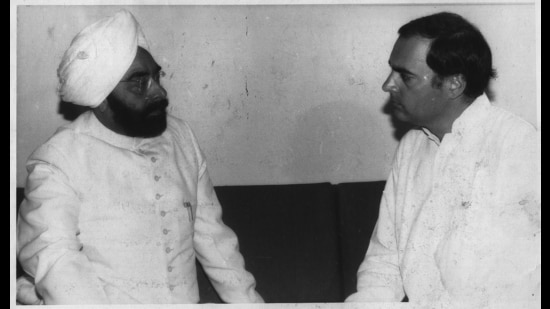
This piece is in response to Karan Thapar’s column Sunday Sentiments on April 16 (A disquieting string of disclosures on politics), which, under the guise of critiquing my book, The Indian President: An Insider’s Account of the Zail Singh Years launched an attack on me. While feedback and good faith criticism are welcome, his pique appears motivated by my turning down his request for an on-camera interview. He ends his piece by suggesting that maybe my intended readership is the current Indian government. The Zail Singh portion of the book was written immediately after my retirement in mid-2008, when a Congress-led government ran India. The first one-third of the book is a product of recent times. It addresses democratic recession and the presidential role, which has contemporary relevance.
Mr Thapar ignored this larger story of a President evolving from a courtier to a nation’s conscience-keeper. He also sidestepped my actions post-Rashtrapati Bhavan. (HT ARCHIVE)
My book centres around the crucial constitutional role of the President as a national arbiter and defender of the Constitution. The first half of the President’s oath — copied verbatim from that of the United States’ president — enjoins him to “preserve, protect, and defend the Constitution of India”. The first one-third of my book examines this aspect, focusing on the first two Presidents, Rajendra Prasad and Sarvepalli Radhakrishnan. Whether the President can dismiss the Prime Minister (PM) figured in the then-attorney general’s advice. Thus, President Singh was not imagining some fictional coup. Mr Thapar finds this of no interest.
He appears to discover in the book’s second half that I “willingly and deliberately” acted to convince the President to dismiss the PM. He confuses my role as facilitator in arranging meetings with my advice. On page 208, I recount taking Girilal Jain, at that time the editor of the Times of India, to see the President. I write that on the PM’s dismissal, “I allayed his concerns in the car”. The President was getting advice for and against the proposal of dismissal. I was in the “against” camp, which Mr Thapar’s summary Vignores. Close aides of PMs, Presidents, or even ministers often play a quasi-political role. It is thus utterly naive to assume that by addressing political issues or conveying messages to political figures, they breach some unwritten law or code. For instance, when VV Giri, as acting President, approved the bank nationalisation ordinance one day before jumping into the presidential race as an independent, surely his aides were invested in his move.
The tense Rajiv Gandhi-Zail Singh relations were unprecedented. The book recounts how the PM ignored the President, and avoided briefing him on matters of State or seeking his advice. The President’s closest aide, IS Bindra went back to Punjab in 1985, leaving just the secretary to the President and myself in Rashtrapati Bhavan. I could have opened channels to the government and played both sides, as most bureaucrats do. I decided instead to help President Singh defend his office by all constitutional means.
By March-April 1987, Prime Minister Rajiv Gandhi, as my book relates, sacked a popular foreign secretary publicly, stonewalled enquiry into the allegations swirling around the Bofors payoffs, foisted an intrusive postal bill on the nation, and got routed in the Haryana elections. Additionally, three important ministers at the time — Arun Nehru, Arun Singh and VP Singh — resigned or were dropped from the Cabinet in quick succession. In any functioning liberal democracy, the PM would have been forced to quit. But the anti-defection law negated the possibility of a parliamentary party revolt. How do you then obtain accountability? The conundrum persists.
But Mr Thapar ignored this larger story of a President evolving from a courtier to a nation’s conscience-keeper. He also sidestepped my actions post-Rashtrapati Bhavan. I knew that aiding and advising a President in conflict with the PM may have consequences. Thus, when my promotion to director grade in 1988 was withheld, I offered my resignation. But the Rajiv Gandhi government promoted me after deliberation, recognising that a presidential aide’s role was for the President to define. All this “befuddles” Mr Thapar.
Readers must peruse the book to judge the veracity of the accusations or my explanations above. Mark Twain once wrote, “Loyalty to country always. Loyalty to the government when it deserves it.” Regrettably, Mr Thapar has failed to observe the difference.
KC Singh is a former diplomat and strategic affairs expert The views expressed are personal

 E-Paper