
 E-Paper



Mind the Gap: It’s 2025. Why is male still the default gender?
Time to junk the male default model that is everywhere from medicine to entire cities.

 Prefer HTon Google


Women are 73% more likely to be injured in a front-seat car crash. Yet, the dummy used in vehicle tests by the US highway traffic safety administration is modelled almost “entirely off the body of a man”.
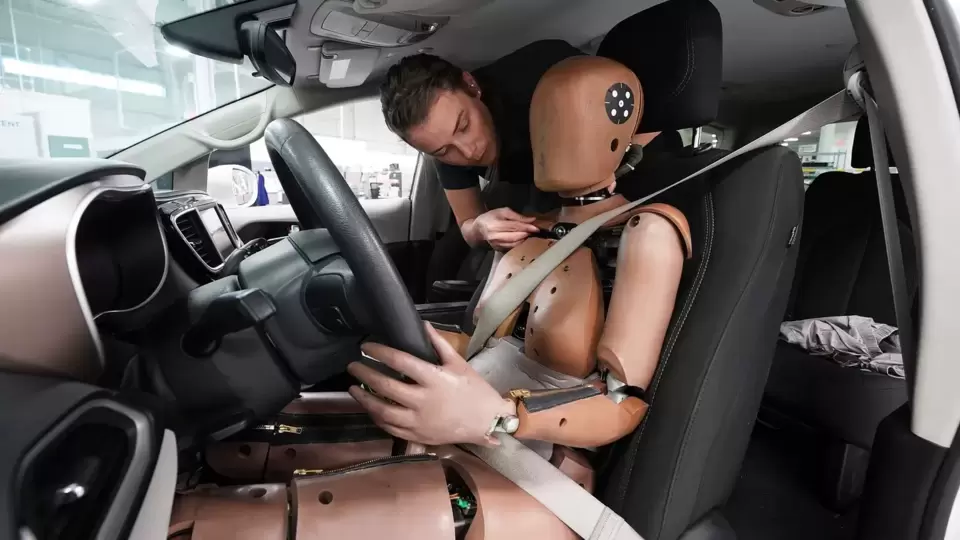
The crash test dummy, reports Associated Press (AP), has a name, Hybrid III and has, since its birth in 1978, been built as a 5-foot-9, 77.5 kg man (in the years since, the average American man’s weight has gone up by 13 kg). To be sure, there is a female dummy that is a “smaller version of the male model with a rubber jacket to represent breasts”. She is usually tested in the front passenger seat or the back seat because, well, women don’t drive do they?
Crash dummies for cars aren’t the only ones to follow a male default.

If your smartphone feels too big for your hand, if the air-conditioning leaves you wishing for a sweater—unless you’re menopausal, in which case it can never be cold enough—then blame the male default, points out Caroline Criado Perez in her 2019 bestseller Invisible Women: Exposing data bias in a world designed for men.
Entire cities, streets, parks, markets, public transport, are built around the male default, despite the fact that when you put together women, transgender people, differently abled, children, adolescents, and senior citizens, able-bodied men are in a clear minority. This lop-sided by design arrangement sends a clear message: Only men matter.
What would an inclusive city look like? It’s “where a wide group of women loiter and spend time in public spaces—a marker that the public spaces are safe, accessible, responsive, and women have the time for self-care,” says Sonal Shah, founder, The Urban Catalysts.
So, street lighting that works, benches in parks, adequate play areas, unoccupied footpaths, buses and rickshaws driven by women to create a sense of confidence and safety. And, most certainly, more loos. When we build the same number of toilets for women as we do for men and wonder why there’s a long line outside the women’s, perhaps it’s because the planners (mostly male) forget women tend to take longer especially when they menstruate.
Earlier this week, New Delhi’s municipal council greenlit “pink toilets” in 37 markets in New Delhi’s swishest area, Lutyens’ Delhi. At present there are six such toilets that have a woman sanitation worker and guard, facilities for baby care and sanitary napkin dispensers.
By law, toilet facilities must be provided for all. Yet, on the ground, large sections of people, women and men, don’t have access. Men can go anywhere, but on construction sites, for instance, women must hold it in till they get off work.

We know what happens when a traditional design bias is fixed. The building of more toilets in schools led to fewer girls dropping out. Today, India has bridged the gender gap in school enrollment. Coincidence? Perhaps not.
Life and death
The assumption of the male default is not just a question of inconvenience but can, especially in healthcare, be a matter of life and death.
There is an inordinate amount of recent research. A 2020 study by the University of Chicago and UC Berkeley found that women tend to be overmedicated because drug dosages are recommended for a male default. These include sleeping pills that impair functioning in the morning.
Then there’s a 2016 study by the University of Leeds and the British Heart Foundation, which found women are 50% more likely to be wrongly diagnosed following a heart attack since they can present different symptoms like shortness of breath and nausea, rather than the acute pain experienced by men. What happens when women are misdiagnosed? A 70% increased risk of death, found the study.
This bias pops up even in gynecology and women’s health where too many women are told by doctors the pain they feel during menstruation or associated with endometriosis is all in their head.

Those of us who’ve undergone a pelvic examination will be familiar with an instrument that looks like it’s designed for medieval torture. The cold metal speculum was designed by a man (of course) James Marion Sims, in the mid 19th century and little has changed in either form or function. In January this year, there were somewhat heartening reports of a new design by two Dutch women, Ariadna Izcara Gual and Tamara Hoveling made of semi-flexible medical grade rubber.
The release of UN Population Fund’s report, The Real Fertility Crisis: The pursuit of reproductive agency in a changing world on June 10 calls for a reframing of the debate over dwindling numbers. The issue isn’t the numbers, the issue is reproductive agency and the “ability to make free and informed choices about sex, contraception and starting a family,” the report finds.
But the report raises an old question, albeit obliquely: Who bears the burden and responsibility for contraception? Across the world, it is women with one in three facing unintended pregnancies. In fact, an earlier 2023 UNFPA brief found 83% of married women in India bore the responsibility of contraception, among these 67% had opted for sterilization.
With entrenched notions of masculinity, men fear loss of virility. In contraception the standard default is stubbornly female. After 60 years of hormonal birth control for women, there is still no effective, reversible contraceptive for men in the market, despite breathless reports of imminent breakthroughs every few years on the “male pill” and injectables.
By design

Designing with the male default isn’t just about gender stereotyping—pink for girls, blue for boys—or even the under-representation of women in practically every field from politics to engineering. This is more insidious in a way, because it invisibilizes women.
We are not smaller men. Men and women clearly have different physiologies and assuming a male default can be fatal for women.
Fortunately, things are changing.
In a colourful corner outdoors at the Holy Family Hospital in New Delhi is a sensory playground designed for all children. “It’s a gift from the special needs children to all children,” says Madhumati Bose, head of the early intervention department.
The playground, perhaps the first of its kind anywhere in Delhi, fills a much-needed gap for children with special needs. But, says Bose: “Everybody waits for their turn. Sometimes, if a child needs more time to do something, the other children will wait patiently.”
When children come together and play, regardless of ability, they become aware that the world consists of different types of people. That everybody belongs.


