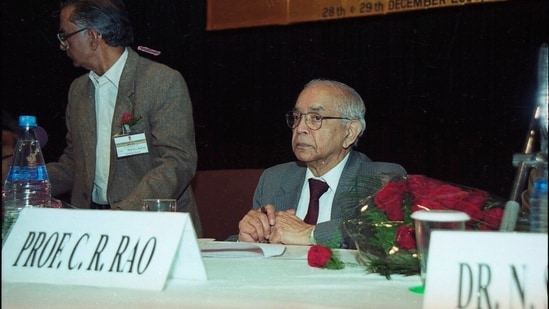
When I decided to major in statistics as an undergraduate, I had no idea what I would be studying. It was a new subject and I had not heard about it. The first year was mostly about probability and I liked the subject. William Feller’s book had just been published and I enjoyed reading it. When we started on statistics, there were no real textbooks. But we could use Dr CR Rao’s book — Advanced Statistical Methods in Biometric Research. It contained a wealth of material.
Dr Rao was very accessible. He invited us to his son’s first birthday celebration which included a dance performance by his daughter Teja (Subhendu Das / HT Archive)
We learnt about the Cramer-Rao Inequality (which allows a statistician to assess how accurate an estimate can be) and the Rao-Blackwell Theorem (which provides a method for making an estimate better and more optimal). They were simple and at the same time profound. It was the first time I heard of Dr Rao.
After finishing my undergraduate studies in 1959, I was told about the Indian Statistical Institute, which trains professional statisticians and supports those who want to do research. I took the competitive exam and was selected as a research scholar. In August 1959, I took a train to Kolkata. I had no idea of what to expect or what was expected of me.
I met Dr Rao the day after my arrival. The institute was very large, with many divisions where people worked in different areas including, for instance, the National Sample Survey which was responsible for collecting and analysing data for the government. The hub of our activity was the Research and Training School, RTS in short, and Dr Rao was its head. The overall head of the institute was PC Mahalanobis who was always referred to as professor. In RTS, we had tea twice a day — at 11.30am and 3.30pm in the tea room. The faculty and research scholars would show up and interact freely. JBS Haldane was a regular, smoking a big fat cigar. Dr Rao was there most of the time, and it was a place to meet senior faculty as well as your fellow research scholars.
At some point, Dr Rao asked me what I was interested in. I told him that I wanted to work on the industrial applications of statistics. He did not say anything but suggested I meet with another faculty member, which I did. I tried to read some material and did not find it interesting. I was getting frustrated.
There was a meeting of the Indian Science Congress and Dr Rao was the chair of the statistics section. He wanted to show the strength of the institute as a research institution, and encouraged all the research scholars to present their work. I was only a few months into my research career and had nothing to show. Dr Raghu Raj Bahadur, another senior professor, came to my rescue and suggested some things to read in theoretical statistics. I found the area now known as the Robbins-Monro procedure quite interesting. Dr Rao was pleased I could contribute to the meeting.
At the same time, I met KR Parthasarathy, VS Varadarajan and R Ranga Rao and they convinced me to work in probability theory rather than industrial statistics. Although Varadarajan left for the US, I worked closely with the other two for the next year and a half. Dr Rao noticed my shift in interests and was not displeased. He would ask us periodically what our group was working on and encourage us.
We always had a stream of visitors at the institute and he made sure that we had ample opportunities to interact with them. Andrey Kolmogorov was a famous Soviet mathematician who visited the institute and a group of students accompanied him on a trip to a few cities in India. Dr Rao also arranged for Kolmogorov to be an examiner for my thesis.
Dr Rao was very accessible. He invited us to his son’s first birthday celebration which included a dance performance by his daughter Teja. He had contacts worldwide and would help his students obtain postdoctoral visiting positions in the US, the United Kingdom and the erstwhile USSR.
He was an excellent amateur photographer. I visited him a few times in Pittsburgh and College Park after he moved to the US. He moved to Buffalo to be near his daughter. My last visit was to Buffalo, and I spent a few hours with him and Teja. He was nearly 100 at that time and very alert.
When academics leave this world, they leave behind a legacy of publications and students. On that count, Dr Rao mentored a large number of students at both the doctoral and masters levels. He advised over 50 doctoral students and including students they advised in turn, he had over 750 “descendants”. His publications cover theoretical as well as applications to a multitude of subjects. He was a giant in the field of statistics and leaves behind a rich legacy. I was fortunate to have had him as a mentor and role model.
SR Srinivasa Varadhan is a professor at the Courant Institute of Mathematical Sciences at New York University, and a winner of the Abel Prize and the Padma Vibhushan. The views expressed are personal

 E-Paper