
 E-Paper



Providing the impetus for an Army of talent
It is perhaps this attitude towards life that makes an army personnel push the boundaries and achieve great heights, even in the playing arena.


“Whether it is the border or the playing field, duty comes first. Smile or cry, you have to do it,” says Dattu Bhokanal, a rower who was part of the men’s quadruple sculls team that won gold at the 2018 Asian Games. Bhokanal is a havildar in the Indian Army.
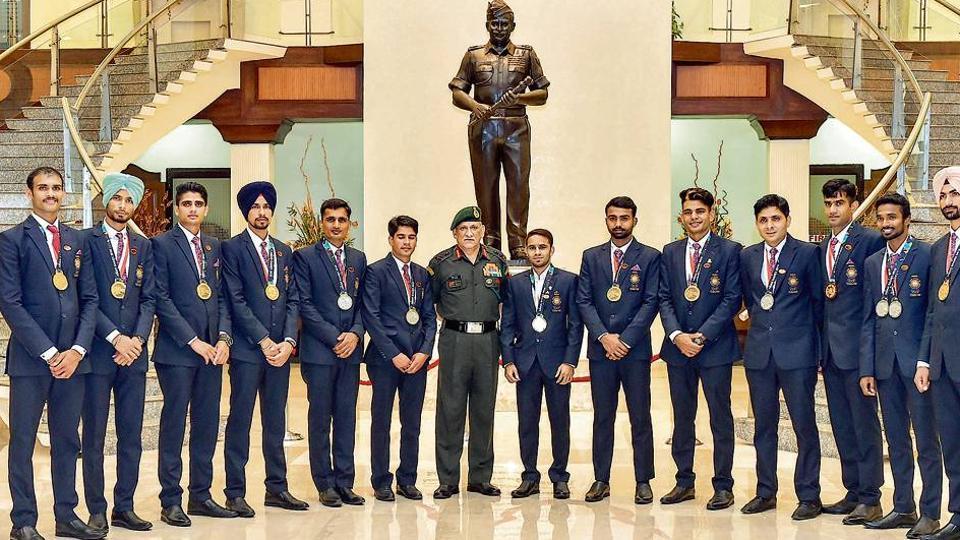
It is perhaps this attitude towards life that makes an army personnel push the boundaries and achieve great heights, even in the playing arena.
From the days of the great Milkha Singh to Rajyavardhan Singh Rathore, an Olympic silver medallist and Union sports minister, the army has nurtured and produced sportspersons who have made India proud.
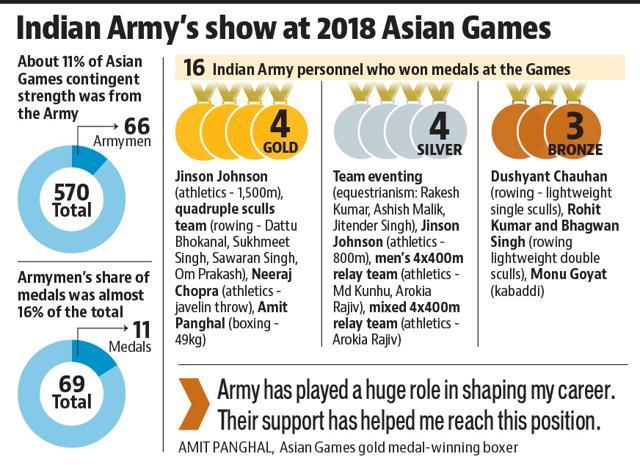
It was no different at the 2018 Asian Games in Indonesia. The army provided the impetus India needed for its best haul in the history of the Games, winning a total of 69 medals including 15 gold. A total of 66 army personnel participated in Jakarta and Palembang; 16 won medals --- four gold, four silver and three bronze.
“The army provides equipments, support staff, coaching. Add to this discipline, diet and job security. All of this makes army athletes more successful. These factors also make the mentality of an army man very different,” says Olympian Bhokanal.
Existing sporting infrastructure and facilities make it easier for army men to get off the blocks. Take Major Ashish Malik for example. Malik’s silver in team eventing would not have been possible without the army. Equestrianism is expensive and without the army’s patronage, pursuing the sport could have been difficult for him.
Right from his academy days to when he was commissioned, Malik was “sent out for competitions.” “When I got commissioned, I was given dedicated horses for training,” he says.
Job security, promotion, accommodation and travel, apart from respect and honour, are significant factors which add to the lure of joining the army. A civilian will have to worry about all these aspects before taking up a sport as a career.
Subedar Rajiv Arokia, who won silver in both men’s and mixed 4x400m relay, pointed out that the army takes care of their needs which otherwise would stop many Indian sportspersons, who come from poor backgrounds, from giving of their best.
“If I was a civilian, I would have to worry for everything: food, water, stay. But not in the army which is a power in itself. For any problem, the army is there to solve it,” said Rajiv, who hails from Tiruchirappalli. “What we want or don’t want, what needs to be controlled or what we need to do to go ahead, all that is taken care of by the army.”
Naib Subedar Amit Panghal, the saving grace for India’s boxing contingent in Indonesia, feels he has become a better pugilist after working with “great coaches and good boxers” of the army.
“The army has played a huge role in changing my life and shaping my career. Their support has helped me reach this position. After every national camp when I return to the army, they have very good coaches who make me practice from the heart and superb boxers with whom I train and who point out mistakes so that I can rectify them,” says Panghal, who won the 49kg gold in Jakarta beating reigning Olympic champion Hasanboy Dusmanov.
Naib Subedar Jinson Johnson, one of the stars of the Asian Games, says the army provides not just a base but an excellent platform for athletes to go the distance. “Whether it is volleyball, athletics or any other sport, there are facilities and grounds even in the smallest units. Fitness is very important and there are several cross-country races in every unit. All this has helped the army to produce many sportspersons,” says Jinson, who won the men’s 1,500m gold and 800m silver at the Asian Games.
The push by ASI
The Army Sports Institute (ASI) in Pune is a premier facility with good infrastructure, sports science centres, foreign experts, a sporting environment which helps in churning out top sportspersons. The best among the army’s sportpersons head to Pune to train under foreign coaches who are backed up by top class doctors and physios.
Those athletes selected for India attend national camps but if not, they can continue training at the ASI. In addition, the athletes also take part in intra-army competitions or, as part of the Services team, participate in various national events which keep them in top form and ready for international events.
Training for weightlifting, fencing, diving, athletics, archery, boxing, rowing and wrestling is provided in Pune while other major army training centres are Mhow (shooting), Mumbai (yachting) and Meerut (equestrianism).
“The main idea of setting up ASI was to give best facilities. We have also roped in five foreign experts in archery (coach from South Korea), fencing (Russia), diving (Cuba), boxing (Cuba) and weightlifting (Slovakia). The Army Boys Company (ABC) is the main breeding ground where talented athletes in the age-group of 10-16 are selected and given training and provided with education,” says Col Rakesh Yadav, Commandant of ASI.
“The ABC was set up in coordination with Sports Authority of India (SAI) at different army units. There are 210 youngsters in the scheme spread across the country and contributes nearly 60 per cent to the elite group.”
The ASI also scouts for talent through sports quotas and its regular recruitment drives. “If someone shows potential, we give opportunity to further polish skills and put the sportsperson in one of the five training centres. Good facilities help them make the cut for the national team like Jinson Johnson and Rajiv Arokia,” says Yadav.
Following the success at the Asian Games, the army is now focusing on bigger targets. “The Asian Games was a good platform to show that we have potential. I’m certain our athletes will do better in future. We have had discussions with coaches and athletes and they believe performance could be improved with more international exposure. Hence, we will chalk out a programme to give regular international exposure to fine-tune competitive skills and also build-up confidence under Mission Olympic Cell,” says General Bipin Rawat, Chief of Army Staff.
With several top stars coming from the army, it won’t be a surprise if we have another medal from it at Tokyo 2020.
Statistics
66 – Total number of Indian Army personnel who took part in 2018 Asian Games
16 – medal winners from army
11 – medals (4 gold, 4 silver and 3 bronze)
Gold – Jinson Johnson (athletics - 1,500m), quadruple sculls team (rowing - Dattu Bhokanal, Sukhmeet Singh, Sawaran Singh, Om Prakash), Neeraj Chopra (athletics - javelin throw), Amit Panghal (boxing - 49kg)
Silver – team eventing (equestrianism: Rakesh Kumar, Ashish Malik, Jitender Singh), Jinson Johnson (athletics - 800m), men’s 4x400m relay team (athletics - Md Kunhu, Rajiv Arokia), mixed 4x400m relay team (athletics - Rajiv Arokia)
Bronze – Dushyant Chauhan (rowing - lightweight single sculls), Rohit Kumar and Bhagwan Singh (rowing lightweight double sculls), Monu Goyat (kabaddi)


