
 E-Paper



Photos: Revisiting Gandhi’s Bombay days in Mumbai
Although MK Gandhi never liked big cities, the city of Bombay remained important for him throughout his life. In 1919, Gandhi chose Bombay to launch his first nationwide satyagraha against the Rowlatt Act that curbed the freedom and rights of the people. In 1921, the swadeshi movement was launched from the city. When he launched the Quit India Movement from Gowalia Tank Maidan in 1942, citizens turned Gandhi’s “Do Or Die” slogan into a revolution. But sadly, most landmarks from Gandhi’s association with Bombay have been demolished, sold off or are in shambles.
Updated on: Sept 26, 2019 5:43 PM IST


Share via


Copy link

1/7
 View Photos in a new improved layout
Updated on Sept 26, 2019 5:43 PM
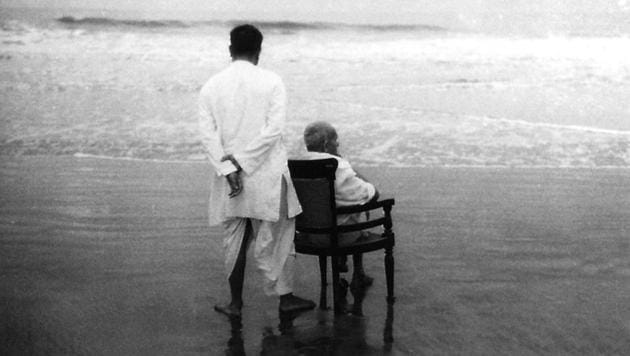
Mahatma Gandhi with his son Devdas at Juhu Beach in May 1944. To most historians, the Mahatma can come across as a man whose heart lay in rural India. Yet, MK Gandhi spent several years in Mumbai — or Bombay as the city was then called — first as a potential barrister, then as a lawyer with an established practice, and finally, over three decades, as the man who led India to freedom. (National Gandhi Museum)
2/7
 View Photos in a new improved layout
Updated on Sept 26, 2019 5:43 PM
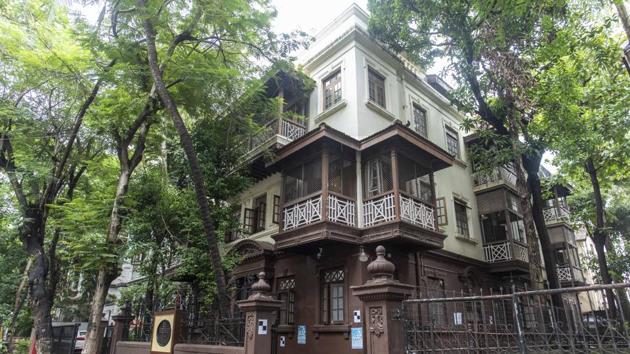
Present-day view of Mani Bhavan, the modest two-storey home of Gandhi’s friend Revashankar Jhaveri, at Laburnum Road, from where Gandhi spearheaded at least six national movements. After returning from Bombay as a trained barrister in 1891, Gandhi attended the Bombay High Court every day, walking 45 minutes to and from his home in Girgaum. In court, he couldn’t follow the cases and would doze off, he wrote in his autobiography. (Aalok Soni / HT photo)
3/7
 View Photos in a new improved layout
Updated on Sept 26, 2019 5:43 PM
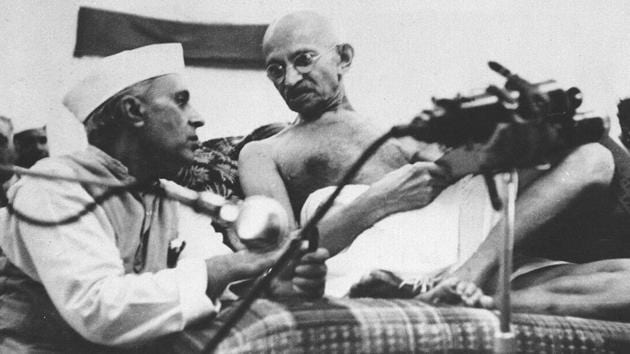
Jawaharlal Nehru and Mahatma Gandhi converse at a session of the Indian National Congress in Gowalia Tank, Bombay, a few hours before their arrest on August 8, 1942. At the historic session of Congress on August 7 and 8 at Gowalia Tank ground (now called August Kranti Maidan in memory of that historic event), Gandhi gave the slogan “Do or Die” which had an electrifying effect on the people. (National Gandhi Museum)
4/7
 View Photos in a new improved layout
Updated on Sept 26, 2019 5:43 PM
Demonstrators stand up to the police in Bombay during the Quit India Movement. Gandhi had immense faith in the abilities of women and this was validated time and again. The women, people from all sections, particularly merchants and the shopkeepers in Bombay, supported him in his movements and constructive activities. (Alamy Stock Photo)
5/7
 View Photos in a new improved layout
Updated on Sept 26, 2019 5:43 PM
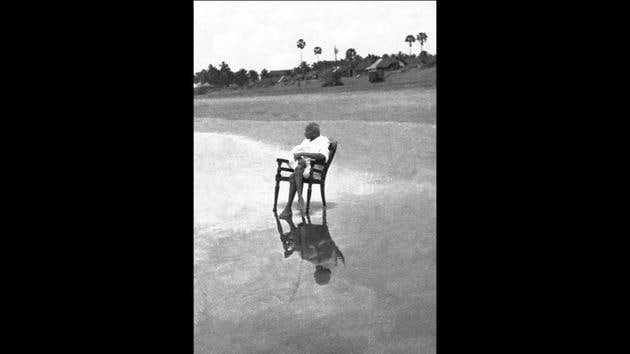
Gandhi at Juhu Beach in May 1944. Perhaps no single act binds Gandhi to the city as closely as the events of July 1921 in the Elphinstone mill compound in Parel. “Swaraj is impossible without Swadeshi,” declared Gandhi, honouring Lokmanya Tilak as spectacular bonfires of foreign-made saris, shirts and jackets were first lit. History records more than 10,000 attendees. This event sparked bonfires across India as people began to reject foreign goods. (Alamy Stock Photo)
6/7
 View Photos in a new improved layout
Updated on Sept 26, 2019 5:43 PM
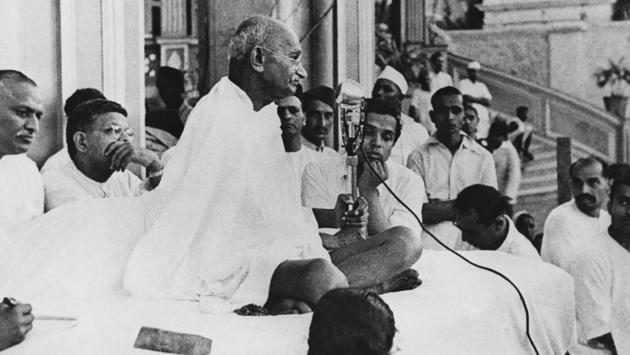
Mahatma Gandhi speaks at a prayer meeting in Bombay, 1946. In 1944, when Gandhi had to travel from Birla House to Jinnah House, up the road, to conduct what came to be called the Gandhi-Jinnah talks (over the two-nation theory and, eventually, Partition), he did so on foot. July 1946 marked Gandhi’s last visit to Bombay. (National Gandhi Museum)
7/7
 View Photos in a new improved layout
Updated on Sept 26, 2019 5:43 PM


