
 E-Paper



Photos: After Wimbledon, its historic forerunner real tennis cuts to the chase
Real tennis, the historic forerunner of the modern sport --Wimbledon, is still played on a few dozen courts across the globe, including at Hampton Court Palace in London. Today, real tennis survives on fewer than 50 courts worldwide: around half are in Britain, with others in the United States and a few in Australia and France. Having to be fit, the mental game like chess and having to learn the technique makes it altogether a fascinating game.
Updated on: Jul 24, 2018 9:26 AM IST


Share via


Copy link

1/9
 View Photos in a new improved layout
Updated on Jul 24, 2018 9:26 AM
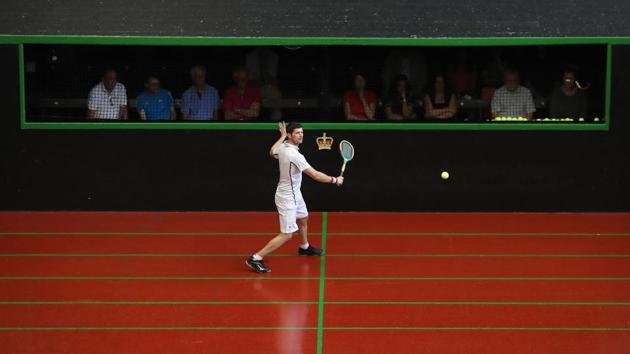
Nick Howell plays during a match at the real tennis champions trophy in Hampton Court Palace, London. As the dust settled at Wimbledon, the real tennis action was under way-- the world’s best players of the original sport duelled it out at the game’s spiritual home. Real tennis, the historic forerunner of the modern sport, is still played on a few dozen courts across the globe, including at Hampton Court Palace. (Daniel Leal-Olivas / AFP)
2/9
 View Photos in a new improved layout
Updated on Jul 24, 2018 9:26 AM
Howell and Ben Taylor-Matthews (top) play a match during the champions trophy. On a court originally built in 1530 for king Henry VIII, the top players laid chases and hit boomerangs, giraffes and railroads -- some of the sport’s quirky moves. Real tennis claims several common phrases originate from the game: cut to the chase, off the wall, in the nick of time, from pillar to post and impress the gallery. (Daniel Leal-Olivas / AFP)
3/9
 View Photos in a new improved layout
Updated on Jul 24, 2018 9:26 AM
Nicola, pro-player and staff member poses with a real tennis racquet. “It’s the best game, ever. Simple!” said world champion Rob Fahey, considered the sport’s all-time greatest player. The 50-year-old Australian said that it’s the beginning of everything and the most important thing is to realise is that this isn’t tennis. (Daniel Leal-Olivas / AFP)
4/9
 View Photos in a new improved layout
Updated on Jul 24, 2018 9:26 AM
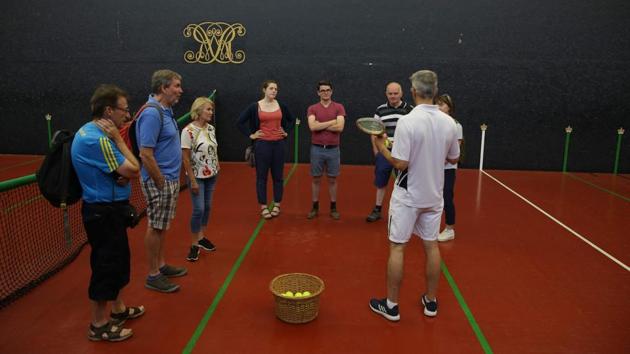
Nick Wood, head professional explains the rules of the real tennis to visitors. The Royal Tennis Court at Hampton Court Palace was built by kings, for kings to play on. The sport evolved as a street game played in medieval European courtyards, hence its asymmetrical layout, with what looks like a row of small shops along two sides whose windows and roofs are part of the court. (Daniel Leal-Olivas / AFP)
5/9
 View Photos in a new improved layout
Updated on Jul 24, 2018 9:26 AM
Clubs need to make their own balls, which are hard and solid, unlike lawn tennis balls. Weighing 81 to 88 grammes, they are comprised of crumbled wine corks, tightly wrapped in cling film and tied in twine, bound in cotton tape, then stitched into yellow felt. (Daniel Leal-Olivas / AFP)
6/9
 View Photos in a new improved layout
Updated on Jul 24, 2018 9:26 AM
Pro-player and staff member Josh Smith changes the strings of a racket during the champions trophy. The sport still uses wooden racquets with a small, angled head. According to Wood, lawn tennis-style graphite racquets were tried but they were judged too powerful and “destroyed the grace and skill of the game.” (Daniel Leal-Olivas / AFP)
7/9
 View Photos in a new improved layout
Updated on Jul 24, 2018 9:26 AM
The ball comes off the racquet at up to 160 kilometres per hour like an Exocet missile coming straight at the player. Real tennis today survives on fewer than 50 courts worldwide: around half are in Britain, with others in the United States and a few in Australia and France. (Daniel Leal-Olivas / AFP)
8/9
 View Photos in a new improved layout
Updated on Jul 24, 2018 9:26 AM
The sport declined in the 20th century as lawn tennis took over, but since the 1970s, new courts have been built and the game is growing. Its French name, jeu de paume, refers to the time before racquets when it was played with the open palm. There were once 250 courts in Paris alone; there are now two in France. (Daniel Leal-Olivas / AFP)
9/9
 View Photos in a new improved layout
Updated on Jul 24, 2018 9:26 AM


