

 E-Paper


Manhattanhenge marvel
1 / 10
 View Photos in a new improved layout
Updated on Jul 12, 2012 12:21 pm IST
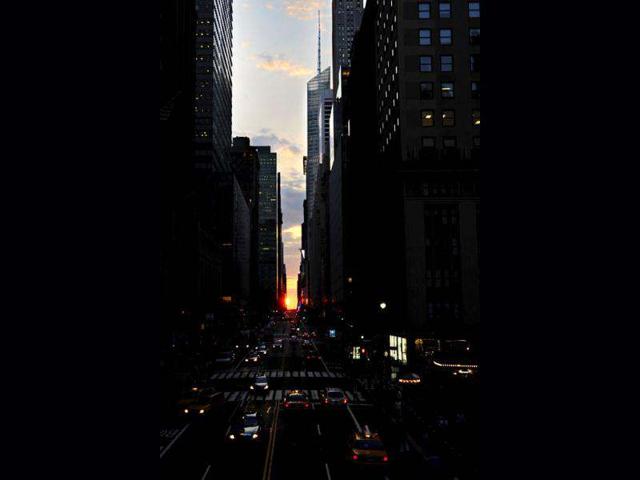
The sun sets over 42nd Street at the Park Avenue overpass in New York's Manhattan borough during a phenomenon known as Manhattanhenge. Manhattanhenge, sometimes referred to as the Manhattan Solstice, happens when the setting sun aligns with the east-to-west streets of the main street grid. The term references Stonehenge, at which the sun aligns with the stones on the solstices in England. (AP Photo/Jeffrey Furticella)
2 / 10
 View Photos in a new improved layout
Updated on Jul 12, 2012 12:21 pm IST
People stand in the middle of 42nd Street in New York's Manhattan borough as the sun sets through the middle of the buildings during a phenomenon known as Manhattanhenge. Manhattanhenge, sometimes referred to as the Manhattan Solstice, happens when the setting sun aligns with the east-to-west streets of the main street grid. The term references Stonehenge, at which the sun aligns with the stones on the solstices in England. (AP Photo/Julio Cortez)
3 / 10
 View Photos in a new improved layout
Updated on Jul 12, 2012 12:21 pm IST
The sun sets as seen from 42nd street in New York City, as Manhattanhenge, sometimes also referred to as Manhattan Solstice, the biannual natural event, when it is perfectly aligned with Manhattan’s numbered streets. AFP PHOTO / TIMOTHY A. CLARY
4 / 10
 View Photos in a new improved layout
Updated on Jul 12, 2012 12:21 pm IST
Photographers aim their cameras as the sun sets through the buildings on 42nd Street in New York's Manhattan borough during a phenomenon known as Manhattanhenge. Manhattanhenge, sometimes referred to as the Manhattan Solstice, happens when the setting sun aligns with the east-to-west streets of the main street grid. The term references Stonehenge, at which the sun aligns with the stones on the solstices in England. (AP Photo/Julio Corte)
5 / 10
 View Photos in a new improved layout
Updated on Jul 12, 2012 12:21 pm IST
A woman takes a photo with an iPad as people wait for the sun to set through the middle of the buildings on 42nd Street in New York's Manhattan borough during a phenomenon known as Manhattanhenge. Manhattanhenge, sometimes referred to as the Manhattan Solstice, happens when the setting sun aligns with the east-to-west streets of the main street grid. The term references Stonehenge, at which the sun aligns with the stones on the solstices in England. (AP Photo/Julio Cortez)
6 / 10
 View Photos in a new improved layout
Updated on Jul 12, 2012 12:21 pm IST
The sun sets as seen from 42nd street in New York City, as Manhattanhenge, sometimes also referred to as Manhattan Solstice, the biannual natural event, when it is perfectly aligned with Manhattan’s numbered streets. AFP PHOTO / TIMOTHY A. CLARY
7 / 10
 View Photos in a new improved layout
Updated on Jul 12, 2012 12:21 pm IST
The sun sets as seen from 42nd street in New York City as Manhattanhenge, sometimes also referred to as Manhattan Solstice, the biannual natural event, when it is perfectly aligned with Manhattan’s numbered streets. AFP PHOTO / TIMOTHY A. CLARY
8 / 10
 View Photos in a new improved layout
Updated on Jul 12, 2012 12:21 pm IST
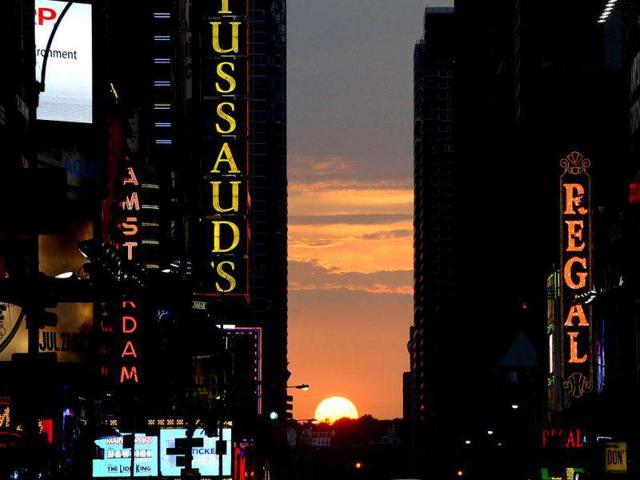
The sun sets as seen from 42nd street in New York City, as Manhattanhenge, sometimes also referred to as Manhattan Solstice, the biannual natural event, when it is perfectly aligned with Manhattan’s numbered streets. AFP PHOTO / TIMOTHY A. CLARY
9 / 10
 View Photos in a new improved layout
Updated on Jul 12, 2012 12:21 pm IST
The sun sets as seen from 42nd street in New York City, as Manhattanhenge, sometimes also referred to as Manhattan Solstice, the biannual natural event, when it is perfectly aligned with Manhattan’s numbered streets. AFP PHOTO / TIMOTHY A. CLARY
10 / 10
 View Photos in a new improved layout
Updated on Jul 12, 2012 12:21 pm IST