E-Paper



What happens to Mumbai’s high-rise buildings after 30 years? Redditors debate maintenance, repairs and redevelopment
Mumbai real estate: A discussion on Reddit has sparked a debate around the long-term maintenance, repair costs and eventual redevelopment of high-rise buildings

 Prefer HTon Google


Mumbai real estate market's skyline continues to build upwards, a question that is rarely part of the conversation around new luxury towers is beginning to attract attention is what happens to these buildings after 30 years? A discussion on Reddit’s Indian real estate forum has sparked a debate around the long-term maintenance, repair costs and eventual redevelopment of high-rise residential buildings in Mumbai.

The concern is particularly relevant for a city where high-rise living involves complex common infrastructure, including lifts, fire-safety systems, water pumps, electrical installations, façades, plumbing networks and parking structures.
Unlike an individual house, maintaining a large residential tower requires an entire society to continuously fund and coordinate repairs. As buildings age, the cost of replacing major equipment and carrying out structural and non-structural repairs can become a significant financial burden for residents.
Mumbai’s regulatory framework already recognises the importance of monitoring ageing buildings. Structural audits are required for buildings crossing prescribed age thresholds, with the first audit generally linked to the building reaching 30 years under Mumbai’s applicable provisions.
The audit, however, does not automatically mean that a building has reached the end of its life. Depending on its structural condition, construction quality and maintenance history, a building can continue to be occupied with appropriate repairs and periodic assessments.
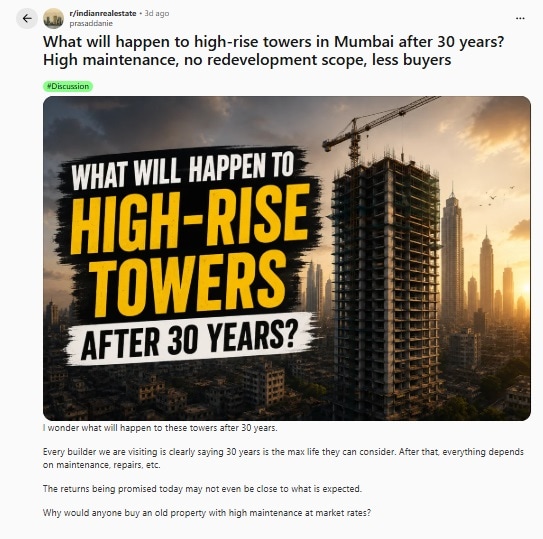
The Reddit post stated, "What will happen to high-rise towers in Mumbai after 30 years? High maintenance, no redevelopment scope, less buyers. Every builder we are visiting is clearly saying 30 years is the max life they can consider. After that, everything depends on maintenance, repairs, etc. I wonder what will happen to these towers after 30 years. The returns being promised today may not even be close to what is expected. Why would anyone buy an old property with high maintenance at market rates?"
Netizens react on social media
On Reddit, the comments reflected the uncertainty surrounding the long-term economics of high-rise ownership. The discussion centred on whether societies would eventually face sharply higher maintenance and repair bills, and whether redevelopment could become the more practical option once buildings become sufficiently old.
Some of the broader sentiment around apartment ownership also focused on construction quality and the ability of residents’ associations to maintain buildings properly over time.
"Modern high rise towers are generally designed to have a life of more than 50 years. Many buildings constructed 40 years ago are still structurally good today if they have been properly maintained. Newer construction technologies can improve construction quality, consistency, and durability when used correctly. I believe we don't need to be worry about a newly constructed tower for the next 50 years, provided it is well-designed, properly constructed, and maintained regularly," a user commented.
Another user said good housekeeping and strong maintenance is the key.
"I live in society of around 1000 flats in Mumbai and we are managing well with mc, pm and society committees so I don't think that's a issue we have completed 10 years while some buildings 5-6 years till now no issues lets see how it goes in next 20-30 years and yeah it's same builders pm team so they know all problems well," one user said.
What experts opine?
Experts say redevelopment will be the solution for old buildings even after 50 years
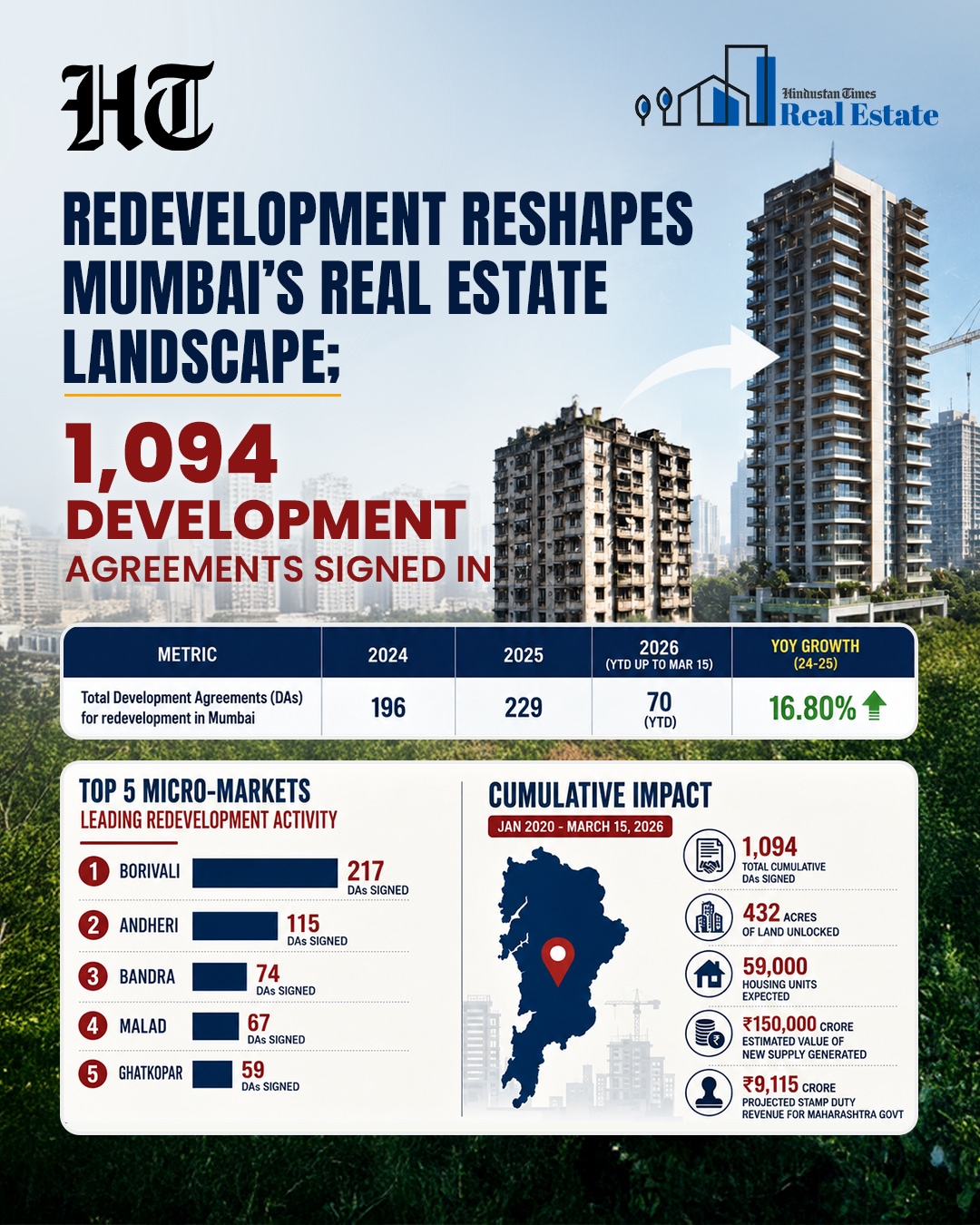
According to experts, redevelopment could eventually offer another route. Mumbai’s property market is already moving towards redevelopment as a major source of housing supply, with redevelopment-project sales recently surpassing sales from new project launches.
Mumbai real estate market's redevelopment segment has reported more than 1,000 projects since 2020, comprising 13% of city's overall residential supply and 15% of housing sales, according to a report released by JLL India and NAREDCO on September 3.
Five locations including Borivali, Malad, Andheri, Vikhroli, and Goregaon, account for around 36% of all projects since 2020, with the western suburbs dominating at 35-45% of both launches and sales (2025-H1 2026).
According to the report, redevelopment’s share of total housing sales has surged to 15% in 2025-H1 2026, up from 6% recorded over 2016-2021, confirming that homebuyers are now actively choosing redevelopment over greenfield alternatives.
Also Read: What is driving the growing interest of large corporates in Mumbai's cluster redevelopment projects?
The report said that currently there are 1,202 active slum rehabilitation projects covering 321,858 hutments across 2,156 acres, nearly 4x the total acreage completed in the 30 years since formation of SRA's in 1995.