
 E-Paper



Bangladesh violence: 32 killed, hundreds injured. Why are students protesting? What are the demands? | Explained
Bangladesh quota protest: Hundreds of university students in Dhaka and other cities have been holding rallies for weeks.

 Prefer HTon Google


At least 32 people have been killed, and over 2,500 are injured in Bangladesh as violence escalated during student protests who are demanding quota system reform for government jobs. On Thursday, the protests took an even ugly turn as the demonstrating students set fire to the country's state broadcaster, a day after Prime Minister Sheikh Hasina appeared on the network seeking to calm the escalating clashes.
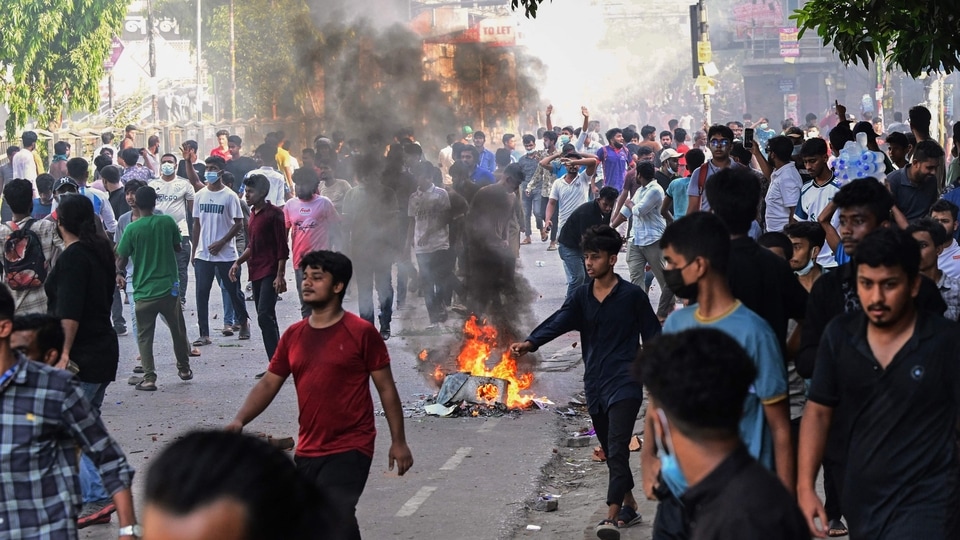
Hundreds of university students in Dhaka and other cities have been holding rallies for weeks, protesting the system of reservation in public sector jobs, including that for the relatives of war heroes, who fought for the country's independence from Pakistan in 1971.
What triggered the Bangladesh protests?
The protests began last month after the Bangladesh high court reinstated a quota system for government jobs, overturning a 2018 decision by Prime Minister Sheikh Hasina's government to scrap it. However, the Supreme Court suspended the high court's order after the government's appeal, setting a date of August 7 to hear the government's challenge.
The demonstrations escalated when Sheikh Hasina refused to meet the students' demands, citing court proceedings.
They turned violent this week following clashes between thousands of anti-quota demonstrators and members of the student wing of Hasina's Awami League party. The police also resorted to using rubber bullets, tear gas and noise grenades to disperse the protesters, but to no avail.
The violence further prompted authorities to shut the metro rail inside the capital alongside the railway services to and from Dhaka since Thursday afternoon. The government also ordered the shutdown of mobile internet networks across several parts of the country. According to outage monitor Netblocks, Bangladesh was suffering a “near-total internet shutdown”.
Also read: Indian residents in Bangladesh urged to avoid travel amid anti-quota protests
Earlier on Thursday, the Bangladesh police website was inaccessible, and the website of the ruling Awami League’s student wing, Bangladesh Chhatra League, was hacked, reported PTI.
The Bangladesh government has also schools and universities to shut indefinitely amid the escalating protests.
What are the students demanding?
The demonstrating students are demanding an end to a quota system that reserves more than half of government jobs for specific groups, including children of veterans from the country's 1971 liberation war against Pakistan.
What is the quota system?
The quota system in Bangladesh has undergone several changes since it was introduced in 1972. The system covers groups such as freedom fighters' families, with women and those from underdeveloped districts receiving a share of a tenth each. Five per cent is allotted to Indigenous communities, and one per cent is allotted to the disabled, reported Reuters.
When the system was abolished in 2018, reportedly, 56 per cent of government jobs were blocked under various quotas.
The protesting students fear that the quota shrinks the number of government jobs open for all, hurting aspirants who want them filled on the basis of merit.
What has Sheikh Hasina-led Bangladesh government said?
On Thursday, Bangladesh law minister Anisul Huq expressed willingness to hold talks with the protesting students after fresh violence erupted across the country.
“Whenever they agree, we will sit...it could be held this (Thursday) afternoon even…Government has agreed to hold talks with the quota reformists,” he said, as quoted by PTI.
Meanwhile, Hasina condemned the loss of lives and called for patience until the Supreme Court delivers its verdict.
(With inputs from agencies)


