
 E-Paper



G-20 Squabbling Overshadows Summit as Global Bond Markets Strain
The finance ministers’ gathering comes to a close amid a global bond-market selloff, spats over tariffs, and public insults.


 Prefer HTon Google


ASHEVILLE, N.C.—U.S. Treasury Secretary Scott Bessent arrived here to host global economic officials in the Blue Ridge Mountains, fresh off the breakdown of trade talks with Canada, currency and bond-market interventions, and President Trump’s renewed economic threats against Iran.
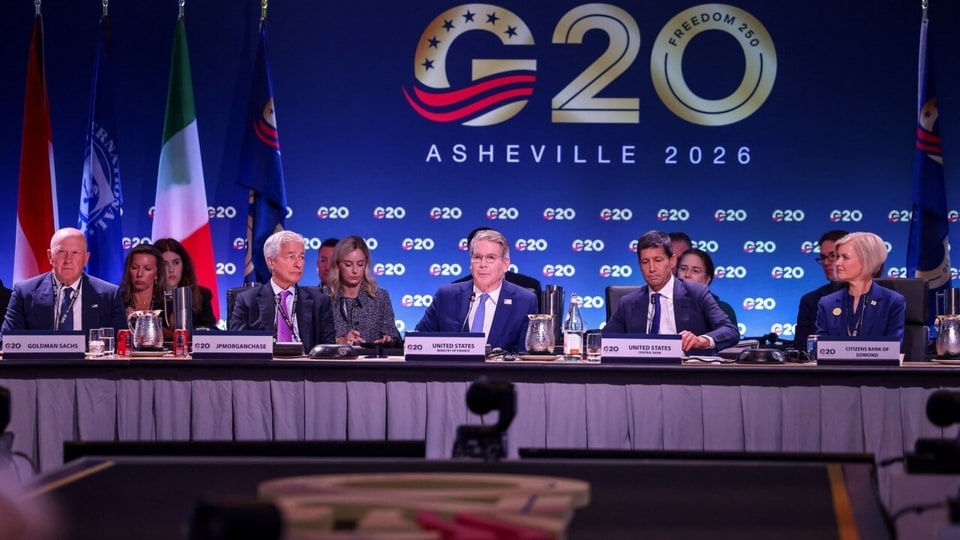
Two days later, the G-20 finance ministers’ gathering comes to a close amid a global bond-market selloff, spats over tariffs, public insults and fighting over a group photo.
In a press conference at the summit’s conclusion Tuesday night, Bessent said that meetings were productive, tackling trade imbalances, artificial intelligence and sovereign debt.
Deep Dive

But the disconnect between the sideline bickering—a renamed Great Lake, a photo with a Russian minister—and the growing stress in global markets raised fears among many investors that leaders aren’t confronting challenges that could quickly spiral out of control. As their meeting concluded on Tuesday, the benchmark 10-year Treasury yield rose to 4.795%, the highest since Trump began his second term.
Global economic leaders are now presiding over rising anxiety in financial markets at a particularly lousy moment. The Americans, carrying a staggering $40 trillion in government debt, used this week’s meeting to make the case that economic growth can outrun that debt.
“The world is awash in debt,” Bessent told reporters Monday at the gathering. “The only way for us to get out of this is to grow our way out of it.”
After the summit, Bessent said, “With America once again leading this forum, the days of settling for subpar growth are over. The discussions we’ve had here this week leave me confident that many of our partners are now prepared to join us.”
The bond market, however, is rebelling against that premise—a selloff is sending yields higher and raising governments’ borrowing costs.
Bessent released a statement that he said reflected the general position of every country present except for China, which he said was unlikely to agree to a pointed statement about trade imbalances. The Wall Street Journal didn’t independently confirm that all countries at the summit agreed with the statement.
“In particular, countries with excessive and persistent external surpluses should remove distortions that constrain domestic consumption and that result in an overreliance on exports for growth,” the Treasury statement said.
Without China, the group was unable to issue an official consensus statement.
It was a summit of squabbling from the start. The proceedings had barely begun when Bessent mocked Canada’s military, dismissing it with a reference to a decommissioned amusement-park ride. Canadians seethed at Trump’s move to rename Lake Ontario and redoubled their efforts to build closer trading ties with other countries. Other delegates bristled that the spat between close allies was an unnecessary distraction.
“I think that in this world where tensions are numerous, it’s probably no time to add tensions, especially between two historical partners,” French Finance Minister Roland Lescure said.
Meanwhile, Europeans were furious that Russia’s finance minister Anton Siluanov was invited. (Russia hadn’t been invited since it invaded Ukraine in 2022). Bessent’s threats to impose sanctions on Iran’s trading partners hovered over his meeting with China’s central bank governor Sunday. Bessent later told former Trump adviser Larry Kudlow at a G-20 event that the longtime U.S. adversary is on their side when it comes to certain aspects of the Iran conflict. China is a top trading partner with the Iranian regime.
“The Chinese agree Iran cannot have a nuclear weapon. The Chinese agree that there should be freedom of navigation in the Strait of Hormuz. We have had private discussions with them in terms of achieving those goals,” Bessent told Kudlow just two days after meeting with the senior Chinese official.
The summit convened finance ministers and central bankers from the “Group of 20” rich and developing countries. The G-20 intends these events to be a substantive appetizer for the G-20 leaders summit, which this year Trump will host at his Doral, Fla., resort in December.
Traditionally, the summit is held to bring together the top financial ministers and find a way for them to coalesce around joint challenges. With 20 countries, there are often differing opinions and factions. But this summit appeared to never have had much momentum. Even the simplest goals spurred divisions.
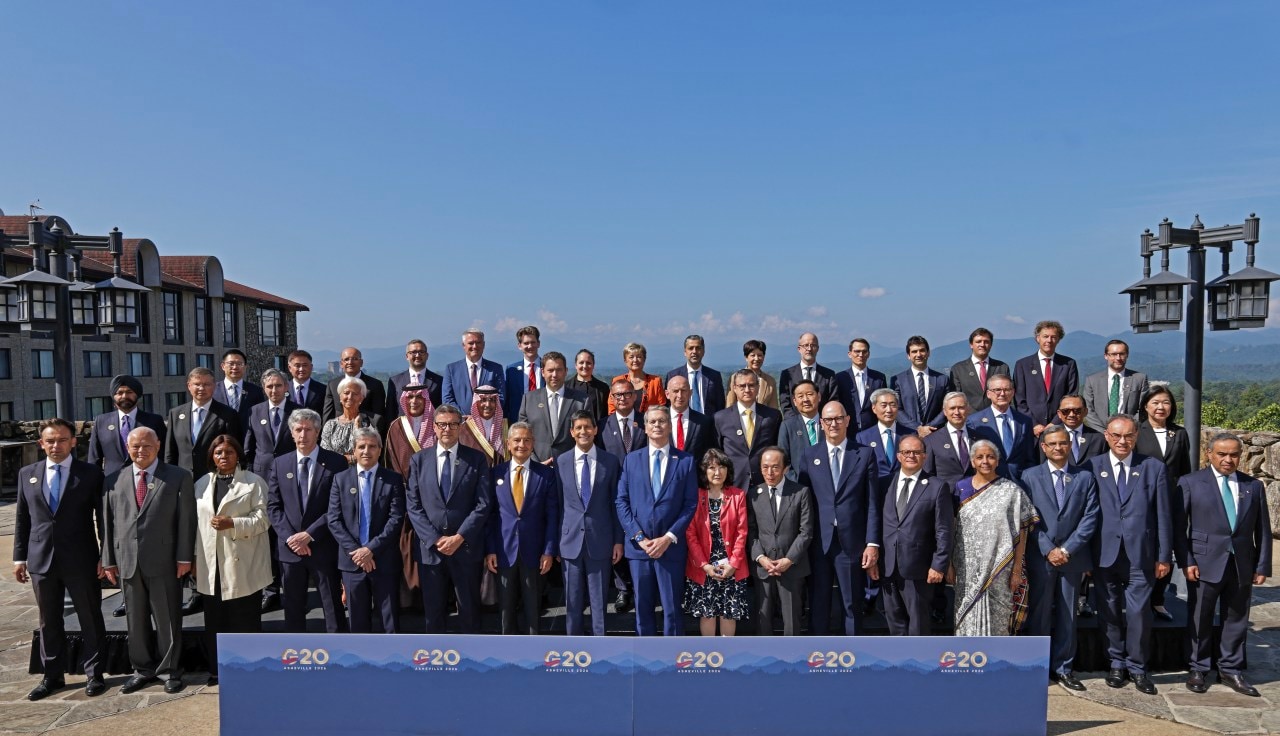
Before the U.S. attempted to gather the top attendees Monday for a “family photo,” a tradition of such summits, the Europeans blanched. Ministers said they wouldn’t participate if the Russian finance minister was in the photo, people familiar with the matter said. They said they would send their deputies instead if the Russian official was part of the photo, one of the people said.
“The joint approach of the Europeans—for which I am also very grateful—ultimately led to this family photo taking place without the Russian finance minister, without the Russian delegation,” German finance minister Lars Klingbeil told reporters.
At the press conference after the summit, Bessent said of the Russian minister’s presence, “I know that some Europeans had a sour taste, but I think it’s very important to engage.”
Just as the meetings were getting started, Bessent had harsh words for Canada, saying it was impossible for the U.S. neighbor to be in a tit-for-tat trade war with “someone who’s 13 times larger than you are.” Bessent also joked that Canada might send mini-submarines previously used on an amusement-park ride to attack the U.S. The U.S. defense secretary, Pete Hegseth, posted a photo on social media of two young women at a Canadian cadet training center that was interpreted as mocking their weight and gender.
“When the Americans stop doing memes, stop throwing shade, stop trying to be tough, and start being serious about having those discussions, we can have those discussions. But look, it’s not constructive,” Canadian Prime Minister Mark Carney told reporters in Ottawa on Tuesday.
The Treasury Department didn’t respond to repeated requests for comment about the summit.
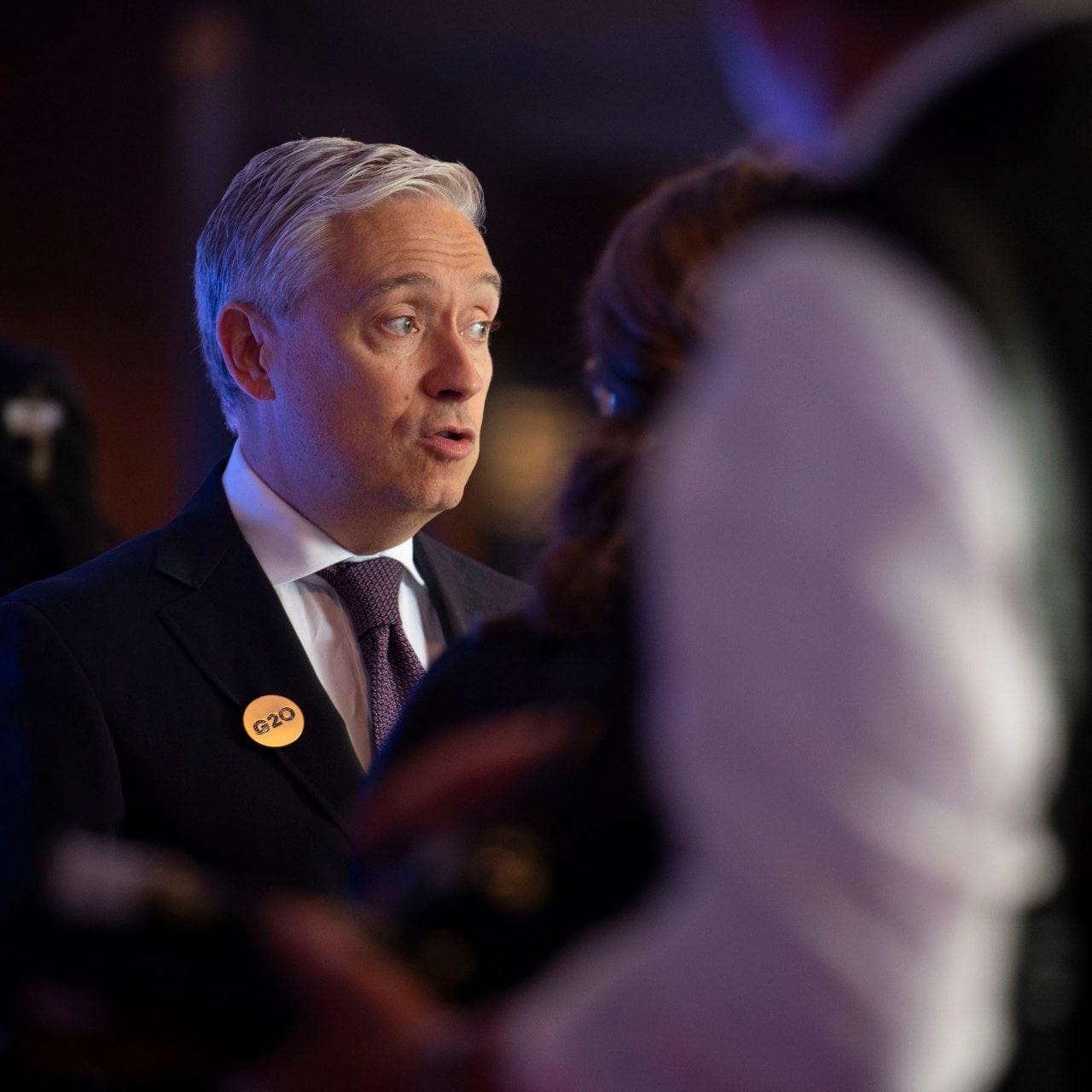
Canadian Finance Minister Francois-Philippe Champagne said he met with Bessent Tuesday. “The message I am going to bring, of course, is that we are going to stand up for our workers,” he told reporters before the meeting.
On Tuesday, Bessent lit into Iran, comparing it to a dying snake still wriggling after decapitation. The prolonged standoff between the U.S. and Iran has added to inflation and put bond markets on edge, and Bessent’s comments suggest that the U.S. is willing to endure more economic pain in order to squeeze Tehran.
This annual summit has been showing signs of fraying for years. In 2025, Bessent skipped the finance ministers’ meeting hosted by South Africa amid Trump’s allegations that South Africa was confiscating land from white South Africans.
The Treasury secretary arrived making the case that the Trump administration was well on its way to fixing an American economy that had floundered under the Biden administration, and that other countries could thrive by following a similar deregulatory agenda.
“I say sometimes I feel like an emergency-room doctor, and the economy is the patient, and the American people were backed over by the Biden Mack truck,” Bessent told reporters Monday. “We have stabilized the patient, and now we are in the healing portion.”
The U.S. economy, however, has shown signs of strain. The U.S. government is running huge budget deficits, gasoline prices are high, the labor market lost 23,000 jobs in July, and inflation is still above the Fed’s target.
Bessent was joined at the summit by Federal Reserve Chairman Kevin Warsh, who faces a tough decision about whether to raise interest rates as soon as this month to combat inflation, despite Trump’s demands for lower rates. Warsh has suggested the Fed might need to act, another factor pushing bond yields higher.
Leaders of two of America’s biggest banks, Goldman Sachs David Solomon and JPMorgan’s Jamie Dimon, took part in a roundtable discussion with finance ministers on Monday. The Trump administration privately requested the executives discuss the state of the U.S. economy at the meeting, according to a person familiar with the matter.
Dimon, in a statement sent to reporters by G-20 organizers, cheered the invite. “For the first time at G-20, the Treasury has given the private sector a place at the table. Good policy is made better when those who lend, hire, invest and build have a voice in shaping it,” Dimon said.
Solomon said in an interview with CNBC on the sidelines of the conference that his outlook is “pretty constructive” and that the “economy is performing well,” noting headwinds with conflicts in the Middle East and trade wars.
Some executives who attended the summit and met with Bessent told their advisers that in private, Bessent made the case that the U.S. economy remains strong. He offered few new details or conclusions during the meetings on how the administration plans to handle Iran as well as a sluggish market, these people said.
The bond market, though, was casting its own verdict on the challenge governments are up against.
The market for U.S. Treasurys, long considered an ultrasafe asset by investors, was flashing a warning light. Short- and long-term yield benchmarks both set new 2026 highs Tuesday.
Write to Matt Grossman at matt.grossman@wsj.com, Brian Schwartz at brian.schwartz@wsj.com, Paul Vieira at Paul.Vieira@wsj.com and Kim Mackrael at kim.mackrael@wsj.com


