
 E-Paper



Trump says Harris is Indian, turned Black recently; his lies spark outrage
Kamala Harris, born to a Black father and Indian mother, calls Trump’s remarks divisive and disrespectful; White House slams Donald Trump for such remarks


Washington: Donald Trump, the presumptive Republican nominee for President, has said that his likely rival, Vice-President and the presumptive Democratic nominee, Kamala Harris was “always Indian”, promoted only Indian heritage, then made a “turn” and “became a Black person”.
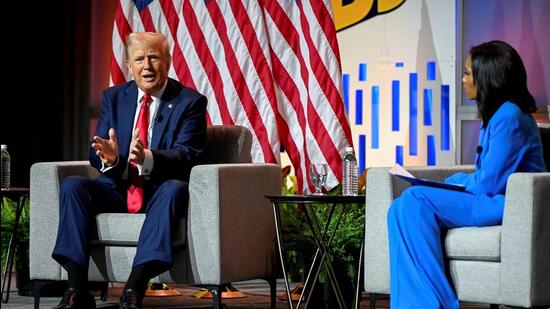
Trump made the clearly false — and some critics allege even racist — assertion while speaking at a gathering of the National Association of Black Journalists (NABJ), in Chicago, Illinois on Wednesday.
Harris, who is biracial, dismissed Trump’s remarks as a part of the “same old show” of divisiveness and disrespect. The White House termed Trump’s statement as “repulsive”. A leader of the Congressional Black Caucus termed it as “extremely offensive” to Black communities. Trump, however, stuck to his claim, with his campaign selectively tweeting videos of Harris cooking Indian food and identifying herself as Indian, an indication that Republicans may continue using the line of attack.
Trump’s attack
In response to a question on whether he thought Harris was a “DEI candidate”, Trump first asked the journalist questioning him, Rachel Scott of ABC News, what DEI meant. When she clarified it was diversity, equity and inclusion, Trump again pushed her for a definition while Scott repeated the question. “I really don’t know, could be,” Trump said. In the Indian context, the closest analogy to Trump’s response would be referring to someone as a “quota candidate”, a label that many would interpret as a casteist slur.
It was then that Trump, unprovoked, questioned Harris’s identity. “I have known her a long time indirectly, not directly very much, and she was always of Indian heritage. And she was only promoting Indian heritage. I didn’t know she was Black until a number of years ago when she happened to turn Black. Now she wants to be known as Black. So I don’t know — is she Indian or is she Black?” When Scott, the journalist, told Trump that Harris was Black, the former president reiterated his claim, “I respect either one but she obviously doesn’t because she was Indian all the way, and then all of a sudden she made a turn and she became a Black person.”
Trump’s remark led to gasps in the audience of Black journalists. Harris was born to a Jamaican Black father and Indian mother, both immigrants, in California. She was raised Black. She went to a historically Black university and has been a part of Black sororities for decades. She has publicly written about and owned both her identities, as a Black and Indian woman. And she is universally recognised as the first Black woman vice-president, only the second Black woman senator in American history, and now possibly the first Black woman to be a nominee of a major party to be president.
Trump’s statement fit in with a pattern. He had questioned America’s first Black president, Barack Obama’s eligibility for the presidency and demanded that Obama show his birth certificate. Trump’s comments also come at a time when Harris’s favourability ratings have spiked, there is clear consolidation of the Black and liberal base behind Harris, and the election has suddenly become a lot closer than what it appeared in the aftermath of the assassination attempt on Trump and the Republican National Convention two weeks ago.
Harris’s Black roots
Speaking, ironically enough at a pre-scheduled Black sorority event on Wednesday night, Harris dismissed Trump’s statement as a part of the “same old show”. “It was the same old show: the divisiveness and the disrespect. And let me just say, the American people deserve better. The American people deserve a leader who tells the truth. A leader who does not respond with hostility and anger when confronted with the facts. We deserve a leader who understands that our differences do not divide us – they are an essential source of our strength.”
While Harris didn’t offer autobiographical details, she has, in her memoir, The Truths We Hold, written of her and her sister, Maya’s, childhood. Harris was born to two immigrants, a Jamaican economics student, Donald Harris, and an Indian science student, Shyamala Gopalan, who met in the early 1960s in Berkley while participating in African American study circles and the civil rights movement devoted to Black rights. Harris grew up in an environment where she both conscious of her Black identity and was surrounded by friends of her parents who became pioneers of an entirely new academic discipline focused on Black history and oppression.
While her parents separated when she was seven, Harris wrote about her mother, “From almost the moment she arrived from India, she chose and was welcomed to and enveloped in the black community. It was the foundation of her new American life….My mother understood very well that she was raising two black daughters. She knew that her adopted homeland would see Maya and me as black girls and she was determined to make sure we would grow into confident, proud black women.”
Harris has also written of Regina Shelton, a Black woman from Louisiana who helped take care of her, as a “second mother”.
Harris also went to Howard University, a historically Black institution in Washington DC, where she joined Alpha Kappa Alpha, a Black sorority. Subsequently, in law school back in California in the mid 1980s, Harris was elected the President of the Black Law Students Association.
In a 2019 New Yorker profile published in the run-up to her presidential bid, Harris was asked about her Black identity. Trump’s son, Donald Trump junior, had then retweeted and deleted a post that denied Harris was a Black American. The magazine quoted Harris telling a radio show, “Look, this is the same thing they did to Barack. They don’t understand what black people are. Because if you do, if you walked down Hampton’s campus, or Howard’s campus, or Morehouse, or Spelman, or Fisk, you would have a much better appreciation for the diaspora, for the diversity, for the beauty in the diversity of who we are as black people. So I’m not going to spend my time trying to educate people about who black people are.”
“Repulsive”: White House slams Trump
Trump’s statement caused widespread outrage.
In a rare comment on a statement by a candidate, White House press secretary Karine Jean-Pierre, who is the first Black person from the LGBTQ+ community to hold the position, said, “As a person of colour, as a Black woman who is in this position, that is standing before you at this podium, what he just said, what you just read out to me is repulsive. It’s insulting. And, you know, no one has any right to tell someone who they are, how they identify. That is no one’s right. It is someone’s own decisions.” Jean-Pierre added that only Harris could speak to her experience. “And she is the vice-president of the United States, Kamala Harris. We have to put some respect on her name, period.”
Gregory Meeks, a Democrat leader of the Congressional Black caucus who is also the ranking member of the House Foreign Affairs Committee, hit out at Trump and claimed his statement was a part of a pattern of lifelong bigotry. “Donald Trump using the largest convening of Black journalists to publicly question Vice-President Harris’ identity as a Black woman and insult her intelligence is extremely offensive to Black voters across our country.”
Derrick Johnson, the president of NAACP, one of the oldest and most prestigious Black civil rights organisations, said on X, “To walk into a room full of Black journalists and attack someone’s ‘Blackness’ is another level of disrespect. To anyone who needs a reminder: we can’t change the colour of our skin, and we don’t want to.”
But Trump and his campaign stuck to their line of attack, which appeared to be aimed at driving a wedge between Harris and the Black community and sow confusion.
Posting a four-year old video of Harris with Mindy Kailing, an Indian-American producer and writer in Hollywood, where both celebrate their Indian, particularly South Indian roots, and prepare to cook Indian food, Trump wrote on Truth Social, “Crazy Kamala is saying she’s Indian, not Black. This is a big deal. Stone cold phony. She uses everybody, including her racial identity!”
Trump’s post was a misrepresentation, for Harris did not say she is not Black, but only celebrated what she, even in the video, termed as the heritage of one half of her family.
Neil Makhija, a former director of Impact, a group dedicated to promoting Indian-Americans in politics, and now the commissioner of Pennsylvania’s Montgomery County said, “I have seen for years, right wing politicians speaking to Indian-American audiences say VP Harris identifies as Black and ‘hides’ her Indian heritage. Now when speaking to a Black audience, Trump and his weirdos say she is Indian, and only recently ‘turned Black’. Turns out she’s always been both and they have no integrity.”


