
 E-Paper





Follow the latest breaking news, major developments and agenda-setting stories from India and around the world with the newsdesk at Hindustan Times. Operating round the clock, the desk brings together experienced editors, reporters and correspondents to deliver fast, accurate and contextual reporting across subjects that influence public policy, governance, business, society and international affairs. The HT News Desk covers politics, elections, government policies, the economy, business and markets, science and technology, the environment, law and order, infrastructure, education, climate issues and geopolitics, while closely tracking developments across states, institutions and global capitals. The team also leads coverage of major breaking news events, policy announcements, court proceedings, natural disasters, public emergencies and significant international developments. Reports published by the newsdesk are based on information gathered from reporters on the ground, official statements, government agencies, court records, regulatory filings, recognised institutions and other authoritative sources. Stories undergo editorial scrutiny and verification processes to ensure accuracy, fairness and relevance, and are updated as events evolve and additional information becomes available. Whether covering a key political decision in New Delhi, an economic policy shift affecting millions, a landmark court ruling or a major global event, the HT News Desk aims to provide readers with reliable, fact-based journalism that delivers not only the latest developments but also the context and analysis needed to understand their wider implications.
 Trending News
Trump-class battleships add to US Navy's cost burden as Iran war stretches fleet: Report
This comes at a time when the Iran war is stretching the Navy's operational capacity, with ships staying at sea longer and maintenance being deferred.


The US Navy's fleet expansion plans have gone billions of dollars over budget, with the proposed Trump-class battleships adding to the cost, according to a report submitted to the US Congress.
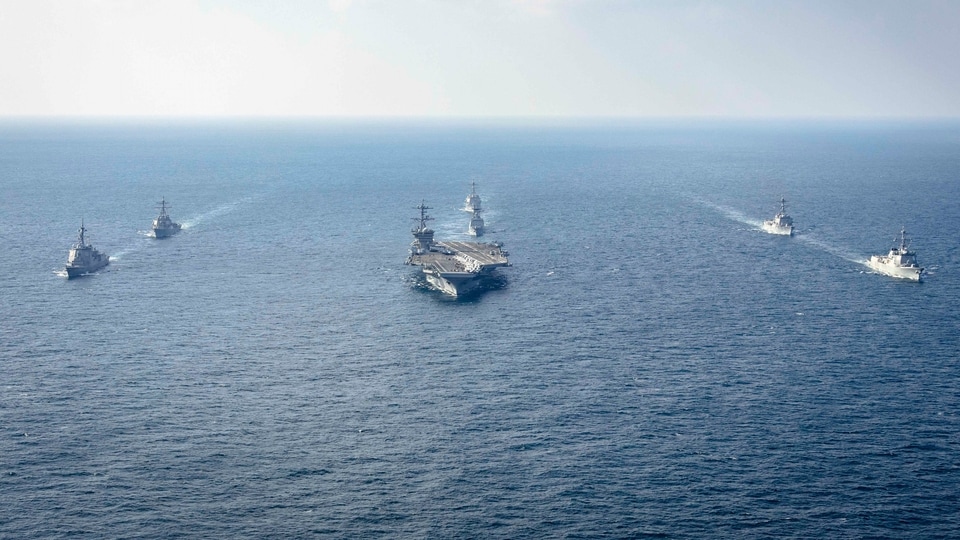
This comes at a time when the Iran war is stretching the Navy's operational capacity, with ships staying at sea longer and maintenance being deferred, officials said.
The challenges facing the world's largest naval force came into focus this week when the USS George Washington returned from the Middle East on Wednesday. Its return ended a rare three-month period during which the US had no aircraft carrier in the Pacific.
US Navy deployments have increasingly lasted more than 300 days, with maintenance and repairs being deferred to keep ships at sea for longer.
Costs higher than estimates
The US Navy plans to expand its fleet from 286 battle force ships to 381 over the next 30 years as it tries to keep pace with China's growing shipbuilding capacity, The Guardian reported.
However, an analysis by the Congressional Budget Office (CBO) of the Navy's 2027 shipbuilding plan found that the service had underestimated the cost of its fleet expansion by billions of dollars.
The report attributed the higher projections to more complicated ship designs and what it described as the “estimated costs of some ships were unrealistically low in earlier shipbuilding plans”.
Also Read: US may have just two aircraft carriers in Persian Gulf as USS George Washington heads to Japan
The CBO estimated that shipbuilding would cost an average of $54 billion annually, in 2026 dollars, over the next 30 years. This is about 18% higher than the Navy's estimates, the report further added.
The 15 proposed battleships belong to the Trump class. President Donald Trump has said the warships will be 100-times more powerful than any previous warship in a US fleet and will “inspire fear in America’s enemies all over the world”.
However, Senate appropriators this week proposed cutting to zero the $1 billion the Navy had sought in advanced procurement funding for the Trump-class ships in the current fiscal year.
Iran war puts pressure on fleet
The rising costs come as the Navy faces mounting pressure from the conflict with Iran.
On Wednesday, acting secretary of the Navy Hung Cao acknowledged at a Senate confirmation hearing that the war was “stretching” the fleet's capacity.
Senator Richard Blumenthal criticised the administration's handling of the conflict and its impact on the Navy.
“The world is less safe as a result of the Iran war,” Blumenthal told Cao as quoted in the report.
“We’ve seen costs soar, lives lost, casualties. Our relationships with allies deteriorate as a result of this war. In fact, the navy has been stretched beyond sustainable limits under your watch, and the fleet is in worse condition than it was when you took office along with this president.”
Michigan senator Elissa Slotkin told the committee that the conflict in Iran was estimated to have cost the US $260 billion.
The Iran war has also forced US Navy ships to remain deployed for longer periods.
Since the conflict began, deployments have lasted 10 to 11 months, compared with the standard seven months. Sailors have also been told to expect extended deployments to remain common for several years.
Several ships have spent more than 300 days on deployment since the war began. The USS Abraham Lincoln spent 265 days at sea, the longest period a Navy ship has gone without visiting a port.
US Navy faces overstretch in the Pacific
For only the second time in two decades, the US Navy had no aircraft carrier group in the Pacific between August and November.
The USS George Washington has now returned to the control of the US Pacific fleet, “conducting routine operations” in the Asia-Pacific region.
Prof Kevin Rowlands, journal editor at the Royal United Services Institute, told the Guardian that the pressure on the US Navy was “critical but manageable – for now”.
He warned that the situation could worsen if the conflict continued.
China expands shipbuilding capacity
The US has maintained unmatched naval strength for decades, allowing it to project military power across the world. However, China is rapidly narrowing the gap.
US naval intelligence estimates that China's overall shipbuilding capacity is roughly 232 times greater than that of the US.
Chinese shipyards delivered more than twice the naval tonnage produced by US shipyards across 2024 and 2025, according to the World Defense Shipbuilding report.


