
 E-Paper


US birthright citizenship at risk? Here's what happens if it's abolished; all we know as Trump faces major setback
US President Donald Trump's second term began with efforts to reinterpret the 14th Amendment, targeting birthright citizenship.

 Prefer HTon Google


One of the initial actions taken by Donald Trump during his second term was an effort to reinterpret the 14th Amendment of the United States Constitution. Amid a series of executive orders, the President of the United States advocated for the termination of birthright citizenship, a principle that has been in place since 1868.
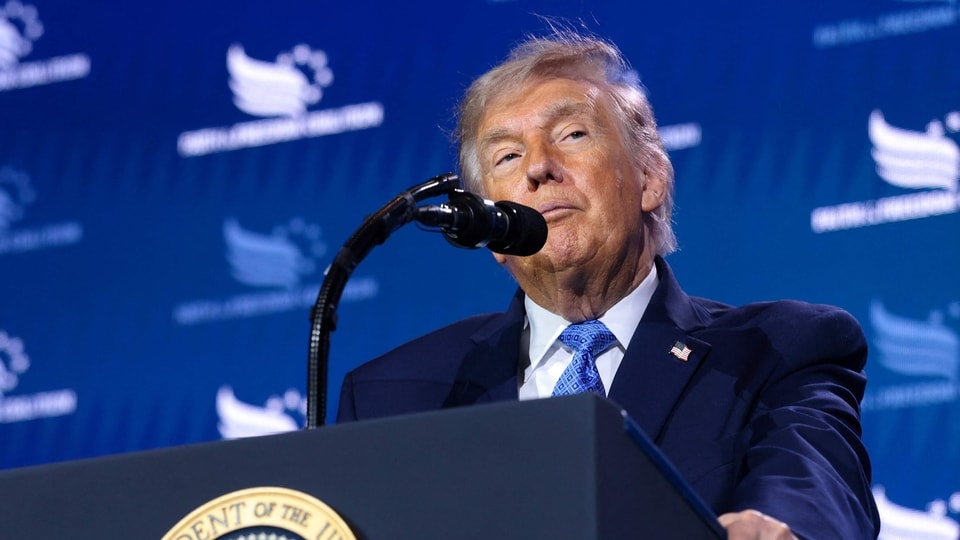
Trump has labeled the current policy as "a disgrace," while his vice president, JD Vance, has previously referred to it as "the dumbest immigration policy in the world." However, the Supreme Court on Tuesday affirmed the principle of birthright citizenship, which states that children born on U.S. soil are automatically granted U.S. citizenship, irrespective of their parents' immigration status.
In an interview with DW, Kim Lane Scheppele, the professor of Sociology and International Affairs at Princeton, said, “The fact that the question is now open in a way it never was has made citizenship more precarious, including for those who have lived all of their lives in the US.”
"Don't forget that citizenship is under attack in many ways under Trump. They've opened an office of denaturalization inside the Justice Department and are pressing to require proof of citizenship to vote. And few of us have such proof, less than half the US public has passports, for example."
Also Read: US Supreme Court upholds laws barring transgender girls and women from school athletic teams
What is the current legislation concerning birthright citizenship in the US?
The 14th Amendment states that all persons born or naturalized in the United States and subject to the jurisdiction thereof, are citizens of the United States and of the State wherein they reside.
This provision has been consistently interpreted by courts and governmental bodies to imply that children born in the US, regardless of their parents' immigration status, automatically acquire US citizenship. There are a few notable exceptions to this general rule, such as children born to foreign diplomats or enemy forces invading the country.
Also Read: US offers $750 service for expedited visa interviews: 5 key things applicants must know
US birthright citizenship: How many people would be impacted?
The Migration Policy Institute estimates that approximately 255,000 children are born annually in the United States to noncitizen parents.
Any proposed changes will not be applied retroactively, meaning that individuals who previously qualified for citizenship through birthright will remain unaffected. Research conducted by the Pew Research Center indicates that this number could be as high as 4.4 million Americans during the period from 2006 to 2023, although some of these individuals may have since left the country or passed away.
Several notable Americans received US citizenship at birth, even though their parents were not citizens at that time. This group includes many individuals from Trump's inner circle, such as Secretary of State Marco Rubio, FBI Director Kash Patel, and Second Lady Usha Vance.
What effects could any changes in law produce?
It is challenging to ascertain the exact implications, but the Trump administration indicates that, at the time of a child's birth, the immigration status of the parents would be evaluated to determine the child's eligibility for citizenship and the essential documentation that accompanies it. Consequently, a birth certificate alone would no longer suffice to obtain a passport or social security number.
The statehood of the child would largely depend on the nationality of the parents. Certain countries do not automatically confer citizenship to children born to their nationals abroad, particularly in Southeast Asia. In such instances, it seems the child could end up stateless.
An important aspect to recognize about the US is that we lack a straightforward method to verify citizenship, primarily because most individuals depend on birthright citizenship for that assertion, stated Scheppele.
"So women who have just given birth — let alone the fathers of new babies — will not have readily available ways of proving their citizenship in the cases of absolutely routine births. Imagine if the citizenship and immigration status of all new parents had to be recorded for every birth in the country – and you can begin to see the administrative chaos that would result."


