
 E-Paper



After Trump announces ‘biggest oil deal’, Venezuela says it helps retain 'sovereignty’
Addressing the nation in a television address, Delcy Rodriguez hailed the accord as a “historic” deal that would help revive the economy.

 Prefer HTon Google


A day after signing of what President Donald Trump described as the “biggest oil deal in world history”, Venezuela interim President Delcy Rodriguez on Sunday said that the energy agreement signed with the United States would remain in force for 25 years, target an increase in crude output to 1.5 million barrels per day (bpd), and preserve the country’s sovereignty over its natural resources.
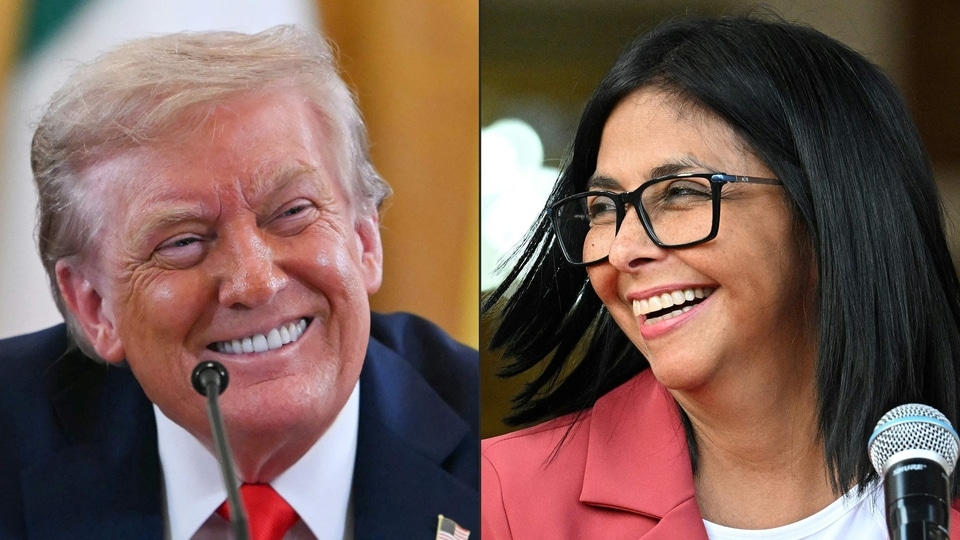
Addressing the nation in a television address, Rodriguez hailed the accord as a “historic” deal that would help revive the economy and boost government revenue, saying it would help shape the country's future, Reuters reported.
“This 25-year bilateral project envisages the development of 17 strategic oilfields with a production target of more than 1.5 million barrels per day," Rodriguez said on state broadcaster VTV.
Along with fulfilling the target of 1.5 million barrels per day (bpd), the broader plan also includes the development of eight greenfield oil blocks as part of a wider expansion of the country's energy sector, she said, according to Reuters.
Trump hails accord as ‘biggest oil deal in world history’
The United States and Venezuela inked what Trump described as the “biggest oil deal in world history”, which would increase American access to crude, expand supplies and eventually bring down gasoline prices.
The US will have access to more than 65 billion barrels of Venezuelan oil reserves through a partnership involving the government and private businesses.
“At my direction, secretary of state Marco Rubio, and secretary of war Pete Hegseth, working closely with Highly Respected Interim President of Venezuela, Delcy Rodriguez, and, through a partnership with private business, have secured majority US control of more than 65 BILLION BARRELS of proven Oil Reserves in Venezuela, at no cost to the American Taxpayer,” Trump wrote on Truth Social.
He said the agreement was a major boost for US energy supplies and claimed it would “MORE THAN DOUBLE” American oil reserves and help lower gas prices.
Venezuela hails deal
Rodriguez welcomed the deal and said that the agreement could generate about $209 billion in revenue for the Venezuelan state, based on a benchmark oil price of $65 per barrel.
She said roughly $19 from each barrel produced and sold under the arrangement would flow directly to Venezuela, providing a significant boost to government revenue, as per Reuters.
She added that the agreement aims to turn "cold, inert" resources underground to "a source of social and economic well-being for the people of Venezuela," according to AFP.
The Venezuelan leader emphasised that through this deal, the country retained “ownership of and sovereignty” over its natural resources, “while leveraging capital, technology and operational expertise to support the recovery of a strategic industry that has been severely affected by sanctions."
US to control 55% output
A White House official said the deal would give the US an effective 55% share of the oil produced by a new private joint venture, which was expected to become the world's second-largest private oil company by reserves.
The official said Rodriguez, with US backing, had given the private company 100-year concessions to operate the oil fields. The venture would be run jointly by the US government and a private operator in Venezuela.
Why the deal matters now
With the Strait of Hormuz being shut as an aftermath to war with Iran, gas prices in the United States and across the world have seen a hit. Before the war, roughly 20% of global energy supplies moved through the strait. Fighting and restrictions on shipping sharply reduced traffic, forcing oil producers, traders and governments to look for alternative supplies.
What makes Venezuela particularly important to Washington is that the country has the world's largest proven crude oil reserves.
The deal comes months after US forces entered Venezuela and captured then-President Nicolas Maduro. Maduro was subsequently taken to the US to face federal charges allegedly due to involvement in a narco-terrorism and cocaine-trafficking conspiracy.


